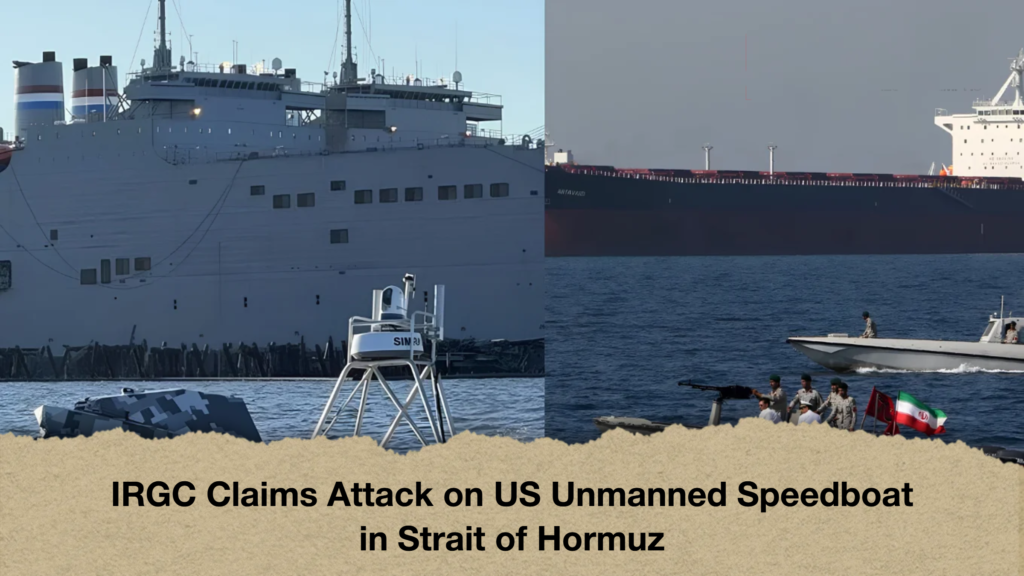
Iran’s Islamic Revolutionary Guard Corps (IRGC) Navy has claimed that it attacked a US military unmanned surface vessel after the craft allegedly attempted to enter a protected area of the Strait of Hormuz.
The IRGC issued the claim in a statement early on Sunday, 6 September, saying its naval forces had confronted the unmanned speedboat while it was attempting to enter what Iran described as a secured zone in the strategically important waterway.
According to the statement, the IRGC is closely monitoring activities by what it described as hostile forces and would respond firmly to any perceived threat or military move within the area. The force also warned the United States against maintaining what it regards as provocative military activity in the region.
Iran has repeatedly stressed the strategic importance of the Strait of Hormuz, a narrow maritime passage connecting the Persian Gulf with the Gulf of Oman and the Arabian Sea. The waterway is a crucial route for international energy shipments, meaning any military confrontation there can have consequences well beyond the immediate region.
The latest incident comes amid heightened tensions between Iran and the United States and growing use of unmanned systems in maritime operations. On 26 March, the US deployed unmanned speedboat drones in Middle Eastern waters during the ongoing tensions with Iran.
Such vessels, also known as unmanned surface vessels or USVs, can operate without a crew on board. Their use can reduce the risks to personnel during surveillance or other operations in potentially dangerous waters. The systems can also be equipped for different military roles depending on their design and mission.
At the time of the US deployment, reports citing the Pentagon said the unmanned speedboats could be used for surveillance as well as so-called kamikaze attacks. In such an attack, an unmanned vessel carrying explosives is directed towards a target and destroyed upon impact. The vessels were reportedly developed by a Maryland-based American company specialising in autonomous reconnaissance craft.
The deployment was significant because unmanned boats had previously been demonstrated and used during military exercises, while their use in an ongoing conflict represented a more direct application of the technology.
The latest Iranian claim also follows earlier allegations involving US naval vessels. The IRGC has previously claimed that it launched ballistic missiles at two American warships, identified as an aircraft carrier and a naval destroyer.
Iranian officials said the two vessels were pursuing Iranian ships and participating in a maritime blockade. According to the IRGC’s account, both warships were damaged in the missile attack and subsequently left the area.
The Iranian force also claimed that the US Central Command had acknowledged an attack involving two naval vessels, presenting that as confirmation of its account. However, the details and extent of any damage remain subject to competing claims, and the information provided by the Iranian side does not independently establish the full circumstances of the incidents.
The Strait of Hormuz remains particularly sensitive because of its location and its importance to international shipping. Military activity involving warships, unmanned vessels or other systems in or around the waterway carries the potential to increase tensions and complicate maritime traffic.
For Iran, monitoring foreign military movements in the area is a central part of its security posture. For the United States, unmanned maritime platforms offer a way to conduct surveillance and other operations without placing crews directly aboard every vessel involved.
The reported attack therefore highlights not only the continuing confrontation between Tehran and Washington but also the expanding role of unmanned technology in maritime warfare. As both sides continue to operate in strategically sensitive waters, incidents involving autonomous or remotely operated vessels could become an increasingly important feature of regional military tensions.