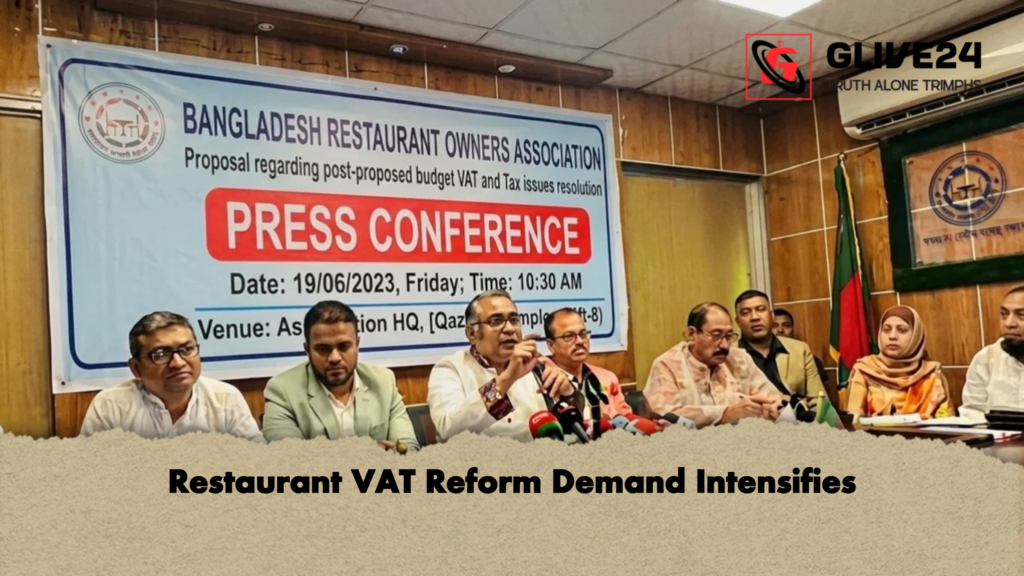
The Bangladesh Restaurant Owners Association has called for immediate and comprehensive reform of what it describes as a fragmented and inequitable value-added tax (VAT) system governing the country’s food service industry. According to the association, the existing structure creates significant distortions between different segments of the sector, placing formally registered restaurants at a competitive disadvantage compared with informal operators.
At a press conference held on Friday at the association’s office in Purana Paltan, Dhaka, leaders outlined what they termed systemic “policy discrimination” affecting restaurants, catering firms, and street food vendors. The written statement was delivered by Secretary General Imran Hasan, who argued that inconsistencies in taxation and regulation are placing mounting pressure on compliant businesses.
Imran Hasan noted that although the government has sought to design a supportive budget amid challenging macroeconomic conditions, persistent inflation and tightening liquidity in the banking sector have substantially increased operating costs for hospitality enterprises. He highlighted the rising prices of liquefied petroleum gas, electricity, and imported food ingredients as key drivers of financial strain, describing the situation as a “serious crisis” for the industry.
While expressing appreciation to senior political leadership involved in the budget process, he criticised the absence of targeted relief measures for the hospitality and food service sector, which he said remains highly labour-intensive and sensitive to cost fluctuations.
A central concern raised by the association is the disparity in VAT rates across different service categories. Restaurants are currently subject to a 5 per cent VAT rate, while catering services face a significantly higher 15 per cent charge. In contrast, many street food vendors operate outside the formal tax system altogether, creating what the association described as an uneven competitive environment.
VAT Structure Highlighted by the Association
| Sector | VAT Rate | Compliance Status | Key Concern Raised |
|---|---|---|---|
| Restaurants | 5% | Registered and monitored | Rising input and utility costs |
| Catering Services | 15% | Registered and regulated | Highest tax burden within formal segment |
| Street Food Vendors | Largely unspecified | Mostly informal / unregistered | Lack of oversight and competitive imbalance |
The association argued that extending VAT registration to all forms of food service, including street vendors, would help create a level playing field while also broadening the government’s revenue base. It further maintained that the current partial compliance framework encourages informalisation and undermines long-term sectoral stability.
Beyond taxation, the association also drew attention to what it described as excessive regulatory complexity. According to Imran Hasan, restaurant operators are often required to obtain between ten and twelve separate licences from different government agencies before commencing operations. This multi-layered approval system, he said, increases costs, delays business expansion, and creates inefficiencies in enforcement.
To address these challenges, the association proposed the introduction of a dedicated one-stop service mechanism for the hospitality sector. Such a system, it suggested, would consolidate licensing procedures, reduce administrative duplication, and improve coordination among regulatory authorities.
In addition, it called for the formulation of a standalone industrial policy for hotels and restaurants. The proposed framework would integrate taxation, licensing, food safety regulation, skills development, and investment facilitation under a unified structure, thereby reducing fragmentation across multiple ministries.
Senior association figures present at the briefing, including Vice-President Shah Sultan Khokon, Joint Secretary General Firoz Alam Suman, and Organising Secretary Taufiqur Islam, echoed the call for urgent reform. They collectively emphasised that without structural changes, the sector risks declining profitability, reduced investment, and long-term stagnation despite growing consumer demand.