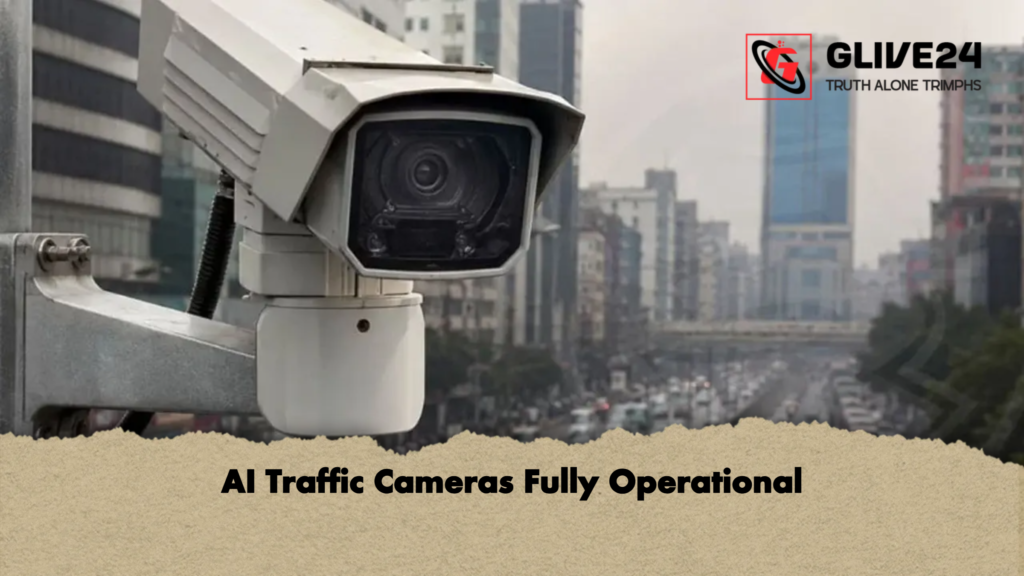
Rumours circulating on social media claiming that artificial intelligence-based traffic surveillance cameras in Dhaka’s Karwan Bazar and Banglamotor areas had been shut down have been firmly dismissed by the Dhaka Metropolitan Police (DMP). The misleading posts, widely shared in the form of images and short captions, suggested that the advanced traffic monitoring systems at two of the capital’s busiest intersections had become inoperative, sparking confusion among commuters and online users.
Authorities, however, have clarified that the information is entirely false. According to the DMP Traffic Division, all AI-enabled traffic surveillance cameras across the capital remain fully functional and are actively supporting enforcement and monitoring operations without interruption.
Table of Contents
Temporary technical disruption, not shutdown
Officials explained that a brief technical interruption did occur in the Karwan Bazar area during scheduled maintenance work on the electricity and communication infrastructure. During this process, a few cables were accidentally disconnected, resulting in a short-lived disruption to the camera network.
The issue affected operations for a limited period of approximately two days in a partial capacity, after which engineers promptly restored full connectivity. Authorities emphasised that this was a maintenance-related fault rather than any system failure or shutdown. In the Banglamotor area, no permanent outage occurred, and the system continued functioning with only minor, temporary interruptions.
Police clarification and response
A senior official from the DMP Traffic Division, Anisur Rahman, confirmed that the disruption was quickly identified and resolved. He stated that all surveillance cameras are now operating normally and continue to monitor traffic in real time.
He further highlighted that the AI-based system plays a crucial role in modern traffic enforcement in Dhaka. The technology automatically detects violations such as running red lights, crossing stop lines, driving against traffic flow, and other forms of dangerous or illegal manoeuvres. Once identified, the system generates digital records for enforcement action.
Addressing misinformation
The police have strongly rejected claims circulating online that the cameras were deliberately deactivated or that enforcement irregularities were being facilitated. Officials described such assertions as completely baseless and misleading.
They also reiterated a firm commitment to transparency and accountability within the traffic management system. Any allegation involving misconduct by personnel will be investigated thoroughly, and strict disciplinary action will be taken if credible evidence is found. The authorities emphasised a zero-tolerance policy towards corruption or manipulation of traffic enforcement mechanisms.
Impact of AI-based traffic monitoring
Experts note that the introduction of AI-driven surveillance technology has significantly improved discipline on Dhaka’s roads. The system has contributed to better compliance with traffic rules, reduced violations, and enhanced overall traffic flow in several key intersections.
A summary of the system’s key functions is provided below:
| Function | Description |
|---|---|
| Red light violation detection | Automatically identifies vehicles crossing signals unlawfully |
| Stop line enforcement | Records breaches of designated stopping points |
| Wrong-way driving detection | Detects and flags hazardous reverse-direction movement |
| Digital penalty issuance | Generates electronic notices and fines automatically |
| Continuous traffic monitoring | Provides 24/7 surveillance at major junctions |
Current status
Authorities confirmed that all AI-based traffic surveillance units installed at major signal points across Dhaka are now fully operational. Routine maintenance and technical upgrades are ongoing to further enhance system reliability and efficiency.
Officials added that the use of such intelligent monitoring systems will be expanded in the future as part of broader efforts to improve road safety, ensure traffic discipline, and reduce congestion in the capital.