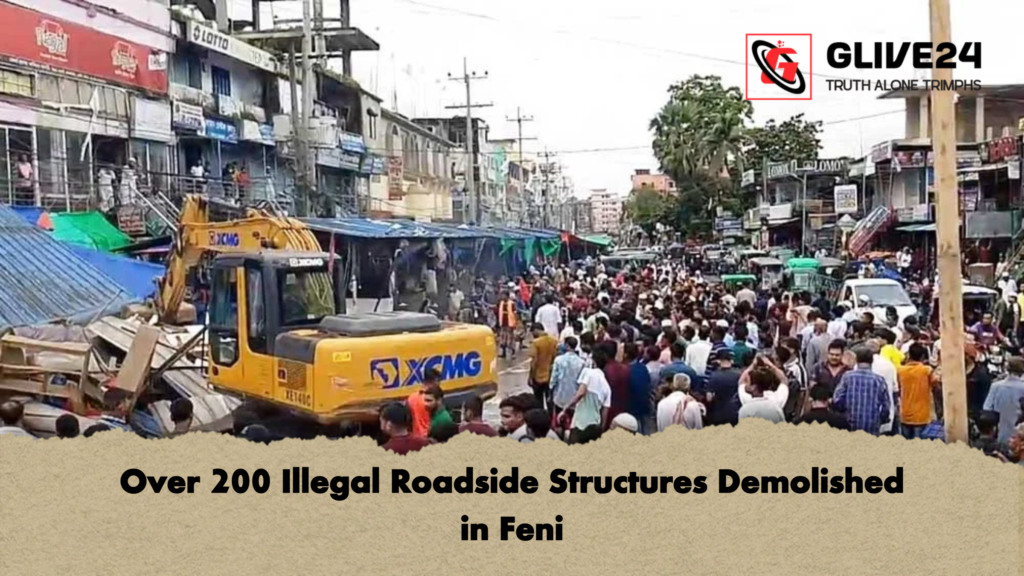
More than 200 illegal roadside shops and temporary structures built along both sides of the old Dhaka–Chattogram Highway in Chhagalnaiya Upazila of Feni have been demolished in a joint eviction drive conducted by the upazila administration and the Feni Roads and Highways (RHD) Department.
The operation was carried out on Monday (20 July) under the leadership of Omar Faruk, Assistant Commissioner (Land) and Executive Magistrate of Chhagalnaiya Upazila. While the authorities described the drive as necessary to facilitate ongoing road expansion and improve public safety, affected traders alleged that they had not been served with written notices or given sufficient time to remove their belongings before the demolition began.
According to officials, the old Dhaka–Chattogram Highway is currently undergoing widening works aimed at improving traffic flow and enhancing road infrastructure in the area. Over the years, numerous makeshift shops, roadside stalls and other unauthorised structures had gradually occupied sections of the highway, including reserved land, footpaths and roadside drainage systems. Officials said these encroachments had significantly narrowed the usable width of the road, contributing to persistent traffic congestion and creating hazards for both motorists and pedestrians.
The administration also stated that the continued occupation of government land was delaying the implementation of the road development project. During peak hours, traffic regularly slowed through the affected stretches as vehicles competed for limited road space. Removing the illegal structures, officials argued, was therefore essential to ensure that construction work could proceed on schedule and that the highway could function more safely and efficiently once completed.
Regarding prior notification, Chhagalnaiya Municipality Executive Officer Tajel Hossain Halder said that, following instructions from the Upazila Nirbahi Officer, public announcements had been made through loudspeakers on Sunday evening, one day before the operation. Traders were urged during those announcements to remove their shops and belongings voluntarily before the eviction drive commenced.
Many business owners, however, disputed the administration’s account. Fruit trader Abdu Salam said he had earned his livelihood from a temporary roadside shop for many years. He claimed that his business operated under a municipal licence and that he regularly paid fees to the local market committee. Despite this, he alleged that his shop was demolished without any written notice, leaving him unable to protect his stock from damage.
Vegetable trader Abu Taher expressed similar concerns. He said officials arrived without warning and immediately began clearing the structures. Because traders were not given adequate time to remove goods, a significant quantity of perishable produce was damaged, resulting in substantial financial losses for small business owners who depend on daily earnings to support their families.
Defending the operation, Assistant Commissioner (Land) Omar Faruk said that illegal commercial activities had long occupied roads, pavements and drainage channels within the municipality. He maintained that these encroachments not only obstructed the road widening project but also disrupted traffic movement and restricted the safe passage of pedestrians. The eviction drive, he said, was carried out in the wider public interest to ensure safer roads, uninterrupted development work and the protection of public land.
The operation has also prompted discussion among local residents about the balance between infrastructure development and the livelihoods of small traders. While many acknowledged that clearing encroachments is necessary for road safety and the successful completion of public infrastructure projects, some argued that greater efforts should be made to provide rehabilitation measures or alternative trading locations for those whose businesses are displaced.
Authorities, meanwhile, reiterated that keeping government land, footpaths and reserved road space free from illegal occupation is part of their statutory responsibility. They indicated that similar enforcement operations would continue wherever necessary to support infrastructure development, maintain orderly urban management and ensure safe and unobstructed public transport corridors.