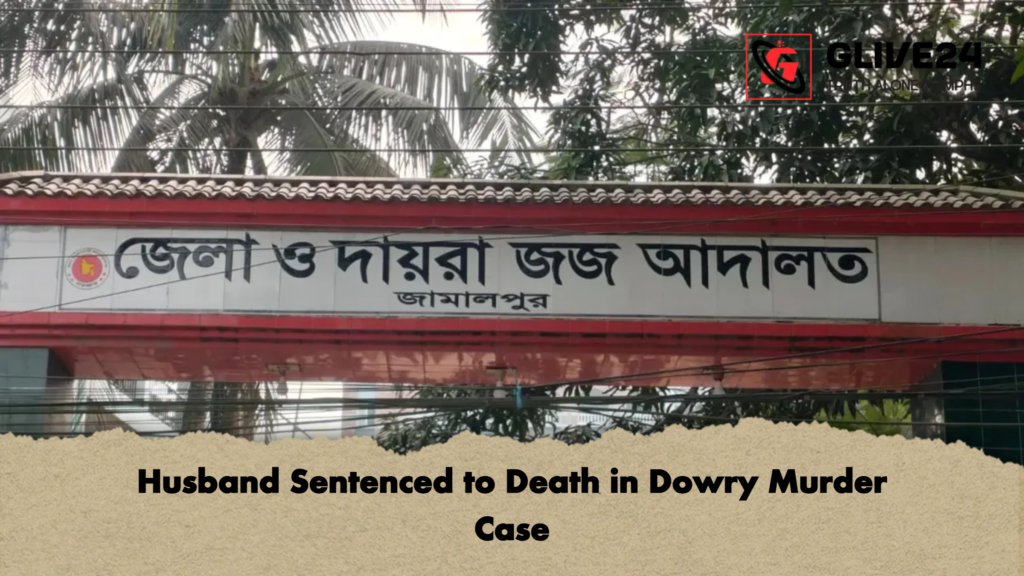
A court in Bangladesh has sentenced a man to death and imposed a fine of Tk 500,000 for the murder of his wife over a dowry dispute, bringing an end to a legal battle that lasted for more than a decade. The verdict has been viewed by those involved in the case as a significant step towards justice for the victim’s family and a reminder of the country’s firm legal stance against dowry-related violence.
The judgment was delivered on Monday, 20 July, by Judge Muhammad Abdur Rahim of the Women and Children Repression Prevention Tribunal-1 under the Jamalpur District and Sessions Judge’s Court.
The convicted man, Hafizul, is the son of the late Pradhan and a resident of Merurchar in Bakshiganj Upazila of Jamalpur District.
According to court records, the fatal incident occurred on the morning of 4 September 2012. Prosecutors said an argument erupted over a demand for dowry, during which Hafizul brutally assaulted his wife, Hanufa Begum. She died from the injuries sustained during the attack.
After receiving news of the incident, Hanufa Begum’s relatives travelled from Bhola to Jamalpur to collect her body and begin legal proceedings.
Approximately two weeks later, on 19 September 2012, the victim’s mother, Amena Begum, filed a murder case at Bakshiganj Police Station against five accused individuals. The case subsequently underwent a lengthy investigation before being brought before the tribunal for trial.
During the proceedings, the prosecution presented witness testimonies, the investigation report and other documentary evidence. After reviewing the material placed before the court, the judge concluded that the allegations against Hafizul had been established beyond reasonable doubt.
Following years of hearings, the tribunal sentenced Hafizul to death and also ordered him to pay a fine of Tk 500,000. The remaining four accused in the same case were acquitted after the court found that the allegations against them had not been proven beyond reasonable doubt.
The state prosecutor, Advocate Fazlul Haque, confirmed the verdict and described it as the culmination of more than twelve years of legal proceedings. He said the ruling represented justice for the victim’s family and carried an important message about the consequences of dowry-related crimes.
He also observed that violence against women linked to dowry demands remains a matter of concern in Bangladesh. According to him, the timely and effective prosecution of such offences can discourage potential offenders while strengthening public confidence in the justice system and offering victims’ families a sense of legal redress.
Legal experts have long maintained that dowry-related abuse and murder are serious criminal offences under Bangladeshi law. They argue that firm punishment, when supported by credible evidence, serves not only to deliver justice in individual cases but also to reinforce the protection of women’s rights and personal safety.
Although legal enforcement plays a crucial role in addressing these crimes, specialists emphasise that lasting progress also depends on broader social awareness. They believe that stronger public education, greater community engagement and continued opposition to dowry practices are essential to building a society where women are protected from violence and discrimination.