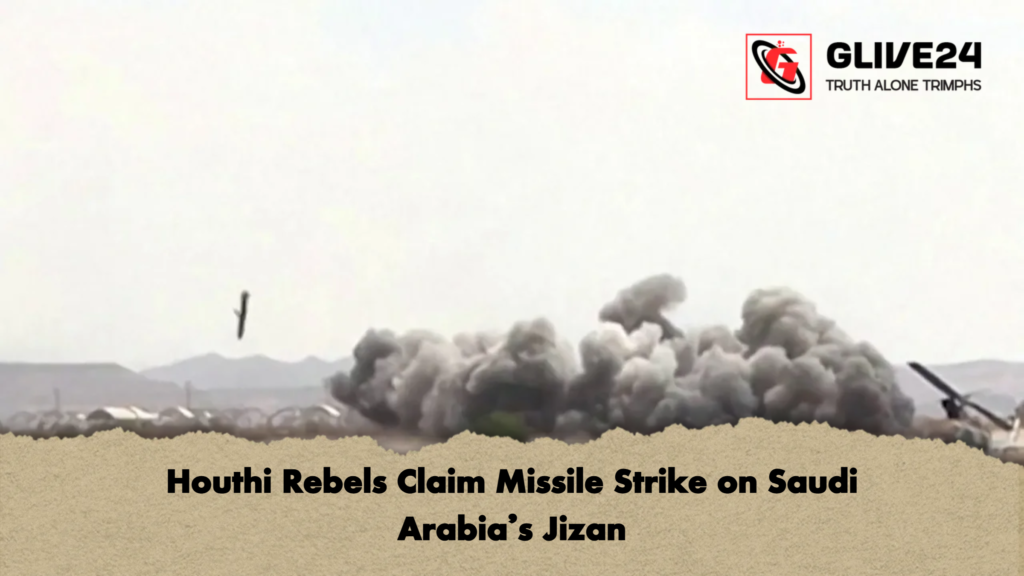
Yemen’s Iran-backed Houthi rebels have claimed responsibility for a missile attack targeting Jizan in south-western Saudi Arabia, raising fresh concerns over the widening security tensions surrounding the region. The claim came on Saturday, 25 July, hours after the group vowed to retaliate against Saudi Arabia following military action against Houthi positions.
According to a Telegram channel affiliated with the Houthis’ Ansarullah movement, a fire broke out in Jizan following the missile attack launched from Yemen. The report was carried by the Russian state broadcaster RT. However, details of the alleged strike, including the type of missile used, the exact target and whether there were any casualties or significant damage, were not immediately independently verified.
The reported attack follows Saudi military strikes on Houthi military installations. Various reports said the Saudi operation came after the Houthis announced measures against Saudi-linked maritime activity in the Red Sea and carried out attacks on shipping. The latest exchange of threats has added another layer to an already volatile security situation stretching from Yemen to the Red Sea and the wider Middle East.
The Houthis described Saudi Arabia’s military action as a dangerous escalation and warned that it would respond. The group has repeatedly demonstrated its ability to launch missiles and drones towards targets in the region, although the extent and effectiveness of individual attacks can be difficult to establish independently amid conflicting claims from the parties involved.
Saudi authorities also issued a brief warning to residents in the Jizan and Yanbu areas following the reported incident. The Civil Defence authorities described the situation as involving a possible danger, prompting a temporary alert for residents. The warning was withdrawn within minutes, with authorities subsequently indicating that conditions had returned to normal.
Jizan, located close to Saudi Arabia’s southern border with Yemen, has long been considered particularly vulnerable to spillover from the conflict across the border. The area has previously been exposed to cross-border attacks during periods of heightened hostilities between Saudi Arabia and the Houthi movement.
The latest development comes amid broader tensions involving Iran, the United States and Israel. The Houthis are part of a network of Iran-aligned groups operating across the Middle East, and their military activities have become closely linked to wider regional conflicts and rivalries.
The Red Sea remains a major concern for international security and global shipping. Any disruption in the waterway can affect commercial vessels travelling between Europe and Asia, while attacks or threats against shipping can force operators to consider longer alternative routes. At the same time, tensions surrounding the Strait of Hormuz have added to fears over the security of key maritime corridors and the potential impact on international trade and energy supplies.
Against this backdrop, US President Donald Trump said no final decision had yet been made on whether Washington would launch further large-scale military action against Iran. He also claimed that Tehran was taking negotiations with Washington seriously.
The reported missile strike on Jizan therefore comes at a particularly sensitive moment for the Middle East. With tensions involving Iran and the United States continuing alongside instability in Yemen and maritime insecurity in the Red Sea, any further military exchanges could carry consequences well beyond the immediate parties involved. For now, however, the full extent of the alleged Houthi attack and the damage it may have caused remain unclear.