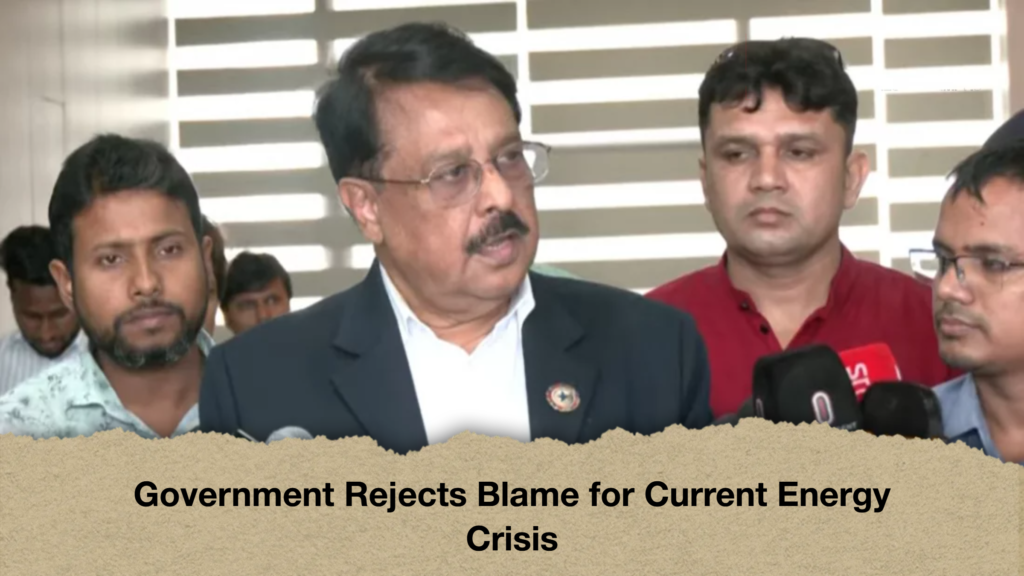
The current crisis in electricity, gas and other energy supplies cannot be attributed to the present government, Principal Secretary to the Prime Minister A.B.M. Abdus Sattar said on Sunday, urging the public to assess the situation in light of the government’s relatively short time in office.
Speaking to journalists at the Secretariat on 16 August, the principal secretary said the problems confronting the country’s energy sector had accumulated over a long period and could not be resolved overnight. He said the government had begun working on several fronts soon after assuming responsibility and was seeking multiple options to ease the pressure on energy supplies.
Responding to questions about the continuing shortages of electricity and gas, Abdus Sattar said the difficulties were not created within a single day. He argued that the government had been in office for only around five months and that it would be unrealistic to expect every long-standing problem to be resolved within such a limited period.
The energy crisis has broader implications because reliable supplies of electricity and gas are closely linked to industrial production, business activity, transport, investment and household life. Any disruption in fuel availability can affect factories and commercial establishments, while shortages in gas and electricity can also increase pressure on operating costs and disrupt normal economic activity.
The principal secretary also linked the present difficulties to what he described as problems inherited from the previous administration. He alleged that the previous government had spent nearly 18 years damaging the public administration system, leaving the current administration with a range of institutional and governance-related challenges.
According to Abdus Sattar, the government is attempting to address these accumulated problems while maintaining the functioning of the state. He insisted that the country was being governed in the right direction, although the administration had been confronted with several complex issues simultaneously since taking office.
The economy, he said, remains one of the government’s most significant challenges. Particular attention is being given to the banking sector, which has faced prolonged weaknesses and various forms of irregularity. Restoring confidence and stability in financial institutions is therefore being treated as a major component of the government’s economic agenda.
The condition of the banking sector is particularly significant because banks play a central role in financing businesses, facilitating trade, supporting investment and maintaining the wider flow of economic activity. Any prolonged weakness in the financial system can compound pressure on an economy already facing challenges in energy supply and other essential services.
Against this backdrop, maintaining stable electricity and gas supplies is likely to remain a major test for the administration. Energy shortages can have consequences far beyond the power sector, affecting production costs, employment, consumer prices and the overall pace of economic activity.
During the briefing, Abdus Sattar was also asked whether there could be a reshuffle in the Cabinet after the government completed 180 days in office. He declined to comment on the matter.
His remarks suggest that the administration views the current energy and economic difficulties as part of a wider set of structural problems inherited from the past. At the same time, the government’s performance will ultimately be judged by how effectively and quickly it can address those problems.
For ordinary consumers and businesses, the immediate concern remains access to dependable electricity, gas and fuel. While the government is asking for time to tackle the accumulated difficulties, sustained improvement in essential services and economic stability will be crucial in determining whether its proposed measures translate into tangible results.