Imagine stepping off a plane into a country where the numbers tell a story of staggering prosperity. On paper, this nation has one of the highest Gross Domestic Product (GDP) per capita figures on the African continent, occasionally rivaling or surpassing those of industrialized European nations at the height of its economic boom. You might expect to see a society characterized by universal healthcare, pristine public schools, and a thriving middle class.
But as you drive from the gleaming airport of Malabo, the capital city situated on the lush, volcanic island of Bioko, the statistical mirage begins to dissolve. Just beyond the multi-lane highways and the opulent government buildings lie neighborhoods where families draw water from communal wells and struggle to afford basic necessities.
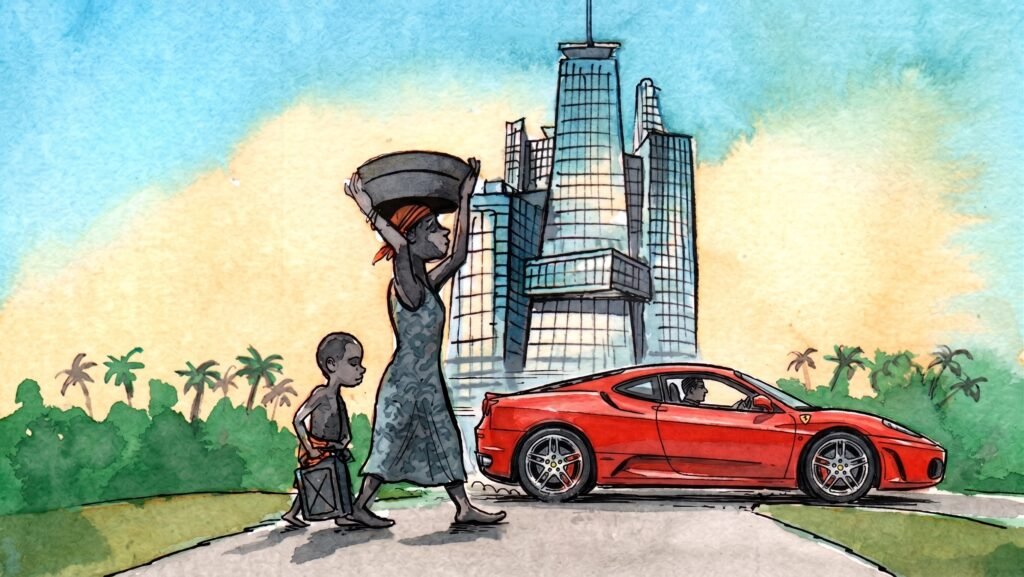
This is Equatorial Guinea: a small, Central African nation of roughly 1.7 million people, and the site of one of the modern world’s most profound economic paradoxes. It is a country drowning in oil wealth, yet plagued by severe, widespread poverty. To ask whether Equatorial Guinea is “rich” or “poor” is to misunderstand the nature of its economy. The country itself is incredibly wealthy. Its people, however, are largely impoverished.
To understand how a nation can be simultaneously so affluent and so deprived, we must look beyond the ledger and into the lived realities of its citizens.
The Discovery That Changed Everything
To grasp the scale of the paradox, one must understand the country’s history. For decades following its independence from Spain in 1968, Equatorial Guinea was an impoverished, agrarian society. Its economy was small and fragile, relying heavily on the export of cocoa, coffee, and timber. The vast majority of its population lived in rural, subsistence-level poverty.
Then, in the mid-1990s, everything changed. Major offshore oil reserves were discovered in the Gulf of Guinea. Almost overnight, Equatorial Guinea transformed from a forgotten post-colonial outpost into a booming petrostate. By the early 2000s, economic growth rates were regularly exceeding 20% per year. The influx of petrodollars was so massive that, by 2008, the country’s GDP per capita peaked at an astonishing $44,000.
Suddenly, international economists and foreign investors were classifying Equatorial Guinea as an upper-middle-income economy. But this classification reveals the fatal flaw of relying solely on GDP per capita to measure a country’s well-being. GDP per capita is simply the total economic output divided by the population. If a single billionaire lives in a town of 99 penniless farmers, the “average” wealth of that town looks spectacular on paper. In Equatorial Guinea, this mathematical quirk became a tragic national reality.
Two Worlds, One Country
The wealth generated from the oil fields did not trickle down to the masses; instead, it was funneled upward, concentrating in the hands of a tightly knit political and military elite.
President Teodoro Obiang Nguema Mbasogo has ruled the country since seizing power in a 1979 military coup, making him the longest-serving current head of state in the world. Under his administration, the national budget has frequently been treated as a private bank account. The most glaring symbol of this inequality is often found in the international headlines surrounding the President’s son and the country’s Vice President, Teodorin Obiang. Over the years, foreign authorities in the US, France, and Switzerland have seized his assets, which included sprawling mansions in Paris and Malibu, private jets, Michael Jackson memorabilia, and fleets of supercars ranging from Bugattis to Lamborghinis.
Contrast this staggering excess with the daily life of an average Equatoguinean. According to a landmark 2025 poverty assessment by the World Bank, nearly half of the country’s population still lives below the national poverty line. While the ruling class shops in European capitals, ordinary citizens in the crowded neighborhoods of Bata (the mainland’s largest city) and Malabo grapple with rolling blackouts, understocked markets, and a lack of reliable public infrastructure.
The government has certainly spent billions of dollars, but the spending has heavily favored vanity projects over human development. The most striking example is the construction of Ciudad de la Paz (City of Peace), formerly known as Oyala. Carved out of the dense mainland jungle, this multi-billion-dollar megaproject is designed to be the country’s new capital. It features grand avenues, luxury hotels, and massive government headquarters. Yet, it remains largely empty—a futuristic ghost town built with oil money while the immediate needs of the population go unmet.
The Human Deficit: Health, Water, and Education
The true tragedy of Equatorial Guinea’s economic paradox is written on the bodies and minds of its people. The “Curse of Oil” (or the resource curse) has deeply stunted the country’s human capital development.
When a government does not rely on its citizens for tax revenue—because it gets all the money it needs from foreign oil companies—the social contract is broken. The state feels little obligation to invest in its people. In a nation that boasts the wealth of an upper-middle-income country, the public spending figures are jarring. The government spends only a fraction of its GDP on public healthcare—around 0.7%, compared to the 3.2% average for other upper-middle-income nations.
This chronic underfunding translates to a devastating reality on the ground. Equatorial Guinea has historically struggled with high infant and child mortality rates, ranking among the worst in Sub-Saharan Africa despite its vast wealth. Life expectancy hovers around a mere 59 to 64 years.
Consider the most basic of human needs: water. In a country flanked by the ocean and covered in rainforests—a country that generates billions in export revenue—a shocking percentage of the population lacks access to clean, safe drinking water. Reports have indicated that in heavily populated areas, only about 41% of individuals have reliable access to clean water. Preventable waterborne diseases remain a persistent threat to children, highlighting a fundamental failure of governance. It is a nation that can afford to build luxury resorts to host international political summits, yet cannot guarantee that a mother will have safe water to mix her baby’s formula.
The education sector suffers a similar fate. While literacy rates are relatively high due to colonial-era foundations and basic primary schooling, the quality of education and the infrastructure of public schools lag far behind what the national treasury could easily support. Many public schools lack modern materials, well-trained teachers, and adequate facilities, forcing anyone with a modicum of wealth to send their children abroad.
The Fading Dream: When the Wells Run Dry
Today, the paradox is entering its most dangerous phase. The oil that fueled this surreal, two-tiered society is finite, and the wells are beginning to run dry.
For the better part of the last decade, Equatorial Guinea’s economy has been contracting. From 2015 to 2021, the country experienced an average GDP per capita growth of -9.4%. While there was a brief bump in 2022 due to a spike in global hydrocarbon prices, the long-term trend is undeniable: oil production is declining as aging fields deplete.
Because the government spent the boom years building jungle palaces and accumulating foreign real estate instead of diversifying the economy, the country is uniquely vulnerable. The agricultural sector, which once sustained the population, was largely abandoned during the oil rush and now accounts for a tiny fraction of the economy. Manufacturing is minimal. Tourism is virtually nonexistent due to strict visa policies and a deeply entrenched authoritarian political climate.
As the oil revenues shrink, the government is facing a looming fiscal cliff. And when petrostates run out of money, it is never the elite who suffer first. It is the poor—the half of the population already living below the poverty line—who will bear the brunt of the economic collapse.
The True Wealth of a Nation
So, is Equatorial Guinea rich or poor?
In terms of natural resources and gross domestic product, it is undoubtedly rich. It has generated enough capital over the last thirty years to transform the lives of every single one of its citizens. It had the potential to become an African Singapore or Norway—a nation that leveraged its natural windfall to build world-class healthcare, education, and innovation.
But in terms of the lived human experience, Equatorial Guinea remains profoundly poor. Wealth, when hoarded in offshore bank accounts and locked within the concrete walls of empty jungle mansions, ceases to be a tool for national development. It becomes a mechanism of division.
The story of Equatorial Guinea is a sobering reminder that a nation’s true wealth cannot be measured in barrels of oil or in the deceptive simplicity of a GDP per capita calculation. True wealth is measured in the health of a population, the safety of their drinking water, the quality of their schools, and the opportunity for a child to live out their full potential. Until the vast riches beneath the soil are finally used to nourish the people living above it, Equatorial Guinea will remain the world’s most heartbreaking economic paradox.