Some songs transcend their musical form to become records of history, witnesses to a particular age and expressions of a people’s hopes and struggles. Some voices do more than carry melodies. They preserve memories of aspiration, grief, resistance and the longing for freedom.
Among such songs is Anshuman Roy’s celebrated rendition, ‘Shono Ekti Mujiborer Theke Lokkho Mujiborer Konthoshorer Dhwani-Pratidhwani’ (‘Hear, from one Mujibur, the echoes of a million Mujibur voices’). Closely associated with Bangladesh’s Liberation War, the song became an important part of the cultural expression surrounding the country’s struggle for independence in 1971.
Table of Contents
Early life and musical journey
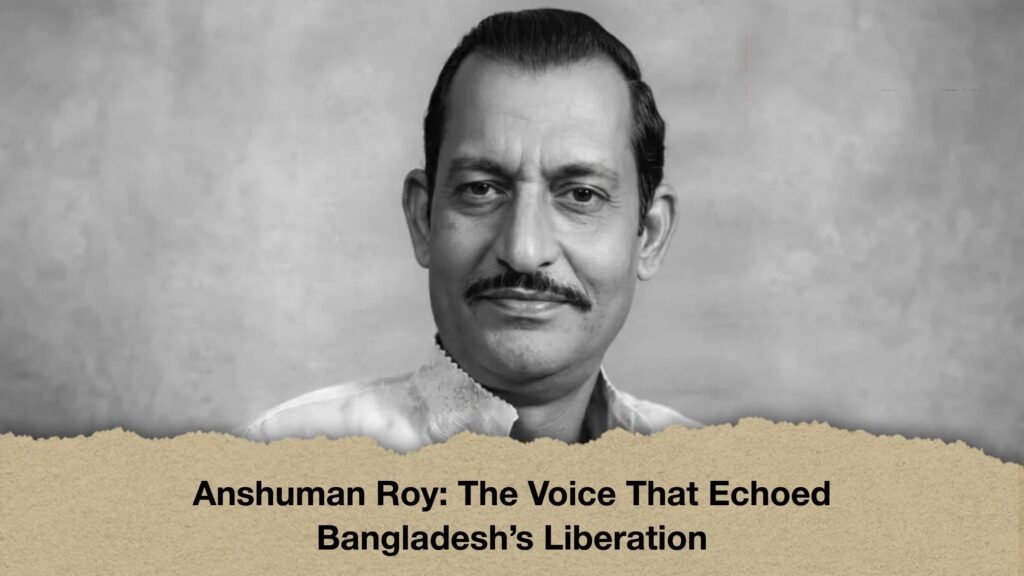
Anshuman Roy was born on 19 August 1936 in Bachurdoba, in Jhargram town of West Midnapore district, West Bengal. A noted folk singer, he developed a distinctive place in Bengali music through his interest in folk traditions and his disciplined approach to singing.
Roy initially worked in government service. His attachment to music, however, eventually led him to leave the security of his job and devote himself to a career in music. From then on, singing became central to his professional and creative life.
Over a career spanning nearly three decades, he performed songs across several genres, including folk, modern Bengali music and film songs. Tracks such as ‘Bhadr Ashwin Mase Bhramar Lage Kacha Bashe’ and ‘Dada Paye Pori Re, Mela Theke Bou Ene De’ earned recognition among listeners on both sides of the Bengal border.
Yet it was his association with a song inspired by Bangladesh’s independence struggle that gave his career a particularly enduring historical significance.
The song that became part of history
The lyrics of ‘Shono Ekti Mujiborer Theke Lokkho Mujiborer Konthoshorer Dhwani-Pratidhwani’ were written by the acclaimed lyricist Gauriprasanna Majumdar, while Anshuman Roy composed and sang the song.
According to accounts surrounding its creation, the song emerged in Kolkata in April 1971 in the aftermath of Bangabandhu Sheikh Mujibur Rahman’s historic 7 March speech. It was subsequently broadcast alongside the speech through All India Radio Kolkata’s ‘Sangbad-Bichitra’ programme.
The circumstances of its creation reflected the extraordinary atmosphere of the time. As plans were made to broadcast Mujibur Rahman’s 7 March speech, the idea arose of accompanying the broadcast with a song. Majumdar wrote the lyrics, while Roy composed the tune and recorded the vocal performance.
The song soon travelled beyond the confines of a radio broadcast. Its words connected Mujibur Rahman’s call for freedom with the collective aspirations of Bengalis, while its melody gave the political message a powerful cultural dimension.
A voice during the Liberation War
During the turbulent months of the 1971 Liberation War, the song spread across the border between India and what was then East Pakistan. Its references to Mujibur Rahman and Bangladesh resonated strongly with a population facing a historic struggle for self-determination.
Music played an important role in the cultural resistance surrounding the Liberation War. Songs were broadcast, performed and circulated to encourage people, preserve morale and express support for Bangladesh’s independence. Roy’s song became part of that broader musical landscape.
The song was also performed through the Swadhin Bangla Betar Kendra, the radio station associated with the Bangladeshi independence struggle. Noted singer Mohammad Abdul Jabbar also recorded and performed the song, helping it reach a wider audience.
Its significance therefore extended beyond its musical qualities. The song became associated with the period’s political aspirations and the cultural mobilisation surrounding the independence movement.
A lasting connection with Bangladesh
Roy’s relationship with Bangladesh was also rooted in family history. His ancestors had links to Rajshahi, adding a personal dimension to his connection with the land and its people, according to accounts recalling his life and work.
His contribution to the Liberation War was later formally recognised by Bangladesh. In 2012, the Government of Bangladesh posthumously awarded him the ‘Muktijuddho Maitri Sammanona’ for his contribution during the Liberation War. The honour was received in Dhaka on his behalf by his son, noted musician Bhaskar Roy.
The original account also records that in 1975 Bangabandhu Sheikh Mujibur Rahman had decided to honour Anshuman Roy and lyricist Gauriprasanna Majumdar with the ‘Bangabandhu Gold Medal’ for the song. The award, however, was not presented following the political upheaval of 15 August that year.
A bridge between two Bengals
Anshuman Roy died on 22 April 1990, aged 53. Although his life ended decades ago, the song that connected his voice with the history of Bangladesh’s independence has continued to be remembered.
His importance in Bangladesh’s musical memory rests largely on the unusual historical role of that song. It emerged at a moment when music, poetry, broadcasting and other forms of cultural expression were closely intertwined with the struggle for independence.
Roy was an Indian singer, but his voice became closely associated with the aspirations of the people of Bangladesh during one of the most decisive periods in the region’s modern history. His work also reflects the cultural links between West Bengal and Bangladesh, where language, music and artistic traditions have long crossed political borders.
On 19 August, the anniversary of his birth, Anshuman Roy is remembered not simply as a successful Bengali singer but as an artist whose voice became part of the cultural record of Bangladesh’s Liberation War.
His voice fell silent in 1990. The recording, however, remains.
‘Shono Ekti Mujiborer Theke Lokkho Mujiborer Konthoshorer Dhwani-Pratidhwani’ continues to evoke the atmosphere of 1971 and the extraordinary power of music to preserve historical memory. Through that song, Anshuman Roy’s name remains woven into the story of Bangladesh’s struggle for independence and the enduring cultural relationship between the two Bengals.