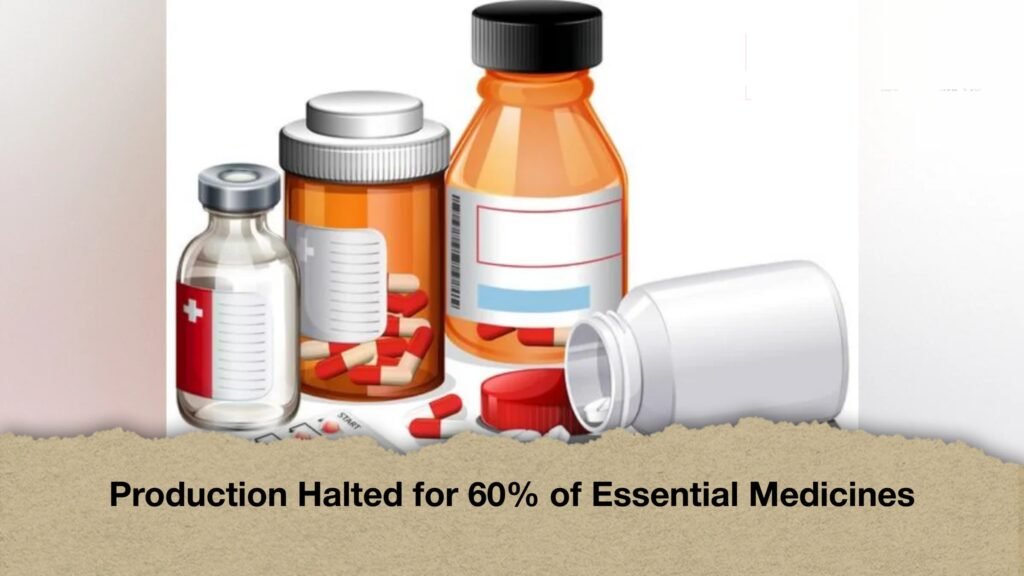
Around 60 per cent of the 117 medicines listed as essential are no longer being produced by pharmaceutical companies at various times, according to the Bangladesh Association of Pharmaceutical Industries (BAPI). The industry body says rising inflation, exchange-rate pressures, wages, fuel and electricity costs have made the production of many of these medicines financially unsustainable.
The issue was raised at a discussion titled ‘Progress of the Pharmaceutical Industry: Challenges and Prospects’, held at BAPI’s office in Tejgaon, Dhaka, on Monday. Industry leaders said the suspension of production was forcing patients to turn to alternative medicines that are often more expensive, increasing the overall cost of treatment.
BAPI representatives said medicine prices are currently determined largely on the basis of a pricing framework introduced in 1994. Over the past 32 years, prices have been adjusted only twice, despite significant changes in production costs and the wider economy. The industry had expected price adjustments averaging around 8 per cent a year, they said.
Since the existing pricing framework was introduced, pharmaceutical manufacturers have faced substantial increases in the cost of imported raw materials, labour, energy and other inputs. Changes in the exchange rate have also raised the local-currency cost of imported materials. Industry representatives argue that these pressures have made it increasingly difficult to continue producing some essential medicines at existing prices.
They called for a system under which medicine prices would be reviewed and adjusted automatically at regular intervals, based on changes in production costs and other relevant economic indicators. Such a mechanism, they argued, would make pricing more predictable while reducing the risk of prolonged losses for manufacturers.
The industry has no objection to updating the list of essential medicines, BAPI leaders said. However, they stressed that any revision should involve qualified medical and pharmaceutical experts. They also called for a transparent, sustainable and regularly adjustable framework for setting medicine prices.
The continuing pressure on gas and electricity supplies has added another layer of difficulty. Pharmaceutical manufacturing requires uninterrupted power because production processes cannot simply be stopped midway. Any unexpected interruption can disrupt an entire production cycle and potentially result in losses.
Dr Zakir Hossain, former secretary-general of BAPI and managing director of Delta Pharma Ltd, said treating the pharmaceutical sector solely from the perspective of price control could undermine production and investment in the long term.
He said there was no objection to maintaining a list of essential medicines, but it should be reviewed regularly in consultation with qualified experts. He also called for a proper and transparent mechanism for determining medicine prices.
According to Dr Hossain, ensuring affordable access to necessary medicines is a responsibility of the government. He said the government could use subsidies or public procurement to make essential medicines available at lower prices. However, expecting private manufacturers to continue producing medicines at low prices for an extended period without any form of support or subsidy was not realistic, he argued.
Dr Hossain also cautioned against directly comparing private pharmaceutical companies with the state-owned Essential Drugs Company Limited (EDCL). He said EDCL operates with specific government purchase orders and a guaranteed market, while it does not face the same level of marketing expenditure as private manufacturers.
The government, he suggested, could make greater use of EDCL to produce essential medicines and distribute them free of charge or at reduced prices to patients at public hospitals.
BAPI Vice-President Mosaddek Hossain said the 1994 national drug policy played a significant role in the development of Bangladesh’s pharmaceutical industry. At the time, a list of 117 essential medicines was prepared. However, 19 of those medicines were not registered for production, leaving 98 medicines for which availability and accessibility were sought to be ensured.
He said production costs for many of the medicines had since risen to a level at which manufacturers could no longer recover their expenses at existing prices. As a result, nearly 60 per cent of the essential medicines have had their production suspended at different times because prices have not been adjusted accordingly.
BAPI Secretary-General Muhammad Halimuzzaman said shortages of gas and electricity were also driving up production costs. He said factories were unable to receive adequate electricity for a significant portion of their operating hours and were therefore being forced to rely on generators, large uninterruptible power supply systems and alternative fuels.
These backup arrangements carry additional costs. More importantly, pharmaceutical production cannot always be interrupted safely once a manufacturing process has begun. A power failure in the middle of a production cycle can jeopardise the entire process and result in losses.
The gas shortage has also increased dependence on diesel to operate generators, Halimuzzaman said. Many companies do not have sufficient capacity to store large quantities of diesel, meaning they may have to arrange emergency supplies when existing stocks run out. This adds further pressure to production costs.
The concerns raised by the industry highlight a difficult balance in Bangladesh’s pharmaceutical market: keeping essential medicines affordable for patients while ensuring that manufacturers can continue producing them sustainably. Industry representatives argue that regular price reviews, reliable energy supplies and a transparent pricing mechanism are necessary if essential medicines are to remain consistently available without placing an excessive financial burden on consumers.