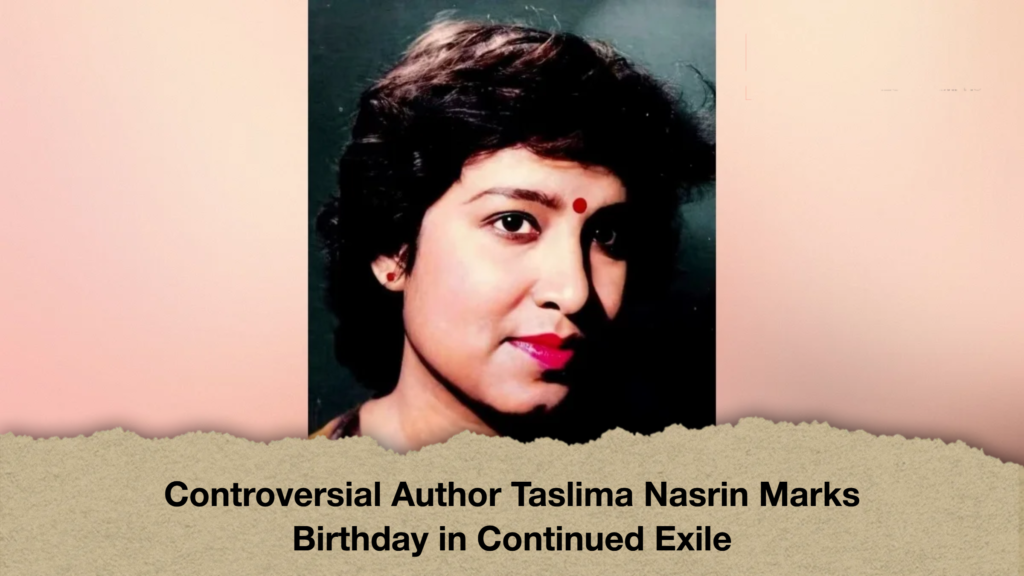
Renowned and polarizing author Taslima Nasrin celebrates her birthday on 25 August, marking another milestone in a life defined by literary dissent, fierce iconoclasm, and decades of forced exile. Few figures in contemporary Bengali literature have stirred as much intense debate or challenged established social orthodoxies with such uncompromising vigor.
Born in Mymensingh in 1962, Nasrin was raised in a professional household; her father, Rajab Ali, worked as a physician, while her mother, Idul Wara, managed the family home. Nicknamed “Tona” by the celebrated poet Helal Hafiz, she completed her schooling at Mymensingh Residential School in 1976 and finished her higher secondary education at Ananda Mohan College in 1978. She subsequently enrolled at Mymensingh Medical College, graduating with an MBBS degree in 1984. Nasrin then embarked on a medical career, serving at a rural government clinic, the gynaecology ward at Mitford Hospital, and the anaesthesiology department at Dhaka Medical College Hospital.
Parallel to her clinical practice, Nasrin’s literary identity took root early. She began writing poetry at thirteen and edited the literary magazine Sejuti between 1978 and 1983. Her debut poetry collection, Shikore Bipul Khudha (Tremendous Hunger in the Roots), appeared in 1986. Subsequent volumes—including Nirbasito Bahire On Tore, Amar Kichhu Jai Ase Na, Atole Ontorin, Balikar Gollachhut, and Behula Eka Bhasiyechilo Vela—boldly confronted female marginalisation, solitude, and anger alongside themes of love.
During the 1990s, her writing took on a sharper socio-political edge. Her newspaper columns attacking religious fundamentalism, patriarchy, and gender inequality sparked fierce public debate, earning her the prestigious Ananda Puraskar in 1992 for Nirbachito Kolam (Selected Columns).
The publication of her 1993 novel Lajja (Shame), set against the backdrop of anti-Hindu violence in Bangladesh following the destruction of the Babri Masjid in India, marked a definitive turning point. The book triggered immense hostility, culminating in religious edicts (fatwas), death threats, and physical harassment that eventually forced her to flee Bangladesh in 1994.
Despite living across Europe and India in long-term exile, Nasrin continued to write prolifically. Autobiographical works such as Amar Meyebela and Ka raised uncomfortable questions about sexuality, religion, and freedom, resulting in bans in both Bangladesh and India. While critics denounce her provocative tone, supporters view her as a fearless defender of secularism and women’s rights. Her work remains a formidable, undeniable force in modern Bengali cultural history.