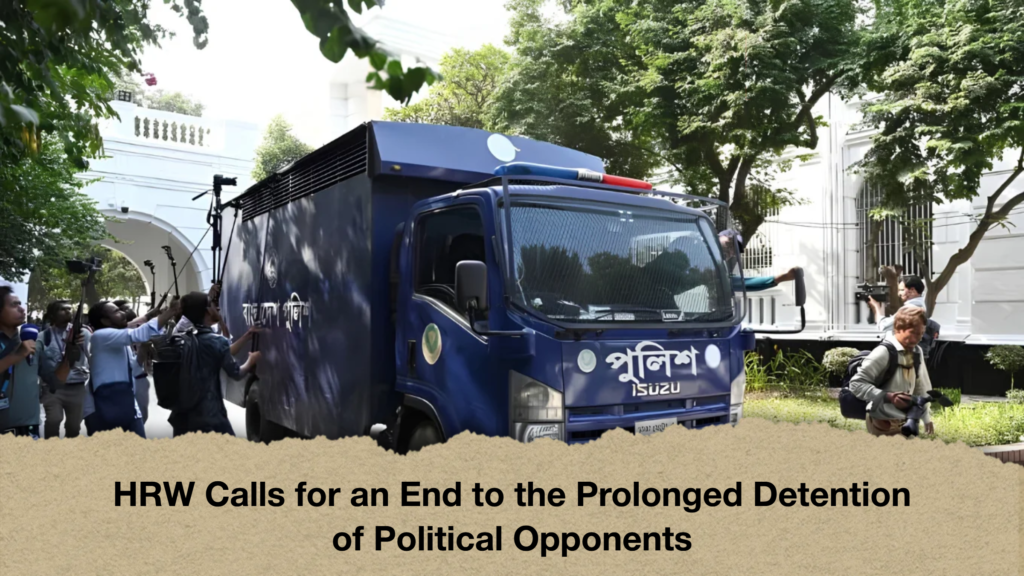
Human Rights Watch has called on Bangladesh’s government to end the indefinite detention without trial of politicians and other individuals associated with the ousted Awami League government.
In a statement issued on Monday, the international rights organisation said thousands of Awami League leaders, activists and supporters were detained by police after Sheikh Hasina was forced to leave the prime minister’s office following weeks of protests in August 2024. According to the organisation, hundreds of those detained remain in custody without specific charges having been formally brought against them.
Human Rights Watch acknowledged that some officials associated with the former government may have been involved in serious human rights violations. However, it said many people had been arrested over allegations relating to the killing of protesters without publicly presented evidence establishing their individual involvement.
The organisation said families and lawyers had raised concerns about the condition of detainees, particularly older people and those suffering from serious health problems. Some families have also alleged that detainees have faced difficulties in obtaining bail and adequate medical treatment.
According to Human Rights Watch, at least 10 Awami League activists and leaders have died in custody during the six months since Tarique Rahman became prime minister. The organisation said most of those who died had not been formally charged with specific offences.
Elaine Pearson, Asia director at Human Rights Watch, said political opponents should not be held for prolonged periods without evidence or proper legal procedures. She argued that the government’s pledge to pursue reforms should include ending arbitrary and prolonged detention.
The organisation has also expressed concern over the proposed National Human Rights Commission Bill. It warned that if the legislation is passed without necessary reforms, the new commission could lack the authority required to investigate allegations of arbitrary arrests and other abuses.
The statement said those detained without formal charges include former Awami League lawmakers, former legislators from other parties that supported the Hasina administration, government officials and journalists perceived as supportive of the previous government. Security personnel and other individuals have also faced allegations involving extrajudicial killings, torture, enforced disappearances and corruption.
Human Rights Watch further alleged that prosecutors have repeatedly opposed bail in cases where evidence has not been publicly presented. According to the organisation, lower and district courts have frequently rejected bail applications, while individuals granted bail by the High Court have sometimes faced fresh cases before they could be released.
The case of former chief justice A B M Khairul Haque was cited as an example. The 82-year-old was arrested on 24 July 2025 over allegations relating to the killing of a protester. During the following three months, he was shown arrested in four additional cases, including corruption allegations. His bail applications were rejected by lower courts.
His family reportedly told Human Rights Watch that he suffered a heart attack while in custody. Although the High Court granted him bail, police showed him arrested in two new cases on 10 March 2026, preventing his release. The High Court later granted bail in those cases on 12 May, but another murder case was brought against him before he could leave custody.
The organisation said the cycle of bail orders followed by new cases continued until the Appellate Division intervened, leading to his release on 19 August. Human Rights Watch said no charge sheet had been filed against him in any of the cases during the period described.
Lawyers representing other detainees reportedly told the organisation that they had become reluctant to seek bail because they feared their clients would face fresh cases if released.
Human Rights Watch also raised concerns about prolonged detention under Bangladesh’s International Crimes Tribunal. The organisation said the tribunal permits detention exceeding one year without charges only under circumstances that are formally identified as exceptional. It claimed that more than 150 people detained through the tribunal had not been granted bail.
Among the cases mentioned was that of former prime minister Sheikh Hasina’s adviser Toufiq-e-Elahi Chowdhury, aged 81. He was first detained by the tribunal in October 2024 and, according to the organisation, had remained in custody for 22 months without formal charges. His bail application in April 2026 was reportedly rejected, while proceedings were adjourned twice, most recently until the end of August.
Human Rights Watch also referred to former parliamentarian Kamal Ahmed Majumder, who had reportedly spent 22 months in tribunal custody. His family alleged that he developed gangrene while imprisoned and had to undergo surgery resulting in the amputation of three toes. He also reportedly fractured his hip after a fall. His bail application was rejected by the tribunal in July.
Concerns over medical treatment have also been raised in relation to other elderly detainees. Rights activists have called for the release of 75-year-old Shahriar Kabir, who reportedly suffers from several long-term illnesses and requires a wheelchair for mobility. The organisation also said 71-year-old R A M Obaidul Muktadir Chowdhury had been detained without trial for 22 months and suffered from heart disease.
The statement referred to the death of former Awami League lawmaker Ramesh Chandra Sen, who was 85. He was arrested in August 2024 in three murder cases and one explosives case and remained in custody until his death on 7 February 2026. His family alleged that he did not receive adequate medication and was denied bail.
Human Rights Watch also raised concerns about the death of S M Ziaul Haque Zia, a member of the Jamalpur district Awami League. The 65-year-old was reportedly already ill when he was detained on 6 January. His bail application was rejected, and he died in custody on 14 April.
The organisation stressed that international human rights law permits pre-trial detention in certain circumstances, but such detention should remain an exception rather than become the norm. Each case, it said, should be assessed individually, with authorities required to establish that continued detention is lawful and necessary.
It also called for detainees to have their cases reviewed promptly by a judge or equivalent independent authority. Individuals have a right to a fair and timely trial, and where authorities cannot provide one within a reasonable period, continued detention should be reconsidered.
Pearson said the government should order independent investigations into every death occurring in custody and take steps to prevent prolonged detention without formal charges. The organisation argued that safeguarding due process, access to medical care and judicial oversight would be essential to ensuring that Bangladesh’s promised institutional reforms are consistent with fundamental human rights principles.