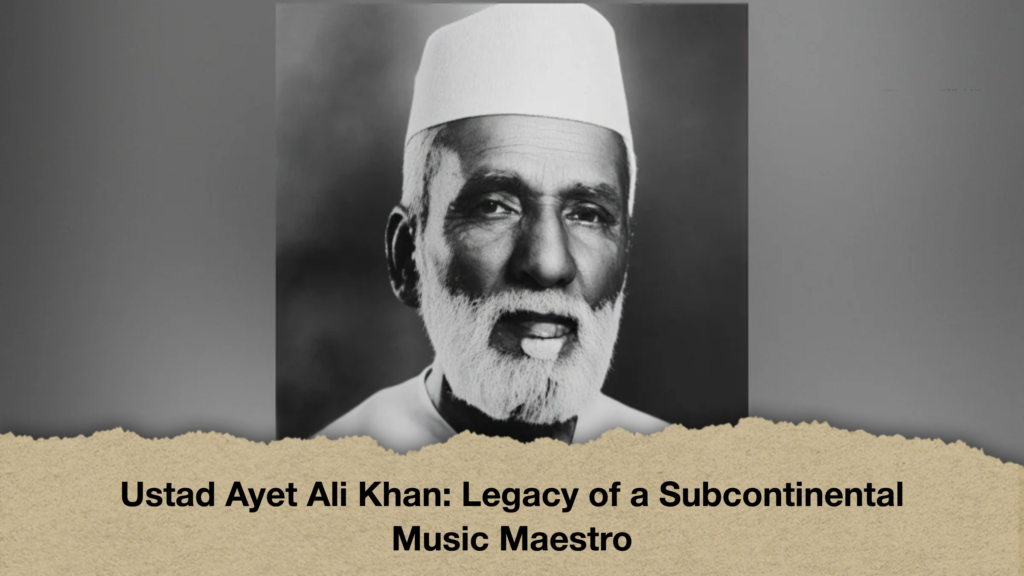
Few musicians leave a imprint as profound or enduring on the landscape of Subcontinental classical music as Ustad Ayet Ali Khan. A dedicated practitioner of Indian classical music, a master of the sitar and surbahar, and an imaginative composer, he carved a distinct niche for himself within the regional cultural tradition.
Born on 26 April 1884 in Shibpur village under Nabinagar Upazila in Brahmanbaria, Ayet Ali Khan belonged to an exceptionally gifted musical family. He was the son of Sabdar Hossain Khan and Sundari Begum, and the younger brother of the legendary musician Ustad Alauddin Khan. Inheriting a deep musical tradition, Ayet Ali Khan expanded this family legacy through rigorous personal discipline, technical precision, and creative innovation.
While initially trained in vocal music, Khan ultimately earned renown through his mastery of stringed instruments, particularly the sitar and surbahar. His performances were celebrated for combining emotional depth, tonal sweetness, and strict adherence to classical grammar with personal artistic improvisation.
Rather than confining himself to traditional instrumental performance, Khan worked actively as an innovator and craftsman. He designed and built two new musical instruments, named the Manohara and the Mantranad. Additionally, he composed several new ragas, including Chandrasarang, broadening the musical vocabulary of the era.
His career was closely linked with prestigious royal courts across British India. He served as a court musician in the princely states of Maihar and Rampur, positions that highlighted his high standing among contemporary classical musicians. His reputation eventually led to an invitation from Nobel Laureate Rabindranath Tagore to join the faculty at Visva-Bharati University in Santiniketan, where he taught music and fostered deeper connections between Bengali culture and classical music traditions.
Between 1951 and 1965, Khan brought his surbahar recitals to a much broader public through regular radio broadcasts on Pakistan Radio. These broadcasts allowed his art to transcend royal courts and private gatherings, reaching households across the region.
Throughout his life, Khan headed a large family of eleven children: Ambia Khanam, Ustad Abed Hossain Khan, Bahadur Hossain Khan, Mobarak Hossain Khan, Mamata Khanam, Sheik Sadi Khan, Tansen Khan, Yasmin Khanam, Beethoven Khan, Kohinoor Khanam, and Rizia Begum. Several of his descendants pursued distinguished careers in music, preserving and furthering the family’s heritage.
Khan’s lifelong artistic achievements received formal recognition both during his lifetime and posthumously. He received the Governor’s Gold Medal in 1960 and the Pride of Performance award in 1966. Following his death on 2 September 1967, his legacy was further honoured with the Bangladesh Shilpakala Academy Award in 1976 and the Independence Award—Bangladesh’s highest civilian honour—in 1984.