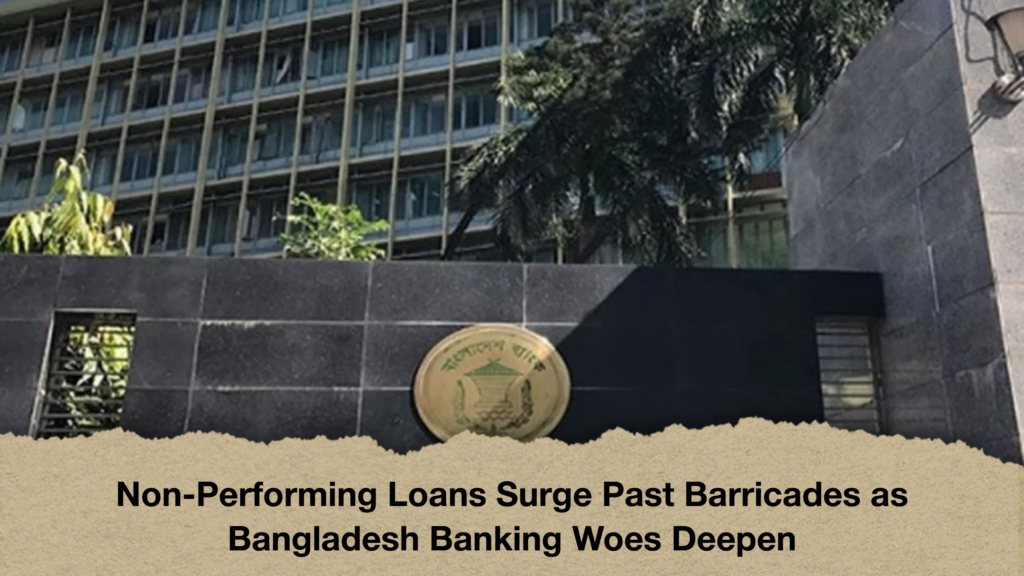
Repeated policy concessions and lenient debt restructuring schemes have failed to contain the mounting distress in Bangladesh’s banking sector, where non-performing loans (NPLs) have crossed the six trillion taka mark. The latest statistics released by Bangladesh Bank depict a worsening financial landscape, with bad debts rising sharply over a single quarter amidst a severe contraction in commercial activity.
Data from the central bank reveals that default loans expanded by BDT 17,851 crore in the three months leading up to June, reaching BDT 6,06,284 crore. This marks a notable escalation from the BDT 5,88,704 crore recorded at the end of March. Distressed assets now account for an alarming 32.78 per cent of total outstanding credit across the banking network. In practical terms, nearly BDT 33 out of every BDT 100 extended in loans is currently classified as default, severely impairing the financial health of commercial lenders and restricting their capacity to issue new credit.
| Financial Indicator or Policy Metric | Value / Status |
| Total Non-Performing Loans (June) | BDT 6,06,284 crore |
| Total Non-Performing Loans (March) | BDT 5,88,704 crore |
| Quarterly Increase in Default Loans | BDT 17,851 crore |
| NPL Ratio to Total Distributed Credit | 32.78% |
| Private Sector Credit Growth Rate | 4.47% (Record Low) |
| Total Rescheduled Credit (September Package) | Approximately BDT 1,000,000 crore (~ BDT 1 trillion) |
| Number of Corporate Borrowers (September Package) | Approximately 300 |
| Grace Period (September Package) | 2 Years |
| Repayment Period Limit (September Package) | Up to 10 Years |
| Updated Maximum Repayment Tenure (August Package) | Up to 15 Years |
| Threshold for 15-Year Restructuring Eligibility | Loans exceeding BDT 1,000 crore |
| Revised Restructuring Term Limit | Extended from 2 to 4 Years |
| New Target Business Stimulus Package | BDT 60,000 crore |
This rapid accumulation of bad debt coincides with private sector credit growth dropping to a record low of 4.47 per cent. Financial analysts and economists attribute this deceleration directly to sluggish commercial activity. Stagnant production and subdued investment have severely eroded business cash flows, making it increasingly difficult for borrowers to maintain regular loan repayments.
Regulatory Concessions and Structural Relief
To address the situation, Bangladesh Bank introduced a special debt restructuring scheme last September. Around 300 major corporate borrowers restructured roughly BDT 1,000,000 crore under that arrangement, securing a two-year grace period alongside a ten-year repayment window. Despite those generous terms, a significant number of beneficiaries have slipped back into default—even before their initial grace periods expired.
The continuous deterioration prompted the central bank to issue a further relaxed facility on 31 August. Under the revised framework, borrowers holding default debts exceeding BDT 1,000 crore can reschedule their liabilities for up to 15 years, including a two-year grace period. Additionally, the maximum tenure allowed for general debt restructuring has been doubled from two years to four. Existing beneficiaries operating within their grace period have also been permitted to reapply under the new terms, reflecting regulatory eagerness to prevent large-scale corporate failures.
Macroeconomic Strains and Liquidity Injections
Central bank officials maintain that external economic shocks necessitated these interventions. The industrial sector has faced consecutive operational hurdles, including severe domestic gas shortages, volatile global energy prices linked to international conflicts, and elevated production costs. These factors have combined to weaken corporate debt-servicing capacity, prompting regulators to grant structural relief.
To complement these measures and revive economic momentum, Bangladesh Bank has launched a fresh BDT 60,000 crore low-interest stimulus package accessible to all commercial banks. Monetary authorities hope that liquidity injections will reignite industrial activity, improve business earnings, and eventually curb non-performing assets.
Economists warn that granting repeated concessions risks masking the true state of default loans without addressing core balance-sheet vulnerabilities. Unless underlying operational cash flows improve, extending repayment horizons provides only temporary relief. Restoring stability will require stricter risk management, robust recovery mechanisms, and a clear distinction between genuinely struggling enterprises and willful defaulters.