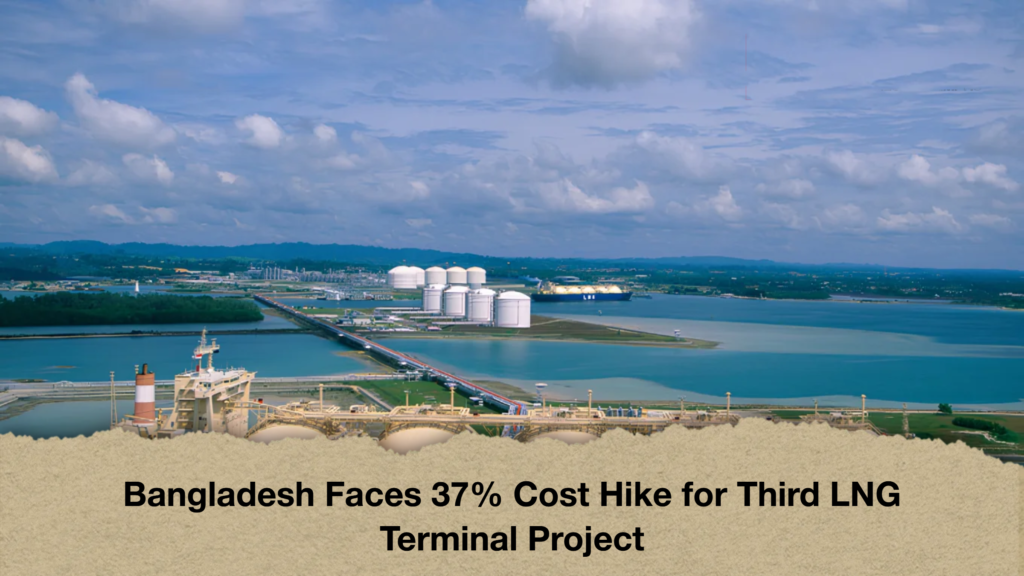
Bangladesh is poised to pay significantly higher regasification fees for its proposed third floating storage and regasification unit (FSRU) under a government-to-government arrangement with a Chinese state-owned enterprise. While negotiating teams acknowledge the steep premium, they remain unable to quantify precisely how much of the added cost is commercially justifiable amid rising global energy pressures.
Background and Proposal Structure
The China National Energy Engineering and Construction Co (CNEE) submitted a formal proposal on June 19 to establish an offshore liquefied natural gas terminal at Kutubjom in Maheshkhali. Operating under a build-own-operate model, the facility would feature a base regasification capacity of 600 million cubic feet per day (mmcfd) and a peak capacity of 750 mmcfd.
Under the terms of the 15-year arrangement, CNEE would levy a daily fee of $342,000 for the FSRU. This rate sits 35 to 37 percent higher than the charges incurred under existing contracts with current providers.
Comparative Fee Structure
A comparative analysis of daily FSRU service fees across current and proposed projects highlights the widening cost margins:
| Project / Supplier | Contract Duration | Daily Fee (USD) | Status / Reference |
| Excelerate Energy | Standard Operating | $254,000 | Current Operational Terminal |
| Summit LNG Terminal | Standard Operating | $249,115 | Current Operational Terminal |
| Summit’s Second FSRU | 15 Years | $300,000 | Agreed in March 2024 (Terminated) |
| RPGCL Benchmark Study | 2025 Study | $239,653 | State-Owned Feasibility Benchmark |
| CNEE Proposed Option A | 15 Years | $342,000 | Includes Fixed, Operational, and Port Fees |
| CNEE Proposed Option B | 20 Years | $329,000 | Alternative Long-Term Structure |
The proposed CNEE daily fee breaks down into a $246,000 fixed fee, a $59,000 operational fee, and a $37,000 port service fee under the 15-year term. It also exceeds the benchmark rate of $239,653 recommended in a 2025 feasibility study by the state-owned Rupantarita Prakritik Gas Company (RPGCL).
Committee Recommendations and Citing Factors
Despite the cost disparity, a seven-legged negotiation committee headed by Petrobangla Chairman Md Abdul Mannan presented two options to the government on August 30: a 15-year deal at $342,000 daily or a 20-year agreement at $329,000 daily. The Cabinet Committee on Economic Affairs had previously granted in-principle approval on July 28.
CNEE justified the premium by pointing to shifts in global energy markets following recent conflicts in the Middle East, rising shipbuilding material costs, supply chain uncertainties, and tight delivery schedules requiring commissioning within 18 months of signing. The negotiation committee noted these global headwinds could warrant a higher rate, though it conceded that verifying the exact reasonable limit required deeper assessment.
Technical Advantages and Expert Skepticism
The committee favoured a larger 1,74,000-cubic-metre vessel utilising a 2016-built ship over a smaller 165,000-cubic-metre variant built in 2008. The increased storage capacity provides operational flexibility, accommodates larger LNG carriers, and could potentially shave $0.05 to $0.10 per million British thermal units (MMBtu) off import costs through economies of scale. The present value of Petrobangla’s payment obligation under the 15-year option is calculated at $1.002 billion, or approximately Tk 12,324 crore, at a 12 percent discount rate.
However, energy experts have raised critical questions regarding the absence of competitive bidding, implementation feasibility, and pricing. Mohammad Tamim, a former dean of BUET and vice-chancellor of Independent University of Bangladesh, questioned the project’s logic given the higher costs. He also expressed strong doubts about CNEE’s ability to complete conversion, geological surveys, wave analysis, and physical installation within the aggressive 18-month timeline, noting that such projects typically demand at least 24 months. Tamim strongly recommended commissioning an independent third-party review to evaluate the proposed pricing structure before finalising commitments.
Fuel Crisis Context
The push to fast-track another FSRU follows severe disruptions in the nation’s energy supply chain. Primary supplier QatarEnergy halved its scheduled 2026 deliveries after Middle East hostilities disrupted shipments through the Strait of Hormuz, forcing Dhaka to lean heavily on expensive spot market purchases. Domestic vulnerabilities were further exposed when Excelerate Energy’s FSRU went offline following a July incident, cutting grid supply in half and driving projected fiscal year LNG subsidies toward Tk 40,000 crore.