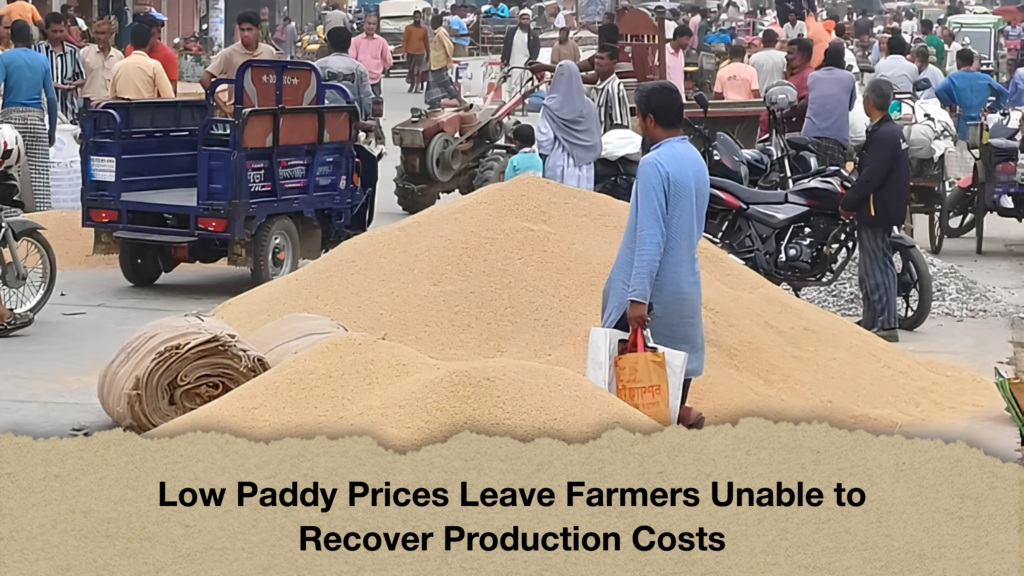
Farmers in Naogaon are facing growing financial pressure despite a bumper harvest of Aus paddy this season, as market prices have fallen sharply below production costs. In one of Bangladesh’s major rice-producing districts, growers say the low price of paddy has wiped out the benefit of a good harvest, leaving many unable to recover what they spent on cultivation.
A survey of several local markets found that Zirashail, Katari and BRRI-28 varieties of paddy were selling for Tk 800 to Tk 950 per maund. Farmers said prices were Tk 300–400 lower per maund than last year, while the cost of cultivation had risen because of higher expenses for fertiliser, seed, irrigation, pesticides, land preparation and farm labour.
The situation has created a difficult imbalance for growers. A higher yield normally offers farmers an opportunity to increase their income, but when the selling price falls substantially, the additional production does little to improve their financial position.
According to the district agricultural extension office, Aus cultivation covered 51,300 hectares in Naogaon during the previous season. This year, the cultivated area increased to 58,573 hectares, indicating that farmers expanded production despite the higher costs involved.
The agricultural authorities estimate that producing Aus paddy costs an average of Tk 64,000 per acre, equivalent to roughly Tk 21,000 per bigha. Farmers in Naogaon Sadar, Mahadebpur, Manda and Niamatpur said their actual expenses on labour, fertiliser, irrigation and land preparation alone had exceeded Tk 20,000 per bigha this season.
Farmers reported yields of around 20–22 maunds per bigha. At a selling price of Tk 800–900 per maund, the revenue from a bigha comes to roughly Tk 16,000–19,800 before other associated expenses are taken into account. In many cases, therefore, farmers are unable to recover their cultivation costs.
For growers who depend on borrowing or sharecropping, the situation is particularly difficult. Paddy sales are often the main source of cash immediately after harvest, when farmers have to repay loans, settle household expenses and meet the costs of preparing for the next agricultural cycle. Holding on to their crop in the hope of better prices is not always possible.
Anwar Hossain, a farmer from Dangapara village in Mahadebpur, brought 10 maunds of Zirashail paddy to the upazila’s main market last Wednesday. He sold it for Tk 880 per maund. He said he had paid Tk 30 per maund in van fare to transport the paddy to the market and would have had to pay a similar amount to take it back home if he failed to sell it.
Anwar said he had sold Aus paddy for Tk 1,300–1,400 per maund last year. The substantial fall in price this season has left him disappointed, particularly as cultivation costs have increased.
Selim Hossain of Gobindapur village in Niamatpur faces a similar problem. He cultivated Aus paddy on three bighas of leased land and borrowed money from a local cooperative to finance the farming. His total cultivation costs were around Tk 60,000. With paddy prices now significantly lower, he is worried about repaying the loan while continuing to meet his family’s regular expenses.
The weakness in the paddy market has also been reflected in wholesale trading. Shahidul Islam, proprietor of M/s Rekha Paddy Trading House at Chatra Market, said prices had fallen by Tk 200–300 per maund within roughly a week and a half. He said the decline became particularly noticeable after the arrival of newly harvested Aus paddy.
Katari paddy is currently being traded at around Tk 900–960 per maund, while Zirashail is selling for Tk 850–900. BRRI-28 is fetching only Tk 800–820 per maund, according to traders.
Naogaon’s Deputy Director of Agricultural Extension, Manzur Rahman, said the average cost of producing Aus paddy in the 2026–27 financial year was about Tk 64,000 per acre. He estimated that farmers would have been able to make a profit if they could sell paddy for Tk 1,200–1,300 per maund.
Paddy prices fall, but rice prices remain steady
One of the main concerns for farmers is that the fall in paddy prices has not been matched by a similar reduction in rice prices at local markets. Rice mill owners say sales have weakened, partly because the country has sufficient stocks following a strong Boro harvest and substantial rice imports during the previous interim administration.
With demand for locally produced rice reportedly weaker, millers have reduced their purchases of paddy. That has created another layer of pressure on farmers arriving at local markets with freshly harvested crops.
Farhad Hossain Chowdhury, general secretary of the Naogaon District Rice Mill Owners’ Group, said large-scale rice imports during the previous interim administration had reduced demand for domestically produced rice. He warned that the effect of those imports could continue into the peak Aman season.
If the trend persists, farmers could face another period of weak paddy prices when the Aman harvest reaches the market. For growers already struggling to recover the cost of Aus cultivation, that prospect is a source of further concern.
The situation in Naogaon highlights a wider challenge for farmers: a good harvest does not necessarily translate into a good return when market prices fall below production costs. With cultivation expenses continuing to weigh on growers, farmers are now looking for a price that reflects the cost of production and allows them to recover their investment rather than simply selling their harvest at a loss.