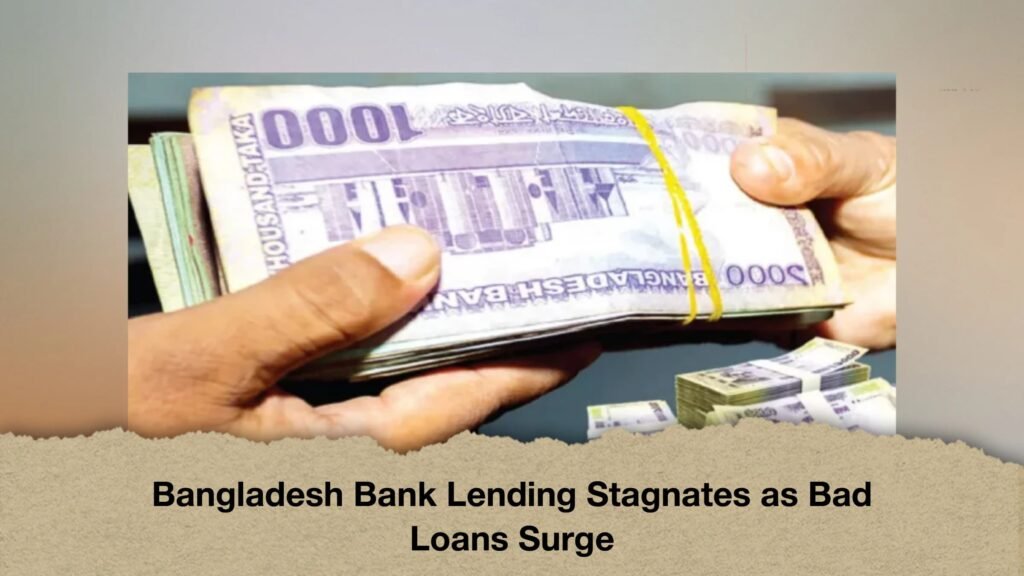
Bank lending in Bangladesh has remained largely subdued, with the loan portfolios of a number of lenders shrinking or registering only marginal growth in the six months to June 2026. The slowdown has come as the banking sector faces a sharp increase in classified loans, prompting lenders to take a more cautious approach to fresh credit.
According to Bangladesh Bank data, outstanding loans and advances across the country’s 61 scheduled banks increased by just 1.77 per cent between December 2025 and June 2026. The total rose from around Tk 17.77 lakh crore to Tk 18.09 lakh crore during the period.
Bank-wise figures show that at least 14 banks either reduced their loan books or recorded almost no growth. The contraction was particularly pronounced among several established lenders.
Sonali Bank recorded the largest decline. Its outstanding loans fell by 9.85 per cent, or Tk 9,399 crore, from Tk 95,381 crore in December to Tk 85,983 crore in June.
Jamuna Bank’s loan portfolio contracted by 8.86 per cent, while NRBC Bank recorded a 7.05 per cent decline. Dutch-Bangla Bank, one of the country’s major private-sector lenders, saw its outstanding loans fall by 2.93 per cent, from Tk 44,884.35 crore to Tk 43,568.58 crore.
The loan books of several other banks also declined. Eastern Bank’s loans fell by 2.38 per cent, Prime Bank’s by 1.55 per cent, Agrani Bank’s by 0.90 per cent and Standard Bank’s by 0.54 per cent. Rajshahi Krishi Unnayan Bank recorded a 1.27 per cent decline, while BASIC Bank’s loan portfolio fell by 1.02 per cent.
Banks involved in merger processes also experienced weak lending growth. Janata Bank’s loans increased by 3.03 per cent during the six-month period, while Rupali Bank recorded growth of 1.46 per cent.
The weakness among several large lenders is significant because the modest overall growth in bank credit was driven largely by a relatively small number of institutions.
Community Bank Bangladesh recorded the highest percentage growth, with its loan book increasing by 50.12 per cent. The increase, however, came from a relatively small base, with its outstanding loans rising from Tk 1,088 crore to Tk 1,634 crore.
Uttara Bank expanded its lending by 13.68 per cent, while Bengal Commercial Bank recorded growth of 12.35 per cent and Citizens Bank 9.55 per cent.
In absolute terms, City Bank added the largest amount to its loan portfolio among the banks cited. Its loans increased by Tk 4,086 crore, representing an 8.14 per cent rise.
Classified loans grow at a faster pace
The slowdown in lending has occurred alongside a significant deterioration in asset quality across the banking sector.
Classified loans rose from Tk 5.57 lakh crore in December to Tk 6.07 lakh crore in June, an increase of 8.85 per cent within six months. As a result, classified loans accounted for 32.78 per cent of total outstanding loans in June, compared with 30.60 per cent in December.
The gap between overall credit growth and the increase in classified loans highlights the pressure on banks’ balance sheets. While total lending expanded only slightly, troubled loans increased much more rapidly.
This environment can make banks more cautious about extending fresh credit, particularly when they are already dealing with a substantial volume of existing problem loans. The figures therefore point to a banking sector placing greater emphasis on managing credit risk and protecting liquidity.
Private-sector lending remains weak
Bangladesh Bank’s quarterly figures also show considerable variation in lending across different sectors of the economy.
Private-sector lending grew by 1.78 per cent during April-June, while public-sector lending declined by 10.91 per cent.
Among major economic activities, trade loans increased by 4 per cent during the quarter. Term loans, however, grew by only 0.48 per cent. Working-capital financing declined by 0.47 per cent, while lending to the construction sector fell by 3.17 per cent.
The figures suggest that credit expansion has not been broad-based. Some commercial activity has continued to receive additional bank financing, but lending for longer-term purposes and working capital has remained weak.
For businesses, slower credit growth can affect access to financing for expansion, day-to-day operations and investment. At the same time, banks have to consider the risks associated with adding new loans when a large portion of existing credit is already classified.
Banks increase investment in government securities
While lending remained subdued, banks substantially increased their investment in government securities, including Treasury bills and bonds.
Their investment in such instruments rose by 21.53 per cent over the six months to June, increasing from Tk 6.15 lakh crore to Tk 7.47 lakh crore.
The pace of increase was considerably higher than the growth in bank lending during the same period. This indicates a shift in the way banks are deploying available funds amid weak credit demand and heightened concerns over lending risks.
Borrowing from Bangladesh Bank also increased significantly. Banks’ borrowing rose by 29.54 per cent, from Tk 1.77 lakh crore in December to Tk 2.29 lakh crore in June.
The latest quarterly figures show that bank investment continued to rise rapidly, increasing by 11.45 per cent, far exceeding the pace of credit growth.
Taken together, the data indicate that banks are continuing to manage and deploy substantial financial resources, but much of the additional activity is taking place outside conventional lending. Investment in government securities has expanded considerably, while loan portfolios have grown only modestly or contracted at a number of institutions.
The banking sector is therefore facing a difficult balance. It needs to maintain the flow of credit to productive parts of the economy, while also containing the risks associated with rising classified loans. The data up to June show that, for many lenders, preserving liquidity and limiting additional credit exposure have become increasingly important as the quality of existing assets comes under pressure.