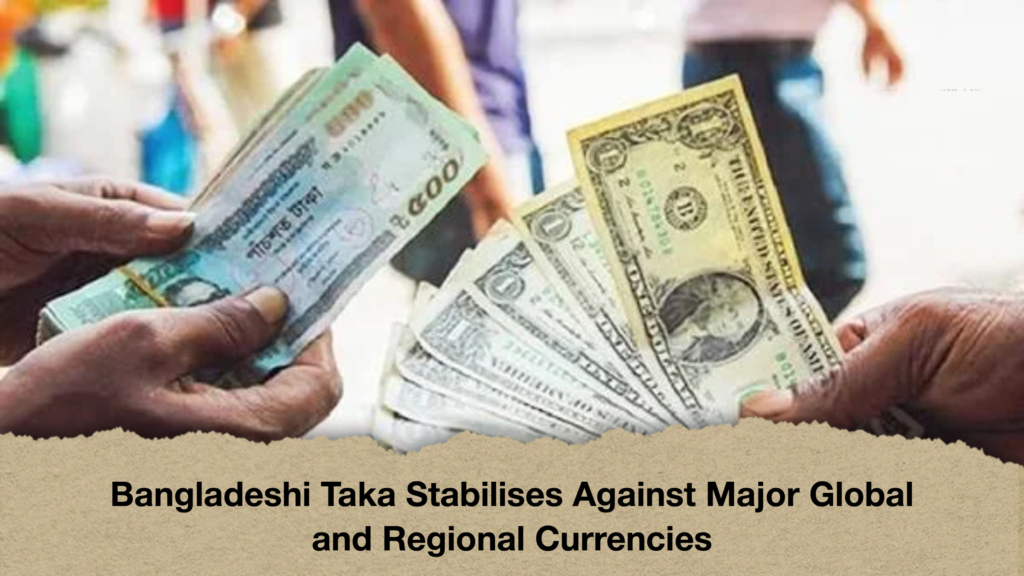
Exchange rate fluctuations remain a central fixture of Bangladesh’s economic environment, directly shaping import-export settlements, remittance conversions, and international debt obligations.
Official statistics released by Bangladesh Bank on Tuesday, 22 September 2026, outline the latest reference exchange rates across major foreign currencies. The US dollar was quoted at Tk 122.72, while the euro stood at Tk 140.66. The British pound reached Tk 163.99, underscoring ongoing currency rebalancing across Western financial markets.
Because the US dollar serves as the primary currency for global trade, its exchange rate carries disproportionate weight for Bangladesh’s macroeconomic stability. It dictates the local cost of crucial imports—including petroleum, industrial raw materials, capital machinery, and essential foodstuffs—while determining the domestic value of export earnings and worker remittances. The euro and British pound similarly play vital roles in sustaining trade flows with the European Union and the United Kingdom, two of Bangladesh’s largest apparel export destinations.
Alongside major Western currencies, key regional and commonwealth denominations recorded steady trading figures. The Australian dollar stood at Tk 87.32, closely aligned with the Canadian dollar at Tk 87.41. The Singapore dollar settled at Tk 96.13, while Northern Europe’s Swedish krona traded at Tk 12.46. In East Asia, the Japanese yen was quoted at Tk 0.78.
| Foreign Currency | Code / Unit | Exchange Rate in BDT | Reference Date | Source / Market Authority |
| US Dollar | USD (1) | Tk 122.72 | 22 September 2026 | Bangladesh Bank |
| Euro | EUR (1) | Tk 140.66 | 22 September 2026 | Bangladesh Bank |
| British Pound | GBP (1) | Tk 163.99 | 22 September 2026 | Bangladesh Bank |
| Australian Dollar | AUD (1) | Tk 87.32 | 22 September 2026 | Bangladesh Bank |
| Japanese Yen | JPY (1) | Tk 0.78 | 22 September 2026 | Bangladesh Bank |
| Canadian Dollar | CAD (1) | Tk 87.41 | 22 September 2026 | Bangladesh Bank |
| Swedish Krona | SEK (1) | Tk 12.46 | 22 September 2026 | Bangladesh Bank |
| Singapore Dollar | SGD (1) | Tk 96.13 | 22 September 2026 | Bangladesh Bank |
| Chinese Yuan Renminbi | CNY (1) | Tk 18.34 | 22 September 2026 | Bangladesh Bank |
| Indian Rupee | INR (1) | Tk 1.28 | 22 September 2026 | Bangladesh Bank |
| Sri Lankan Rupee | LKR (1) | Tk 2.69 | 22 September 2026 | Bangladesh Bank |
Trade corridors within Asia saw the Chinese yuan renminbi quoted at Tk 18.34. Neighboring currencies reflected similar regional pricing, with the Indian rupee trading at Tk 1.28 and the Sri Lankan rupee standing at Tk 2.69. The Indian rupee exchange rate remains particularly consequential for local business owners, given the high volume of cross-border commerce, agricultural imports, and medical travel between Bangladesh and India.
Foreign exchange availability is anchored heavily by remittance flows sent home through formal banking channels by millions of non-resident Bangladeshis. Robust remittance inflows bolster interbank dollar liquidity, easing devaluation pressures on the taka and strengthening national reserves. Conversely, when the local currency weakens, importers face elevated operational expenses, which can feed directly into domestic consumer inflation.
Exchange rates also influence global statistical comparisons. Key national indicators—such as Gross Domestic Product (GDP) and per capita income—are regularly converted into US dollars for international reporting. While central bank reference figures establish a benchmark, actual counter rates at commercial banks and authorised exchange houses vary slightly throughout the day based on market supply, demand, and transaction fees.