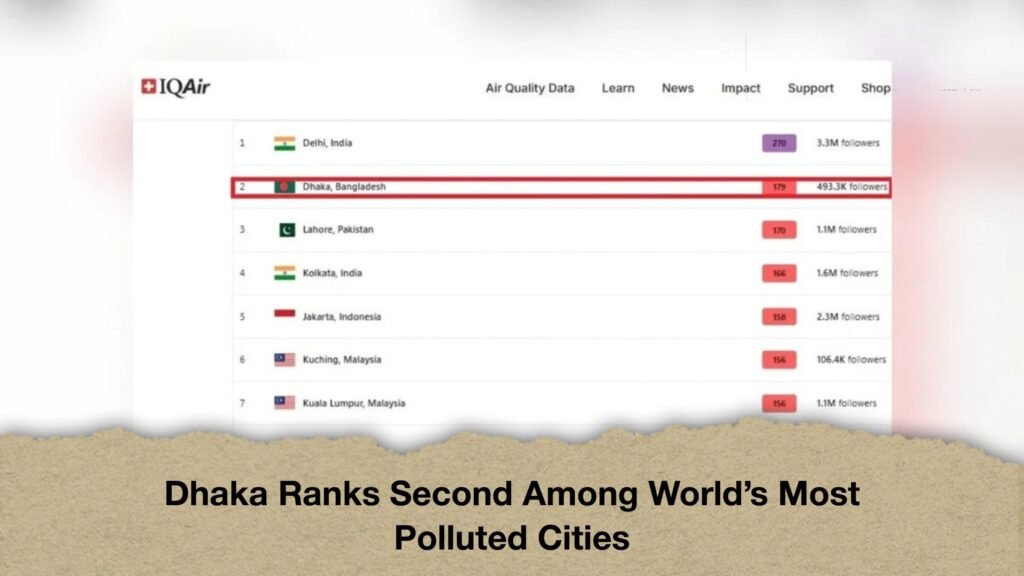
Dhaka ranked second among the world’s cities with the poorest air quality on Monday, with an Air Quality Index (AQI) score of 179, placing the Bangladeshi capital in the ‘unhealthy’ category.
According to data from IQAir, a Switzerland-based air quality monitoring organisation, India’s capital Delhi topped the global list with an AQI score of 270. Its air quality was classified as ‘very unhealthy’, significantly worse than that recorded in Dhaka.
Pakistan’s Lahore ranked third with a score of 170, while India’s Kolkata was fourth at 166. Jakarta, the capital of Indonesia, completed the top five with an AQI score of 158.
The figures, recorded on Monday, 5 October, highlight the persistent air pollution problem affecting major cities across South and Southeast Asia. Dhaka’s position on the list reflects the continued presence of dust, smoke and fine particulate matter in the city’s atmosphere.
Under IQAir’s AQI classification, a score between zero and 50 represents ‘good’ air quality. A reading from 51 to 100 is considered ‘moderate’, while 101 to 150 is classified as ‘unhealthy for sensitive groups’. Scores between 151 and 200 are categorised as ‘unhealthy’, while readings from 201 to 300 are considered ‘very unhealthy’. An AQI above 300 falls into the ‘hazardous’ category.
With Dhaka recording a score of 179, the city’s air quality falls firmly within the unhealthy range. Prolonged exposure to polluted air can pose greater risks to vulnerable groups, particularly children, older people and those with existing respiratory or cardiovascular conditions.
Bangladesh’s AQI assessment takes several major pollutants into account. These include particulate matter such as PM10 and PM2.5, as well as nitrogen dioxide (NO₂), carbon monoxide (CO), sulphur dioxide (SO₂) and ozone (O₃). Fine particulate matter is particularly concerning because the smallest particles can penetrate deep into the respiratory system.
Dhaka’s air pollution has several established sources. A report prepared by Bangladesh’s Department of Environment and the World Bank in March 2019 identified brick kilns, vehicle emissions and dust from construction sites as three major contributors to the capital’s poor air quality.
The city’s rapid development and extensive construction activity have made dust management a continuing challenge. Emissions from vehicles also add to the pollution burden, while activities outside the city can contribute to deteriorating air quality depending on weather and atmospheric conditions.
The health consequences of prolonged exposure to polluted air extend well beyond temporary discomfort. According to the World Health Organisation (WHO), air pollution is associated with serious illnesses including stroke, heart disease, chronic obstructive pulmonary disease (COPD), lung cancer and acute respiratory infections.
The WHO estimates that air pollution contributes to around seven million deaths worldwide each year. For densely populated cities such as Dhaka, improving air quality therefore remains a significant public health concern.
The latest AQI ranking serves as another indication of the scale of the challenge facing the capital. Reducing pollution will require sustained efforts to control emissions from major sources, manage construction dust and improve the overall monitoring and management of urban air quality.