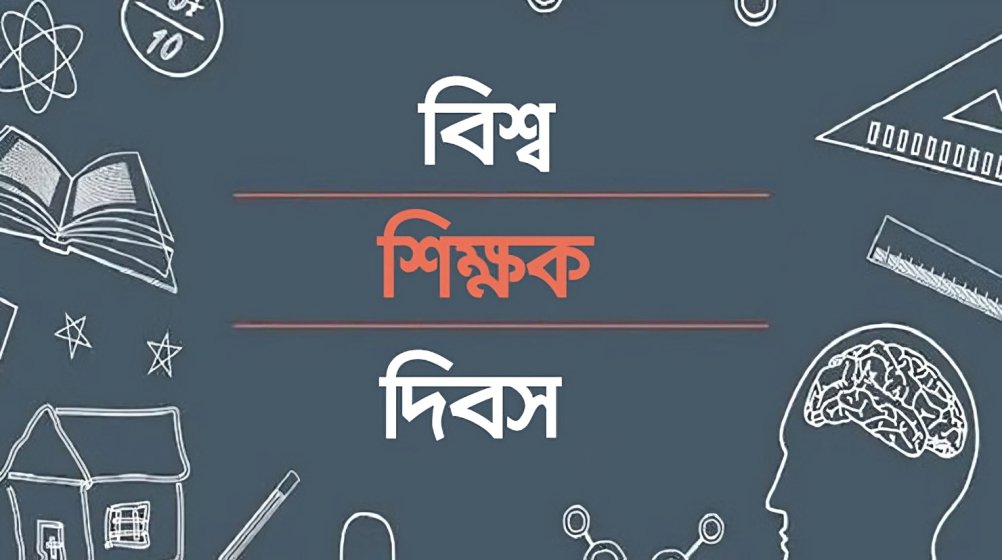
‘Standing with teachers: Sixty years of protecting the profession, advancing its status, shaping our futures’ — this is the global theme set by UNESCO for 2026.
Today, 5th October, marks World Teachers’ Day. While the occasion is being celebrated with genuine warmth across the globe, in our homeland, today feels like little more than a hollow charade. This year’s observance carries a particular historical weight worldwide, marking 60 years since the landmark 1966 ILO/UNESCO Recommendation Concerning the Status of Teachers.
In his legendary poem, Kazi Kader Nawaz famously reflected on whether any deed on Earth could be nobler than a monarch entrusting his son’s upbringing to a teacher. For generations in Bengal, the respect commanded by an educator stood above all else. Emperor Alamgir setting an example by having his own son wash his teacher’s feet was the very bedrock of our civilised values. Yet, when we measure UNESCO’s 2026 theme against the reality on the ground in Bangladesh, it reads like a cruel irony. In a land where emperors once bowed before scholars, teachers today are being publicly degraded and harassed within their own classrooms — often at the hands of their very own students.
Pledges of Protection Versus a Grim Reality
While global forums echo with slogans about ‘protecting the profession and advancing its status’, the scene across educational institutions in Bangladesh is entirely upside down. Recent months have witnessed appalling acts across the country: teachers forced to perform sit-ups while clutching their ears, coerced into signing resignations, paraded with garlands of worn shoes around their necks, and subjected to physical violence. The very people who shape the nation’s future are falling prey to political vendettas, local power trips, and institutional anarchy.
Where the 60-year-old ILO-UNESCO recommendations demand professional security and academic freedom, Bangladeshi teachers now walk on eggshells inside their own lecture halls. Intimidated by self-serving interest groups, educators live in constant fear for their safety — a crisis that is quietly snapping the spine of the entire education system.
When news of a teacher being harassed arrives from a remote rural school, one might try to brush it off as a lack of local awareness. But when students turn on their professors at the country’s premier seat of learning — Dhaka University, long hailed as the Oxford of the East — no excuses are left to make. We have recently seen unprecedented, utterly shameful scenes where a section of students at this historic university verbally abused, publicly disgraced, and physically assaulted their own professors.
When educators who dedicate their lives to lighting the lamp of knowledge are forced to swallow the bitter pill of public disgrace in front of their pupils, it is not merely the individual teacher who is demeaned; the conscience of the entire nation hangs its head in shame. When such dark shadows fall over the grounds of an institution with a heritage as proud and progressive as Dhaka University, it shows just how deep the rot in our collective values has set. Where a teacher’s dignity is dragged through the dirt, a university degree becomes nothing more than a scrap of paper.
The Moral Decay of Students: A Dark Turn for Society
Behind these public humiliations lies a terrifying truth: the severe moral decay of a section of today’s student body. In a culture where young people once considered it a blessing to touch their teacher’s feet out of reverence, the current generation thinks nothing of laying hands on them.
The final phrase of UNESCO’s theme this year reads: ‘Shaping our futures’. But if the very architects of that future are subjected to daily psychological trauma and humiliation, what kind of future are we actually building? The finest minds are already backing away from teaching as a career. If this culture of disrespect continues, our classrooms will be left with nothing but fear and despair.
State-sponsored functions or the conferring of national honours upon a hundred distinguished teachers on World Teachers’ Day are commendable gestures. Yet, unless the state can guarantee the physical safety and fundamental dignity of every teacher in every corner of the country, these official celebrations remain empty public relations exercises.
Protecting the profession cannot be a promise confined to official paperwork; every single act of harassment against an educator must be met with swift, unyielding justice. At the same time, families and academic institutions must work hand in hand to restore basic morality in the young. To stand with teachers is to stand with civilisation and truth itself. If we fail to defend the dignity of our teachers today, our future generations will inevitably drift into an abyss of moral bankruptcy.