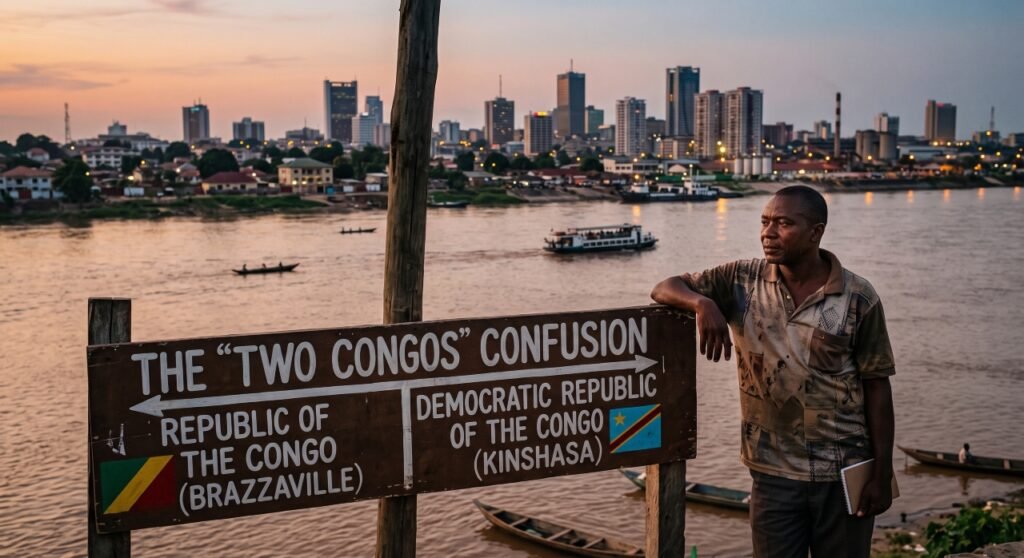
If you stand on the banks of the Congo River just as the equatorial sun begins to dip below the horizon, you are met with a sight that exists nowhere else on the planet. To your left, a sprawling, chaotic, and relentlessly energetic metropolis stretches as far as the eye can see. To your right, just across a wide expanse of churning, mud-brown water, lies another capital city—quieter, smaller, yet unmistakably urban.
This is the Malebo Pool, a wide lake-like section of the Congo River. The two cities facing each other are Kinshasa and Brazzaville. They hold the unique distinction of being the closest national capitals in the world, separated by a mere river but divided by history, scale, and entirely different colonial pasts.
For the casual observer, the geography of Central Africa often presents a frustrating riddle: Why are there two countries named Congo right next to each other? It is a confusion that plagues news anchors, geography students, and travelers alike. To understand the “Two Congos”—the Democratic Republic of the Congo (DRC) and the Republic of the Congo—you have to untangle a story of European colonial ambition, dramatic name changes, and the enduring power of a single, colossal river.
The River That Names Them Both
To grasp the roots of the confusion, we must start with the natural wonder that defines the entire region: the Congo River.
Winding through the heart of the continent, the Congo is the second-longest river in Africa (after the Nile) and the deepest river in the world. For centuries, before the borders of modern nation-states were ever drawn, this immense waterway was the lifeblood of the region. It was the highway for trade, the source of sustenance, and the spiritual center for the indigenous populations, notably the powerful Kingdom of Kongo that thrived near the river’s mouth.
When European explorers arrived, they named the surrounding lands after this kingdom and the river that sustained it. Thus, the name “Congo” became a geographic catch-all for the vast, uncharted (to Europeans) interior of Central Africa.
The trouble began in the late 19th century during the “Scramble for Africa.” European powers descended on the continent, eager to carve it up for their own economic gain. The Congo River basin, rich in ivory, rubber, and unexploited potential, became the grand prize.
The Scramble and the Split
The division of the Congo basin is a tale of two very different colonial ambitions.
On the southern and eastern banks of the river, King Leopold II of Belgium laid claim to a territory so massive it defied comprehension. He didn’t claim it for Belgium, however; he claimed it as his own personal, private property, ironically naming it the “Congo Free State.” This territory would eventually become the Democratic Republic of the Congo (DRC). Leopold’s rule was characterized by unimaginable brutality, forced labor, and the extraction of rubber that left millions of indigenous people dead. The international outcry eventually forced him to hand the territory over to the Belgian government in 1908, at which point it became known as the Belgian Congo.
Meanwhile, on the northern and western banks of the river, the French were staking their own claims. Led by the Italian-born French explorer Pierre Savorgnan de Brazza, the French signed treaties with local rulers and established the colony of the French Congo (later part of French Equatorial Africa). This territory would eventually become the Republic of the Congo. Brazza founded the capital city that bears his name—Brazzaville—directly across the river from the Belgian trading post that would become Kinshasa (then called Léopoldville).
And so, the two Congos were born: one Belgian, one French. They shared a name, a river, and the deep scars of colonialism, but they were ruled from entirely different European capitals with different languages, administrative styles, and economic goals.
The Name Game
If the colonial era set the stage for confusion, the post-independence era turned it into a full-blown identity crisis.
In 1960, the winds of change swept across Africa. Within months of each other, both the French Congo and the Belgian Congo declared independence. But when the newly formed governments chose their names, the world was left scratching its head.
The former French colony became the Republic of the Congo.
The former Belgian colony also named itself the Republic of the Congo.
For a brief, confusing period, there were literally two countries with the exact same name sitting next to each other. To tell them apart, the international community resorted to referring to them by their capitals: Congo-Brazzaville and Congo-Léopoldville (which later became Congo-Kinshasa).
In 1971, the leader of Congo-Kinshasa, Mobutu Sese Seko, decided to clear up the confusion and distance his country from its colonial past. He embarked on a campaign of “Authenticité” and renamed the country Zaire. For over two decades, the “Two Congos” confusion was temporarily resolved. You had Zaire (the massive one) and the Republic of the Congo (the smaller one).
However, in 1997, Mobutu was overthrown by Laurent Kabila. Kabila promptly erased the name Zaire and rebranded the country as the Democratic Republic of the Congo (DRC).
And just like that, the confusion was back. Today, we have the Republic of the Congo (Congo-Brazzaville) and the Democratic Republic of the Congo (DRC or Congo-Kinshasa).
David and Goliath
Beyond their names, perhaps the most striking difference between the two nations is their sheer scale. It is a true David and Goliath scenario.
The Democratic Republic of the Congo (DRC – Kinshasa):
The DRC is a titan. It is the second-largest country in Africa by land area (after Algeria) and the 11th largest in the world. It covers over 2.3 million square kilometers—roughly the size of Western Europe. Its population is equally massive, estimated at over 100 million people. Kinshasa alone is a megacity of over 17 million residents, making it the largest Francophone city in the world, surpassing even Paris.
The Republic of the Congo (Congo-Brazzaville):
By contrast, the Republic of the Congo is relatively diminutive. It covers about 342,000 square kilometers (roughly the size of Germany) and has a population of just around 5 to 6 million people. Brazzaville is a much quieter, more laid-back capital with a population hovering around 2.5 million.
Looking across the river from Brazzaville at night, the glowing, sprawling skyline of Kinshasa feels like looking at an entirely different universe, a testament to the staggering demographic divide between the two neighbors.
Wealth Beneath the Soil
Both countries are blessed—and cursed—by extraordinary natural wealth, but the nature of that wealth differs significantly.
The Republic of the Congo (Brazzaville) relies heavily on offshore oil. It is one of sub-Saharan Africa’s top oil producers. While this has generated significant revenue for the state and given the country a relatively higher GDP per capita than the DRC, the wealth is highly concentrated, and the economy remains vulnerable to the boom-and-bust cycles of global oil prices.
The DRC (Kinshasa), on the other hand, is arguably the most mineral-rich country on Earth. Beneath its soil lies an estimated $24 trillion worth of untapped mineral deposits. It is the world’s leading producer of cobalt (essential for electric vehicle batteries and smartphones) and a major source of copper, diamonds, gold, and coltan. However, this staggering wealth has been the source of endless conflict. The DRC has endured decades of political instability, civil war, and exploitation by both domestic armed groups and foreign interests, preventing the vast majority of its citizens from seeing the benefits of their own land.
A Shared Ecological Heritage
Despite their political and historical differences, the two Congos share a vital responsibility: protecting the Congo Basin.
This vast expanse of tropical rainforest is the second-largest in the world, trailing only the Amazon. It spans across both borders, serving as the “second lung” of the planet and playing a critical role in regulating the global climate.
Both nations are home to some of the world’s most endangered and charismatic megafauna. In the DRC, you can find the legendary mountain gorillas in Virunga National Park, as well as the elusive okapi. Across the river in the Republic of the Congo, conservation areas like Nouabalé-Ndoki National Park offer sanctuaries for western lowland gorillas and forest elephants.
In recent years, ecotourism has slowly begun to take root, offering a sustainable alternative to logging and mining. For adventurous travelers, these dense, misty jungles offer an unfiltered look at Africa’s wild heart.
The Bottom Line: How to Tell Them Apart
If you ever find yourself struggling to remember which is which, here is a quick cheat sheet:
-
DRC (Democratic Republic of the Congo): The massive one. Formerly Zaire. Capital is Kinshasa. Famous for minerals (cobalt, copper) and mountain gorillas. Colonized by Belgium.
-
Republic of the Congo: The smaller one. Capital is Brazzaville. Famous for oil and lowland gorillas. Colonized by France.
While the “Two Congos” confusion will likely persist in trivia nights and geography quizzes for decades to come, the reality on the ground is a tale of two distinct, fiercely independent nations. They may share a river, a name, and a language, but their stories, struggles, and futures are uniquely their own.