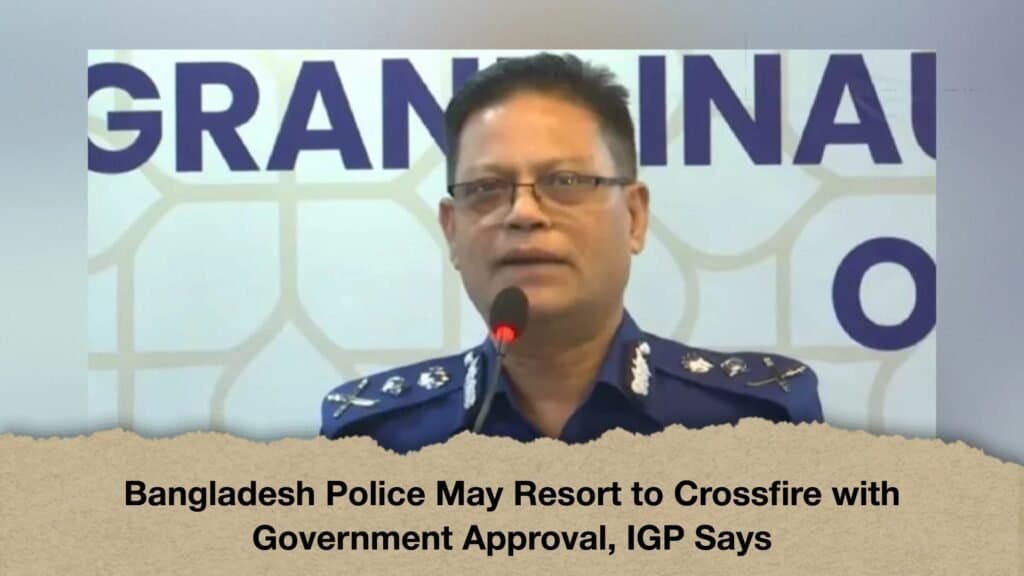
He made the remarks on Monday, 26 October, at the formal inauguration of the ‘Community Islamic Bank System’ in Chawkbazar, Dhaka.
The police chief also defended the role of law enforcement in maintaining public order, arguing that personal freedom does not give anyone the right to act without restraint. He called on citizens to respect the law and refrain from taking matters into their own hands.
“People need the police to live in peace and security. Freedom does not mean that anyone can do whatever they want,” Fakir said.
He also urged the public not to place the blame on the police whenever an incident occurs, without considering the circumstances.
Addressing questions surrounding political developments, the IGP said decisions about who might return to the country, when they might do so, or what might happen politically were not the primary concern of law enforcement agencies. Their responsibility, he said, was to apply the law and the Constitution wherever necessary.
“Our responsibility is to take whatever measures are required under the law and the Constitution. If crossfire is necessary and the government allows it, we will do so,” he said.
His comments have drawn attention to the use of force in law enforcement and the legal limits governing police operations. However, he did not elaborate on the circumstances in which crossfire might be considered or explain the specific legal basis for such action.
IGP Alleges Political Backing for Drug Trade
Fakir also expressed concern about the spread of drugs in neighbourhoods across Bangladesh, alleging that figures associated with the former ruling Awami League had helped foster the problem.
He acknowledged that some members of the police force had also been involved in drug-related activities, adding that some were allegedly still connected to such practices.
“Today, drugs are widespread at gatherings in neighbourhoods and local communities. Who created this situation?” he asked.
The IGP alleged that leaders of the then ruling party had provided support that contributed to the spread of drugs. He also admitted that certain police personnel had been involved, suggesting that the problem had not been entirely eliminated.
His remarks highlighted concerns about possible links between drug trafficking, political influence and misconduct within law enforcement agencies. However, he did not name specific individuals or provide details of particular cases to substantiate the allegations made at the event.
Drug trafficking and the alleged protection of criminal activities by influential individuals pose challenges for law enforcement. Tackling such problems requires investigations that establish individual responsibility and ensure that allegations are dealt with through the appropriate legal process.
Around 27 Police Officers Sent to Jail in Two Months
The IGP said action had been taken against members of the police force as part of efforts to address misconduct within the organisation.
According to Fakir, around 27 police officers had been sent to jail over the previous two months.
He presented the action as evidence that the police were seeking to address wrongdoing within their own ranks rather than focusing solely on crimes committed by members of the public.
“We have sent around 27 police officers to jail in the past two months. You are seeing that we are cleaning up our own house first,” he said.
He also complained that the measures had been subject to various interpretations that, in his view, misrepresented the steps being taken.
The IGP did not disclose the names of the officers, the allegations against them or the current status of their cases. Their detention or imprisonment does not, by itself, establish guilt; the outcome of each case depends on the relevant judicial proceedings.
Accountability and the Limits of Police Powers
Fakir’s remarks focused on three issues: firm action against crime, public responsibility to obey the law and efforts to maintain discipline within the police force.
His acknowledgement that some police personnel had been involved in drug-related activities also underscored the importance of accountability within law enforcement. Allegations of misconduct involving officers require credible investigations and appropriate action under the law.
At the same time, the IGP’s comments on crossfire raise questions about the limits of police powers. The use of force by law enforcement agencies must be assessed against applicable legal requirements and constitutional protections, including the right to life and safeguards against unlawful force.
Although Fakir said police would act in accordance with the law and the Constitution, he did not provide a detailed explanation of how his comments on crossfire would apply in practice.
The remarks at the Chawkbazar event therefore combined a warning against unlawful behaviour by citizens with a pledge to take action against misconduct within the police force. They also placed renewed focus on how Bangladesh’s law enforcement agencies balance crime prevention, the use of force and institutional accountability.