Bangladesh’s spending on petroleum imports more than doubled in the 2025–26 financial year, driven by sharp increases in international fuel prices and heightened demand amid growing geopolitical tensions in the Middle East.
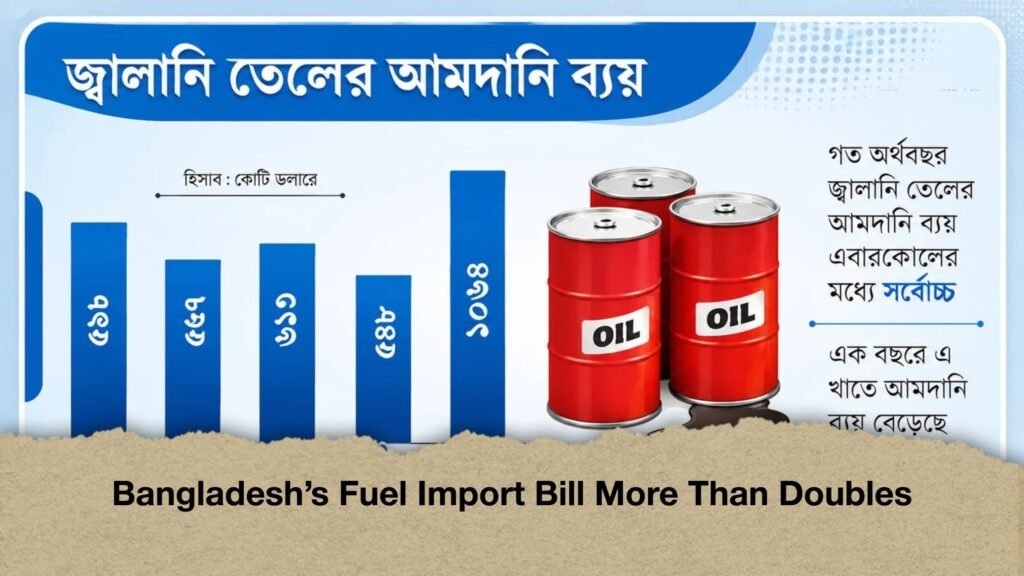
According to Bangladesh Bank data, the country spent around US$10.64 billion on petroleum products during the financial year ended June 2026, compared with less than US$5.14 billion in 2024–25. The increase was about US$5.50 billion, representing a rise of 107 per cent in a single year.
The surge in fuel costs was the main factor behind the overall increase in Bangladesh’s import bill. Total import expenditure rose to US$75.24 billion in 2025–26 from US$68.35 billion a year earlier, an increase of US$6.89 billion, or 10.07 per cent. Petroleum imports alone accounted for most of that additional spending.
Refined fuel accounted for the largest share of the increase. Bangladesh spent US$9.44 billion on refined petroleum products in 2025–26, up from US$4.51 billion in the previous financial year. That represents an increase of more than 109 per cent.
Spending on crude oil also rose sharply. Imports of crude petroleum cost US$1.20 billion in 2025–26, compared with US$620 million a year earlier, marking a rise of around 92 per cent.
The latest figure is the highest annual expenditure Bangladesh has recorded on fuel imports. Before this, the previous peak was US$7.99 billion in 2021–22, when global energy markets were disrupted by the economic effects of the Covid-19 pandemic and the Russia-Ukraine war. The bill subsequently fell to US$5.77 billion in 2022–23 before rising again to US$6.13 billion in 2023–24.
The latest increase has come amid renewed instability in the Middle East. According to people familiar with the situation, attacks involving Iran since February have contributed to heightened uncertainty across the region and increased pressure on international energy markets. For an import-dependent economy such as Bangladesh, movements in global oil prices can quickly translate into higher foreign-exchange expenditure.
The pressure became particularly visible towards the end of the financial year. Bangladesh spent US$1.6033 billion on fuel imports in June alone, while the average monthly expenditure during the 12 months of 2025–26 was around US$886.2 million. The June figure was therefore substantially higher than the annual monthly average.
The higher fuel bill is also affecting the wider economy. Rising energy costs increase expenses for industries, transport operators and other businesses that depend on petroleum products. Manufacturers can face higher production costs, while disruptions in fuel availability can affect regular industrial operations. Such cost pressures can eventually feed into the prices of goods and services, adding to inflationary pressures.
Despite the sharp rise in petroleum expenditure, import spending on some essential consumer goods declined. Bangladesh spent US$5.03 billion on imports of commodities including edible oil, sugar, pulses, spices, milk and cream in 2025–26, down from US$5.68 billion a year earlier. The reduction was around US$350 million, or 11.40 per cent.
Rice imports also became less expensive. Spending on rice imports fell by roughly 22.5 per cent to below US$530 million, from more than US$680 million in the previous financial year. Wheat imports, however, moved in the opposite direction. Expenditure on wheat rose by 26.10 per cent to US$2.05 billion from US$1.62 billion.
Bangladesh’s foreign-exchange position has improved despite the higher import bill. A Bangladesh Bank official said the taka-dollar exchange rate had remained broadly within the range of Tk122 to Tk124 per US dollar for an extended period, while importers were not facing significant difficulties in obtaining dollars. Strong remittance inflows have played a major role in easing pressure on the foreign-exchange market, according to the official.
Bangladesh’s gross foreign-exchange reserves stood at US$37.24 billion on Monday, while reserves calculated under the International Monetary Fund’s BPM6 methodology stood at US$32.44 billion. The BPM6 figure had fallen to US$20.48 billion around the time of the fall of the previous Awami League government. Reserves had previously exceeded US$48 billion in August 2021 before declining amid various economic pressures, including increased concerns over illicit financial outflows.
Import trends in other sectors were mixed. Imports of products related to the ready-made garment industry fell by 4 per cent to US$17.70 billion during 2025–26. By contrast, imports of other intermediate goods increased by nearly 9 per cent to US$19.35 billion.
Imports of capital machinery and other capital goods also increased by more than 7 per cent to US$10.23 billion. Imports classified under other goods rose by more than 3 per cent to US$9.71 billion. The increase in capital-goods imports suggests some areas of industrial and business activity continued to require imported equipment, even as overall investment conditions remained subdued.
Bankers, however, say private-sector investment has yet to recover sufficiently. Gas and electricity shortages, high interest rates and concerns over law and order have been cited among the factors discouraging stronger investment activity. Private-sector credit growth has consequently fallen to 4.47 per cent, described as the lowest level on record.
The relatively comfortable position in the foreign-exchange market is partly linked to subdued investment demand and tighter measures against illicit capital outflows. While this has reduced some pressure on dollars, bankers caution that maintaining stability over the longer term will require stronger export earnings alongside continued growth in remittances.
The latest fuel-import figures highlight a difficult balance for Bangladesh. Higher international energy costs are increasing the country’s foreign-exchange expenditure at a time when businesses are already dealing with elevated production costs and weak investment demand. Maintaining adequate fuel supplies while containing inflation and protecting external-sector stability will therefore remain a major economic challenge.
For a sustainable improvement in the balance of payments, policymakers and businesses will need to focus not only on managing fuel-import costs but also on expanding exports, sustaining remittance flows, encouraging productive investment and preventing the kind of illicit capital outflows that contributed to earlier pressure on foreign-exchange reserves.