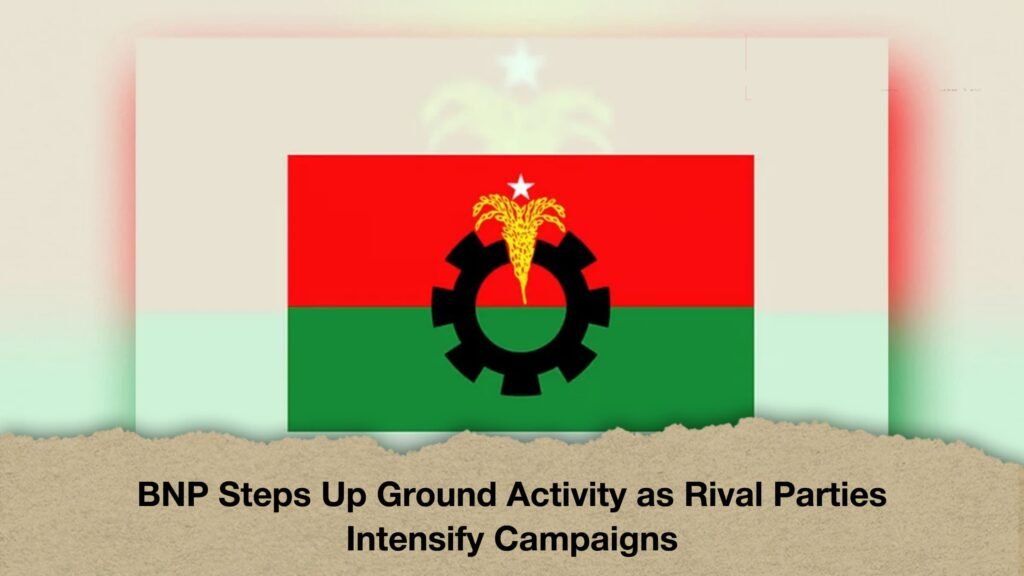
The Bangladesh Nationalist Party (BNP) is increasing its political and organisational activities as opposition parties led by Jamaat-e-Islami continue a series of programmes and the Awami League remains politically active in different parts of the country.
Party sources say organisational instructions have been issued to prepare for counter-programmes, while rallies and processions have already been held in Dhaka and elsewhere without always being announced in advance. BNP leaders, however, reject the suggestion that the party is acting under pressure from rival opposition groups. They say the activities are aimed at responding to what they describe as misinformation from opponents and countering the political activities of the Awami League.
The latest mobilisation comes amid wider economic pressures and growing public concern over the cost of living. The sudden increase in fuel prices has added to the BNP’s internal concerns, according to several party leaders. Jamaat-e-Islami, the National Citizens Party (NCP) and several other opposition groups were already holding programmes on issues including the energy crisis, commodity prices, law and order and corruption. The fuel-price increase has now given those parties another issue around which to mobilise.
BNP strengthens organisational preparations
According to BNP sources, the party has instructed its district and metropolitan units to intensify organisational activity and remain prepared for political programmes at short notice.
Recent rallies and processions in Dhaka and other parts of the country are being viewed within the party as part of that broader effort. Some have been described by party insiders as ‘unannounced’ programmes, reflecting the BNP’s intention to maintain a visible presence on the streets while also responding to developments involving rival political groups.
The party recently held a virtual meeting with leaders from the Chattogram division. The meeting was attended by BNP Standing Committee member and the Prime Minister’s political adviser Nazrul Islam Khan, Acting Secretary General Ruhul Kabir Rizvi and Special Secretary Belayet Mridha.
A similar meeting with leaders from the Dhaka division is expected, according to party sources. Tarique Rahman, the party chairman and Prime Minister, may also take part.
The emphasis on meetings with regional leaders suggests that the BNP is seeking to keep its grassroots organisation active while the government simultaneously deals with economic and administrative pressures. The party’s recent activities also indicate that maintaining political visibility outside formal government functions has become a priority.
Fuel prices add a new issue to opposition programmes
Opposition activity had already intensified before the latest rise in fuel prices.
An 11-party alliance led by Jamaat-e-Islami held long marches from Dhaka to Chattogram on 5 September and from Dhaka to Rangpur on 19 September. The programmes focused on demands including an end to the energy and electricity crisis, control of commodity prices, improvements in law and order, and action against corruption and extortion.
The alliance’s co-ordinator, AHM Hamidur Rahman Azad, said the continuing programmes were putting pressure on the government.
The political situation became more contentious after fuel prices were raised on 21 September. The prices of diesel, petrol, octane and kerosene were each increased by Tk20 a litre.
The move triggered protests by Jamaat-e-Islami, the NCP, Khelafat Majlis and Islami Andolan Bangladesh, among other groups. Their argument has been that households are already struggling with high prices and that more expensive fuel will raise costs across transport, agriculture, industry and the wider supply chain.
The issue is particularly significant because diesel is widely used for transport, irrigation and industrial activity. An increase in fuel costs can therefore feed into the prices of goods and services beyond the petrol station.
Government cites international market pressures
The government has defended the fuel-price adjustment by pointing to higher international energy and transport costs following the conflict in the Middle East.
It has also raised concerns about fuel being smuggled across the border if domestic prices remain substantially below those in neighbouring countries.
State Minister for Energy Anindya Islam said that without the price increase, the financial burden from diesel alone could have reached around Tk40,000 crore a year, while the combined subsidy or loss on petroleum products could have approached Tk50,000 crore.
Mohammad Hatim, president of the Bangladesh Knitwear Manufacturers and Exporters Association (BKMEA), acknowledged that rising global fuel prices had left the government with limited room for keeping domestic prices unchanged. He nevertheless argued that the increase had been too steep, particularly for diesel, and said a smaller rise could have reduced pressure on consumers and industries.
He also called for faster adjustment if international fuel prices subsequently fall.
BNP says its activities are not driven by pressure
Ruhul Kabir Rizvi has repeatedly argued that the government should not be blamed entirely for the rise in fuel prices, pointing to the Middle East conflict and conditions in international energy markets.
He has said that even after the price adjustment, the government would continue to incur a substantial loss on diesel.
Rizvi has also rejected the suggestion that the BNP is increasing its political activity because rival opposition parties have gained momentum. According to him, the party’s programmes are intended to counter what it considers misleading political campaigns and to present its position directly to the public.
He has also accused the Awami League of attempting to create instability through violence and arson, including incidents involving buses and trains. Those allegations are political claims made by BNP leaders and would need to be assessed separately on the basis of evidence and investigations into individual incidents.
The BNP’s position, therefore, is that its recent street activity is primarily a response to the political environment rather than an attempt simply to match the programmes of other opposition parties.
Jamaat offers a different interpretation
Jamaat-e-Islami’s position differs from the BNP’s explanation.
AHM Hamidur Rahman Azad has said the energy crisis affects both the government and opposition parties and that his party’s programmes are not intended merely to create pressure on the authorities. He described the protests as an effort to push the government towards solutions and greater accountability.
The difference in interpretation reflects a broader political contest over economic management. While the government has emphasised international market conditions and the financial burden of subsidising fuel, opposition parties have focused on the immediate impact of higher prices on households and businesses.
The fuel-price decision has consequently become more than an economic issue. It has also become a prominent subject of political mobilisation.
For the BNP, the challenge is now twofold: maintaining organisational cohesion and a visible presence in the field while addressing criticism over economic conditions and the rising cost of living. For rival opposition groups, fuel prices and energy shortages provide an opportunity to connect wider economic grievances with their political demands.
With opposition programmes continuing and the BNP strengthening its grassroots activities, Bangladesh’s political arena is becoming increasingly active around issues of fuel prices, living costs, law and order and political stability. The competing parties are offering different explanations for the country’s current pressures, leaving the coming period likely to remain closely focused on both economic management and street-level political activity.