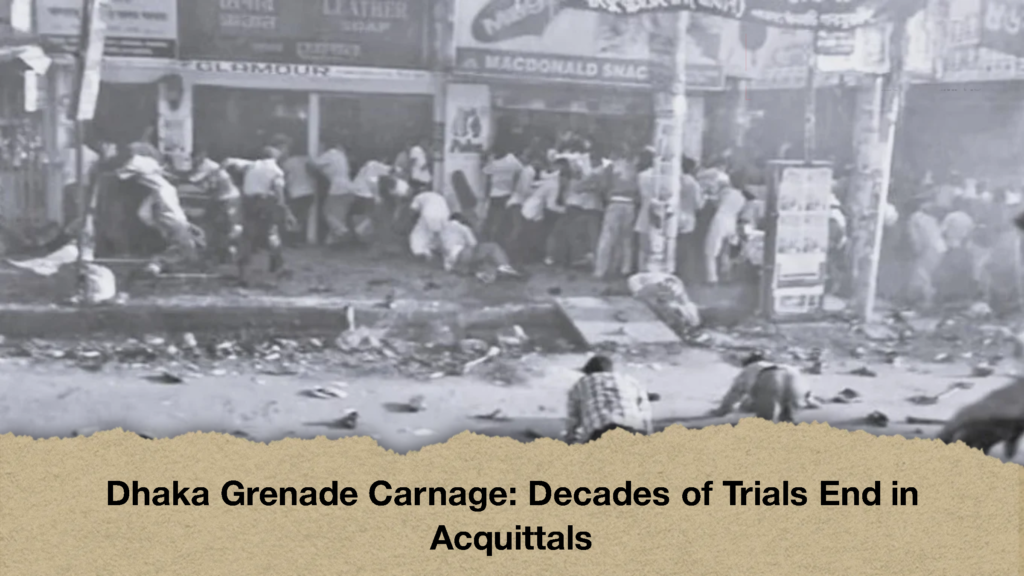
The bloody carnage of 21 August 2004 remains one of the darkest and most consequential chapters in the political history of Bangladesh. On that sweltering afternoon, a synchronised salvo of military-grade Arges grenades tore through an anti-terrorism rally organised by the Awami League on Bangabandhu Avenue in central Dhaka. The assault claimed 24 lives, including Ivy Rahman, the party’s women’s affairs secretary and wife of the late president Zillur Rahman, whilst leaving hundreds severely maimed. Sheikh Hasina, then leader of the opposition, narrowly escaped assassination as party stalwarts formed a desperate human shield around her truck-top podium. What followed was an arduous, convoluted legal saga spanning over two decades, culminating not in definitive accountability, but in a profound judicial vacuum where all 49 individuals previously convicted now stand formally acquitted.
On 1 December 2024, the High Court struck down the 2018 verdicts delivered by Dhaka Speedy Trial Tribunal-1, citing grave procedural irregularities, a lack of credible corroborating material, and confessional statements tainted by coercion. The state pursued an appeal, yet on 4 September 2025, the Appellate Division affirmed the acquittals across the board. The apex court also dismissed the High Court’s recommendation for a fresh, specialised investigation, observing that such a directive amounted to an unwarranted judicial encroachment on executive policymaking. With that decision, the overarching legal framework constructed over two decades of shifting political administrations unravelled entirely.
The inquiry’s earliest phase under the Bangladesh Nationalist Party-led coalition government quickly drew public scepticism through the orchestration of the infamous “Joj Mia” narrative. State investigators presented Jalal Ahmed, an impoverished youth from Noakhali, extracting a coerced confession that framed him as a key operational figure. Subsequent probes thoroughly discredited this version, revealing that senior police and intelligence personnel had deliberately fabricated evidence to derail the pursuit of the actual perpetrators.
A decisive turning point came between 2007 and 2008 under the military-backed caretaker regime. In June 2008, the Criminal Investigation Department submitted a charge sheet implicating 22 individuals, primarily members of the outlawed outfit Harkat-ul-Jihad al-Islami Bangladesh alongside its chief, Mufti Abdul Hannan. Following the Awami League’s return to power, a supplementary investigation culminated in 2011 with 30 additional names added to the docket. The revised indictment broadened the case into an alleged tripartite conspiracy connecting militant operatives, top-tier political figures—such as Tarique Rahman, former state minister for home affairs Lutfozzaman Babar, and former deputy minister Abdus Salam Pintu—and senior administrative officials accused of sheltering the attackers.
In October 2018, the trial court handed down 19 death sentences, 19 life terms, and prison sentences for 11 others. That sweeping judgment, however, failed to survive appellate scrutiny.
Upon re-examination, the higher courts identified fundamental evidentiary deficiencies. The prosecution had failed to establish direct, unimpeachable proof tracing the precise provenance, logistical chain, and deployment of the grenades. Furthermore, the confessional statements recorded under Section 164 of the Code of Criminal Procedure had been formally retracted, casting doubt over their voluntariness. The prosecution’s case suffered an irreparable structural blow because Mufti Hannan had been executed in a separate terrorism case prior to undergoing mandatory examination under Section 342 in this trial.
The judicial clean slate does not imply that the horror of that August afternoon was imaginary. The bloodshed, physical trauma, and national shock remain indisputable historical realities. The courts ruled strictly on the standard of legal proof, finding that criminal liability had not been established beyond reasonable doubt against the individuals arraigned.
Mounting an independent inquiry today confronts daunting practical obstacles. Physical evidence has degraded, key witnesses and accused persons have died, memories have faded, and veteran investigators have long since retired. Two decades after the explosions echoed across Bangabandhu Avenue, the tragedy endures: an undeniable atrocity, lingering grief for the victims, and no legally recognised culprits.