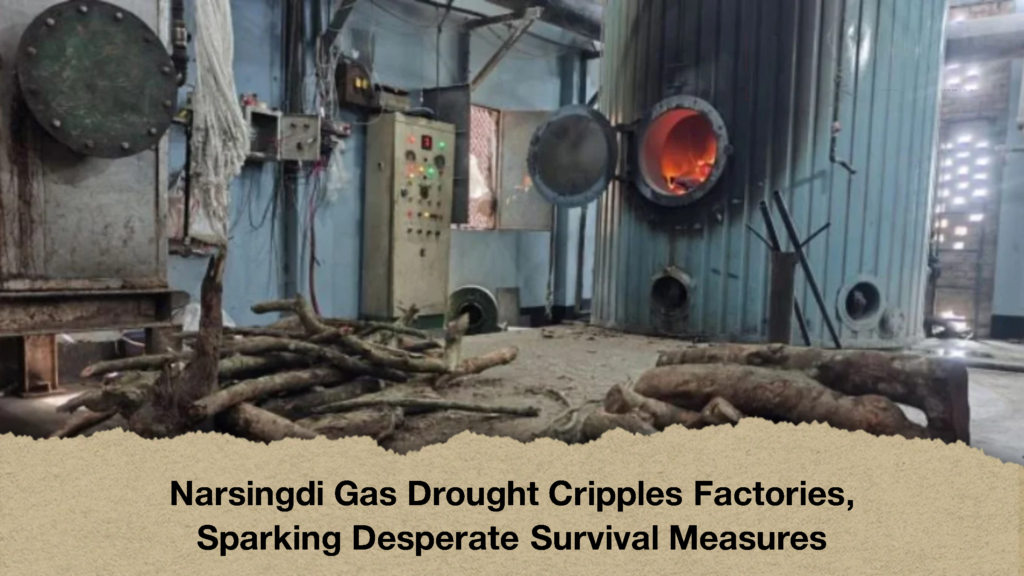
An acute breakdown in pipeline gas supply has brought industrial hubs across Narsingdi to an effective standstill, forcing over 100 manufacturing establishments to suspend operations entirely. Faced with mounting delivery deadlines and heavy financial liabilities, at least 50 factory owners have turned to burning raw firewood in steam boilers to keep a fraction of their capacity operational.
The severe pressure drop has hit yarn-processing sizing units hardest. These facilities depend on continuous steam generation to treat threads before weaving. With natural gas lines virtually dead, operators now spend more than 10,000 Taka per day on firewood alone. At the Chouwala industrial hub, workers at prominent plants including Hoque Textile and Uniphil Textile Mills shovel logs into furnaces around the clock. Boiler technicians noted that fabric scraps from garment factories were previously used during intermittent shortages, but sharp price hikes in the scrap market have left timber as the only viable stopgap.
According to Aslam Fakir, general secretary of the Chouwala Textile Mill Owners’ Association, industrial processes like sizing and dyeing cannot function viably on improvised fuel sources. The resulting paralysis causes an estimated 300 crore Taka in combined business losses every single day.
The industrial fabric of Narsingdi comprises more than 4,000 manufacturing enterprises, with roughly 3,000 units concentrated in textiles, dyeing, sizing, spinning, and apparel production. Among these, around 400 major units rely exclusively on pipeline gas, which requires a steady operating pressure of 10 to 15 PSI to sustain standard manufacturing runs. The disruption began brewing in the first week of August before culminating in an outright collapse in line pressure over recent days. Production output across surviving units has plummeted by up to 70 per cent, whilst some plants run at a mere 10 per cent efficiency amid skyrocketing production costs.
Export-oriented manufacturing has suffered the sharpest blow. At Momin Textile Mills, one of the oldest and largest operations in Chouwala, seven out of ten production units sit completely idle. The enterprise demands 22,000 to 23,000 cubic feet of gas daily to function normally, yet it receives barely 8,000 to 10,000 cubic feet. Despite possessing a daily manufacturing capacity of 2.5 million yards of fabric destined for garment hubs in Sri Lanka and Vietnam, output has collapsed to a minuscule 20,000 yards per day. Nearly 1,500 of the mill’s 2,500 workers currently have no work to perform, though management has retained them on payroll to avoid losing skilled staff.
Masudur Rahman, managing director of Momin Textile Mills, explained that the company managed to satisfy international orders through July, but August brought unprecedented delays. A backlog of two million yards in overseas orders remains stranded on factory floors. Switching to liquefied petroleum gas remains an alternative, but it would inflate production costs by at least 2.5 Taka per yard. Meanwhile, foreign buyers are continuously questioning local energy reliability, stoking fears that key contracts may be permanently reallocated to other nations.
Downstream operations have suffered severe knock-on effects. At Al Madina Textile Mills, which sources treated yarn from sizing facilities to weave grey fabric for subsequent dyeing, production plunged from 100,000 yards daily to under 30,000 yards. The company has slashed its work schedule from two shifts to a single shift and sent nearly 100 of its 150 workers on mandatory leave to curb financial bleeding.
Official figures from the Narsingdi office of Titas Gas Transmission and Distribution Company reveal that the district requires roughly 130 million cubic metres of natural gas per month to support domestic, commercial, and heavy industrial users, including the Ghorashal-Palash Fertiliser Complex. Deliveries during the ongoing shortfall have dropped to less than half of that aggregate demand. While utility managers anticipate gradual improvements in the coming days, factory floors across the district remain dependent on chopped timber to survive.