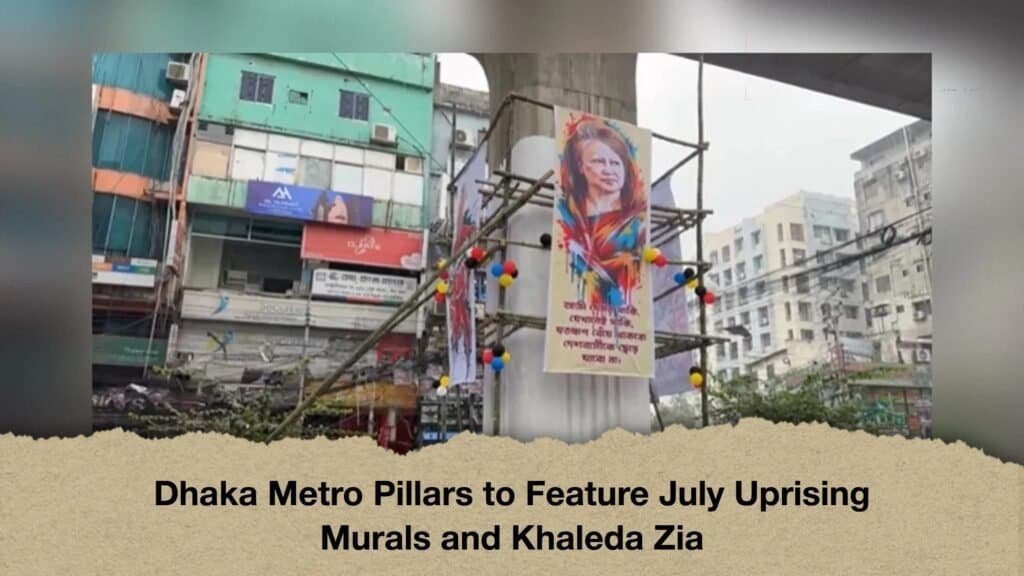
Dhaka North City Corporation (DNCC) has launched a campaign to repaint the metro rail pillars in Mirpur with graffiti commemorating the July uprising, including images of former Prime Minister Khaleda Zia and figures associated with the movement.
The campaign, titled ‘Let’s Remake July Graffiti’, was inaugurated on Friday, 9 October, by DNCC Administrator Md Shafiqul Islam. The initiative aims to transform the pillars into spaces for public art while preserving the memory of the July movement and recognising the contributions of those involved.
According to the city corporation, residents will be invited to participate in painting the murals. DNCC will provide the necessary materials, including paint and brushes, to facilitate public involvement.
The initiative follows an earlier drive to remove posters from the metro rail pillars within 72 hours. Speaking at the inauguration, Shafiqul Islam said the task had been completed ahead of the deadline with assistance from local political leaders, particularly members of Jatiyatabadi Chhatra Dal, Jubo Dal and Swechchhasebak Dal.
He said the removal of posters had paved the way for the next phase of the plan: replacing them with graffiti that reflects significant events and contributions associated with the July uprising.
“We wanted to ensure that those who have sacrificed their lives or contributed to the making of Bangladesh’s history continue to have a place in people’s hearts,” he said, explaining the rationale behind the initiative.
Khaleda Zia to Be Featured in the Murals
One of the campaign’s notable features will be the inclusion of Khaleda Zia, the former prime minister and Bangladesh Nationalist Party (BNP) chairperson.
Shafiqul Islam described her as a significant figure in Bangladesh’s political history and said the DNCC had decided to include her image on the metro rail pillars. He also attributed a major role to her in the events leading to the July uprising, expressing his view that her contribution should be recognised.
The planned murals will also feature individuals who played leading roles in the July movement, including figures from Chhatra Dal and other political organisations. The administrator said the intention was to recognise contributions to the country’s history through visual representations rather than turn the project into a political dispute.
“We will not engage in politics over this initiative,” he said, adding that the murals would reflect the respective contributions of those whose roles deserved to be recorded in history.
The proposed artwork is therefore expected to bring together representations of the July uprising and prominent political figures, although the DNCC has not announced a complete list of individuals whose images will appear on the pillars.
Public Participation and Urban Beautification
The campaign also seeks to improve the appearance of a prominent part of the capital’s transport infrastructure. Metro rail pillars are highly visible along busy roads, where accumulated posters and other promotional materials can detract from the urban environment.
By removing the posters and replacing them with planned artwork, the DNCC intends to combine urban beautification with the preservation of historical memories. The decision to invite residents to participate could also provide an opportunity for community involvement in shaping public spaces.
However, details about the final designs, the selection process for individuals to be depicted and the timeline for completing the murals have not yet been announced.
The project’s implementation will determine how the different political and historical contributions are represented. For now, the DNCC’s stated aim is to turn the metro rail pillars in Mirpur into public canvases that commemorate the July uprising while giving residents an opportunity to contribute to the transformation of their city.