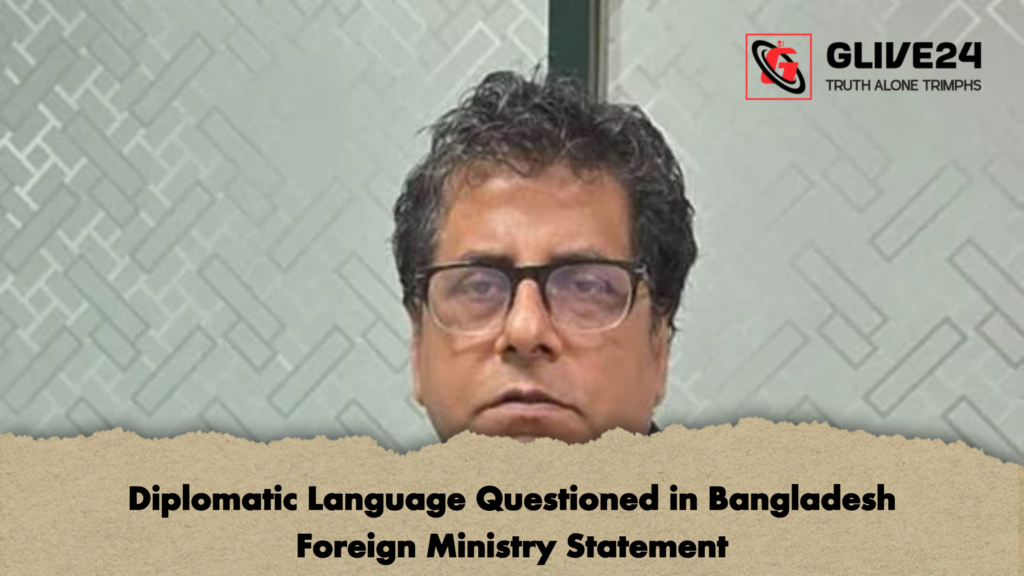
Senior journalist and former diplomatic correspondent Anis Alamgir has questioned the language used in a recent statement issued by Bangladesh’s Ministry of Foreign Affairs, arguing that while the government’s decision to object to former Prime Minister Sheikh Hasina’s appearance at a press conference in India may be justified, the wording of the official response falls short of established diplomatic standards.
In a post shared on social media, Alamgir said Bangladesh was right to communicate its concerns to neighbouring India regarding the issue. In his view, it was appropriate for the government to clarify its position on a matter it considers significant. His criticism, however, centred not on the decision to protest but on the manner in which that protest was expressed through an official diplomatic communication.
According to Alamgir, statements released by a country’s foreign ministry are expected to reflect restraint, professionalism and carefully balanced diplomatic language. Such documents are generally drafted with the intention of protecting a state’s long-term foreign policy interests while leaving room for continued dialogue between governments. He argued that the wording of the recent statement did not fully reflect those principles.
Alamgir also drew attention to the publication process of the statement. He claimed that after it was initially posted on the Ministry of Foreign Affairs’ social media page, it underwent multiple revisions. According to his account, the statement was edited at least eight times following publication. He suggested that repeated revisions to an important government communication could raise questions about the drafting, review and approval process behind such a significant diplomatic document.
He further observed that the post attracted a large number of “Haha” reactions on social media. While reactions on digital platforms do not necessarily reflect broader public opinion, Alamgir argued that such responses may indicate public debate over the tone, wording and presentation of a sensitive government message.
A significant part of his criticism focused on several English expressions used in the statement. He argued that phrases such as “Mafia enterprise”, “Henchmen”, “Venomous vitriol” and “Criminal cohort” resembled the language commonly heard in political speeches rather than that typically found in formal diplomatic correspondence.
According to Alamgir, official foreign policy communications should rely on measured language, legal reasoning and carefully documented positions. He maintained that the objective of diplomacy is not to intensify political rhetoric but to articulate a country’s interests in a manner that remains credible before the international community and preserves opportunities for future engagement.
He also questioned the broader role of a foreign ministry in representing a country’s interests abroad. In his view, the institution’s principal responsibility is not to adopt overtly political language but to communicate national positions through calm, balanced and professionally crafted diplomatic messaging. He argued that the effectiveness of diplomatic communication lies in its reliance on facts, legal arguments and carefully chosen language rather than emotionally charged expressions.
Alamgir was particularly critical of the section of the statement that reportedly characterised India’s actions as an infringement upon Bangladesh’s sovereignty. He argued that allegations of such seriousness are typically conveyed through established diplomatic mechanisms, including a note verbale or other formal government-to-government channels. Public statements, he suggested, are generally expected to complement—not replace—those official diplomatic processes. Using highly charged language in a public communiqué, he warned, could narrow the scope for constructive dialogue in the future.
He also expressed reservations about the inclusion of politically loaded expressions such as “Dark days of fascism” and “Client State”. In his assessment, terminology of this nature may blur the distinction between domestic political discourse and formal diplomatic communication. He stressed that the language used in political debate differs fundamentally from the language expected in official foreign policy documents, where precision, neutrality and restraint are traditionally regarded as essential.
Concluding his remarks, Alamgir said that even when a government wishes to express strong dissatisfaction, international diplomacy requires measured language and careful judgement. He argued that a country’s legal and political position is strengthened not by aggressive rhetoric but by disciplined, responsible and strategically crafted communication. Excessively emotional or confrontational wording, he warned, can sometimes overshadow the substance of a government’s message and potentially weaken its standing in international forums. In his view, safeguarding national interests is best achieved through professionalism, diplomatic restraint and adherence to internationally recognised diplomatic practice.