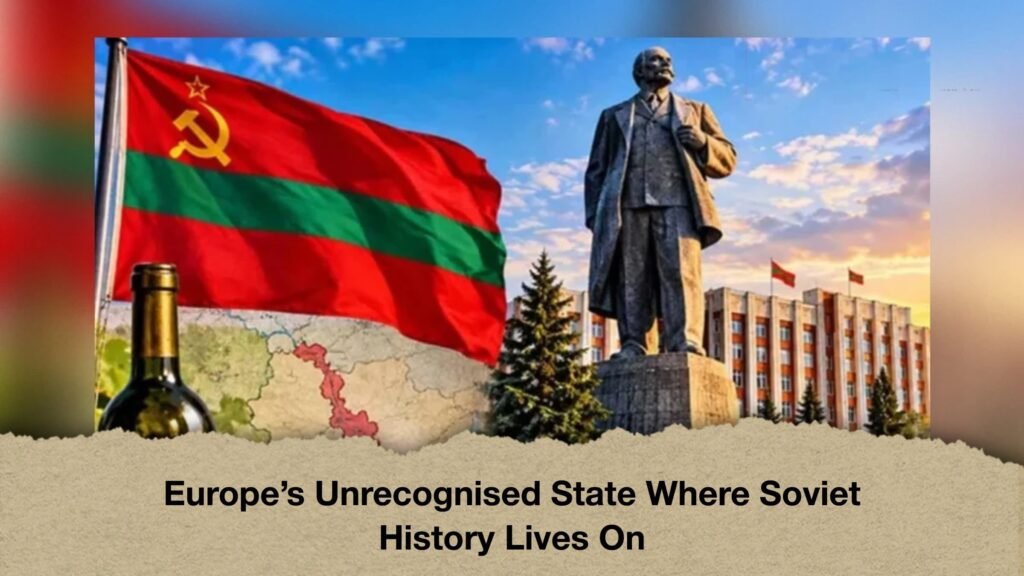
At first glance, Transnistria looks remarkably like a country. It has its own flag, currency, security forces, government institutions, border controls and even postage stamps. Yet on the international stage, it is not recognised as an independent state. The narrow territory in eastern Moldova has therefore developed a peculiar identity of its own, attracting travellers fascinated by geopolitics, Soviet history and places that exist in a grey area between statehood and territorial dispute.
Officially known as the Pridnestrovian Moldavian Republic, or PMR, Transnistria declared independence from Moldova in 1990 as the Soviet Union was approaching its collapse. The declaration was followed by armed conflict between separatist forces and the Moldovan authorities in 1992. A ceasefire ended the fighting, but no comprehensive political settlement has resolved the territory’s status.
Internationally, Transnistria continues to be regarded as part of Moldova. Even Russia does not formally recognise it as an independent country, although Moscow has maintained substantial political, economic and military influence there. Reuters reported in September 2026 that about 1,500 Russian troops remained in the region, despite Moldova’s repeated calls for their withdrawal.
That unresolved status is precisely what makes Transnistria so unusual.
Its capital, Tiraspol, often gives visitors the impression of stepping into another era. Soviet-era monuments remain prominent, including statues of Vladimir Lenin, while communist symbols can still be seen on official buildings and public sites. The streets, architecture and political iconography have helped earn the territory descriptions such as a ‘living time capsule’ of the Soviet period.
For travellers, the experience is also markedly different from visiting a conventional European destination. There is no international airport serving Transnistria, so visitors generally reach the territory by road, often travelling from Moldova’s capital, Chisinau, towards Tiraspol and other settlements. Entry procedures involve document checks at the administrative boundary, and foreign visitors need to comply with the rules applied by the local authorities.
The region’s distinctive currency is another reminder of its de facto separation. The Transnistrian ruble is used locally, alongside an administrative system that operates separately from Moldova in many areas of everyday life. The territory also maintains its own security and border structures.
Tourism has added another layer to Transnistria’s unusual reputation. Travel bloggers and independent visitors have drawn attention to its Soviet monuments, local markets, architecture and political symbolism. Unlike Europe’s heavily commercialised tourist centres, Tiraspol can appear comparatively quiet and inexpensive, making it attractive to travellers looking for an unconventional destination.
The area’s food and wine culture also reflect its wider regional heritage. Moldova and the surrounding parts of eastern Europe have long-standing traditions of grape cultivation and wine production, while local restaurants offer a mixture of influences shaped by the region’s complex history.
Yet describing Transnistria simply as an exotic tourist destination would overlook the political realities that define it.
Its location has acquired renewed strategic significance since Russia’s full-scale invasion of Ukraine in 2022. Transnistria lies close to Ukraine’s western border, while Moldova has sought closer integration with the European Union. The competing interests surrounding the territory have kept its future unresolved.
The region’s relationship with Russia remains particularly significant. Moscow provides political and economic support, while Russian military personnel remain stationed there. At the same time, Moldova continues to regard Transnistria as part of its sovereign territory and has pursued the goal of peaceful reintegration.
The issue remains sensitive enough to trigger diplomatic disputes. In September 2026, Russia’s decision to establish polling stations in Transnistria for its parliamentary election prompted objections from Moldova. Chisinau argued that elections should be held only at Russia’s embassy because Moldovan authorities have no control over procedures inside the separatist-controlled territory. Moscow rejected those objections.
For visitors, this means that the region’s apparent calm should not be confused with the disappearance of its political tensions. Transnistria may look like a functioning country in everyday life, but its international status remains fundamentally different from that of a recognised sovereign state.
That contradiction is what continues to draw attention. A traveller can see a national flag, cross a controlled boundary, use a locally issued currency and encounter institutions resembling those of a conventional country. Yet beyond the territory’s de facto structures, the international community continues to recognise the land as part of Moldova.
Transnistria, therefore, is not a country that simply vanished from the map. It is something more complicated: a self-governing, internationally unrecognised territory whose institutions have endured for decades while its political future remains unsettled. For visitors intrigued by Soviet history and Europe’s unresolved borders, that unusual combination has made Tiraspol and its surrounding territory one of the continent’s most distinctive destinations.