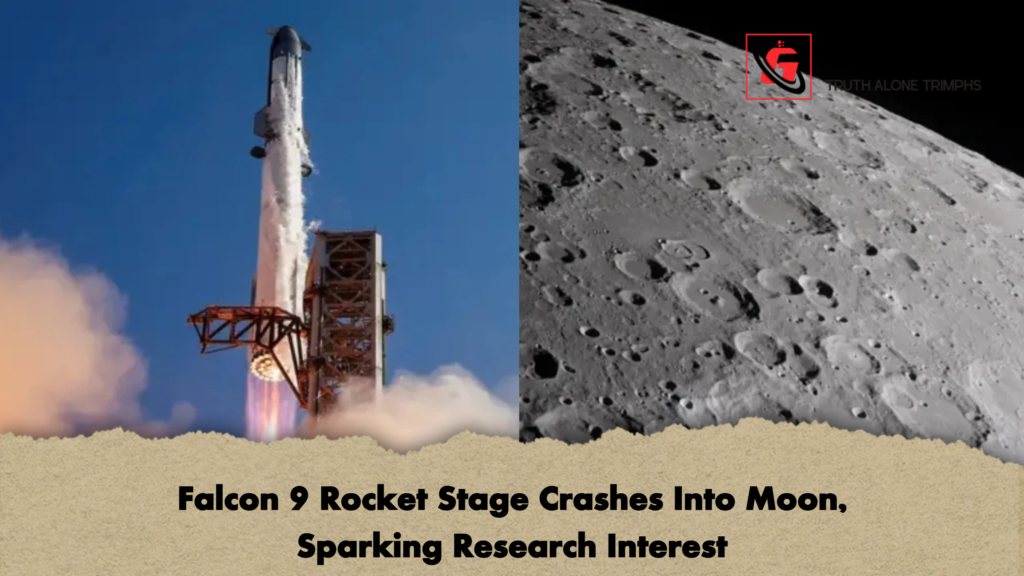
The Moon has become the site of another significant event in the history of space exploration, as scientists believe a spent upper stage of a SpaceX Falcon 9 rocket has struck its surface. Initial assessments suggest that the approximately 4,000-kilogram rocket component impacted an area near the Einstein crater, located on the Moon’s near side — the region that remains visible from Earth.
The unexpected lunar collision has drawn renewed attention from researchers around the world, particularly because it offers a rare opportunity to study the effects of human-made objects striking another celestial body. Scientists are now examining available observations, orbital calculations and telescope data to determine the exact nature and consequences of the impact.
The rocket stage was launched last year as part of a space mission. After completing its primary task, the upper stage separated from the main spacecraft as planned. Normally, such rocket components are either guided towards a controlled disposal path or placed in a designated orbit. However, in this case, the upper stage remained in space for an extended period in an uncontrolled trajectory.
Over time, gravitational influences from celestial bodies gradually altered its path, eventually sending it towards the Moon. The object continued travelling through space until it entered a collision course with the lunar surface.
The impact itself was not directly observed or broadcast live. Scientists lacked a nearby monitoring system capable of capturing real-time footage of the collision site at the moment of impact. Instead, researchers are relying on data collected before and after the event, along with telescope observations and trajectory models, to understand what occurred.
NASA spokesperson Jimmy Russell said the collision posed no threat to Earth. According to him, such an event represents a valuable scientific opportunity rather than a danger. Researchers hope the impact will provide important information about how the Moon’s surface reacts to external forces, how much dust and material are ejected during a collision, and how similar objects behave in space environments.
The findings could contribute to future lunar missions by improving spacecraft navigation methods and helping scientists better understand the challenges associated with operating around the Moon. As countries and private companies increase their lunar exploration efforts, detailed knowledge of the Moon’s environment is becoming increasingly important.
Experts believe that accidental impacts such as this one can serve as natural experiments, offering insights that would otherwise be difficult to obtain. The information gathered may prove useful as plans progress for expanded lunar activity, including long-term scientific facilities and possible future human operations on the Moon.
At the same time, astronomers have raised wider concerns about the growing problem of space debris. Astronomer Matt Bothwell warned that the number of abandoned rocket parts, inactive satellites and other fragments orbiting Earth continues to increase. If this trend continues, managing space operations safely could become significantly more difficult in the coming decades.
The growing amount of debris increases the risk of collisions in orbit, potentially threatening communication satellites, scientific missions and future crewed space flights. A major collision could create even more fragments, triggering a chain reaction that would make certain orbital regions increasingly hazardous.
Space experts argue that stronger measures are needed to ensure responsible management of used rocket components and defunct spacecraft. They emphasise the importance of international cooperation in tracking, controlling and reducing space debris.
The Falcon 9 upper-stage collision with the Moon is therefore more than an isolated scientific event. It highlights the growing need for better space management practices and raises important questions about how humanity can safely expand its presence beyond Earth while protecting the space environment for future generations.