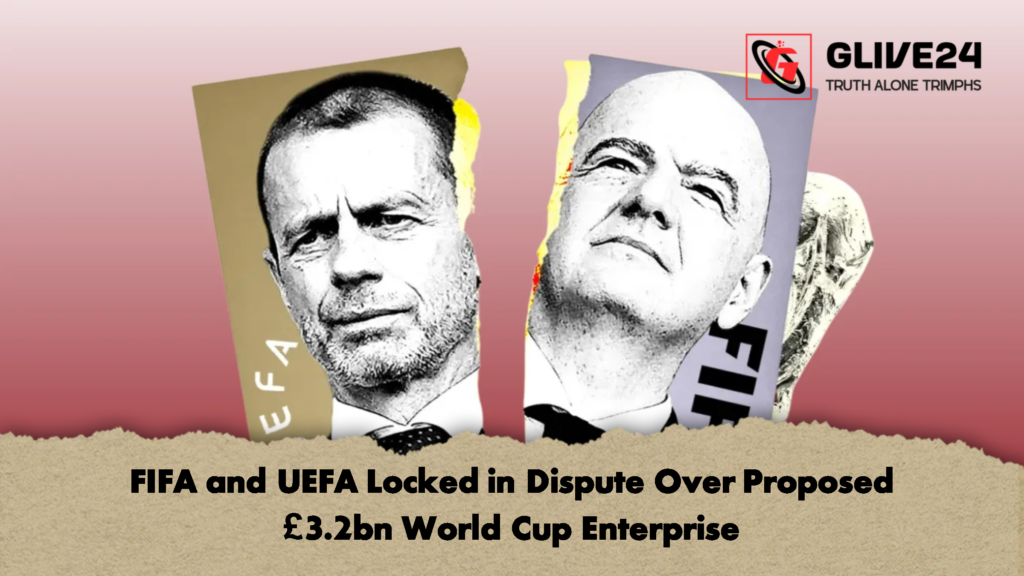
A major rift has emerged within international football administration, placing global governing body FIFA and European authority UEFA at odds over a proposal to commercialise a stake in World Cup operations.
Following the expansion of the tournament to a 48-team format, FIFA outlined plans to set up a 20-million-dollar subsidiary named “FIFA Forward Enterprise” to manage the commercial rights of its flagship event. Under the proposal, FIFA intends to sell up to a 20 per cent minority stake in the new corporate entity to private investors, seeking to raise roughly 4.2 billion USD (approximately 3.2 billion GBP) in capital. Investment banking firm JPMorgan has been engaged to identify prospective financial partners.
FIFA President Gianni Infantino presented the initiative as a significant step for football development worldwide, assuring that capital raised would be redirected back into the sport. Under the suggested allocation model, each of FIFA’s 211 member associations would receive up to 20 million USD in one-off grants for infrastructure projects, women’s football, and grassroots initiatives. That allocation is projected to rise to 24 million USD per member state between 2035 and 2038. Infantino argued that the arrangement promotes broader financial distribution and delivers critical support to smaller footballing nations.
However, UEFA has firmly rejected the proposal, maintaining that bringing private equity into tournament administration crosses established administrative boundaries. In a public statement, UEFA asserted that football’s heritage and governance cannot be treated as tradeable assets, emphasizing that no sports authority holds the mandate to sell off operational stakes in the World Cup. European officials expressed concern that introducing external commercial stakeholders could compromise the governance of the sport.
The disagreement has prompted UEFA to convene an emergency meeting with its 55 member nations this week. Reports suggest that several European member associations are prepared to discuss potential countermeasures, including a boycott of future World Cup tournaments, to oppose the scheme. A similar stance by European authorities in 2021 contributed to FIFA stepping back from its proposal for a biennial World Cup.
The debate has also drawn comment from British political figures, with Prime Minister Andy Burnham expressing clear opposition to FIFA’s approach. Writing on social media, the Prime Minister stated that the World Cup remains the world’s premier sporting competition rather than a commercial product, warning that selling equity in its operational structure risks commercialising the core identity of the sport.
While FIFA has long generated significant revenue through broadcasting, sponsorship, and ticketing, opening core commercial operations to private equity investors represents a new direction for the organisation. Opinion remains divided across the sport, with some viewing the proposed capital investment as a useful funding source for global development, while others caution that commercial profit incentives could conflict with the broader interests of the game.