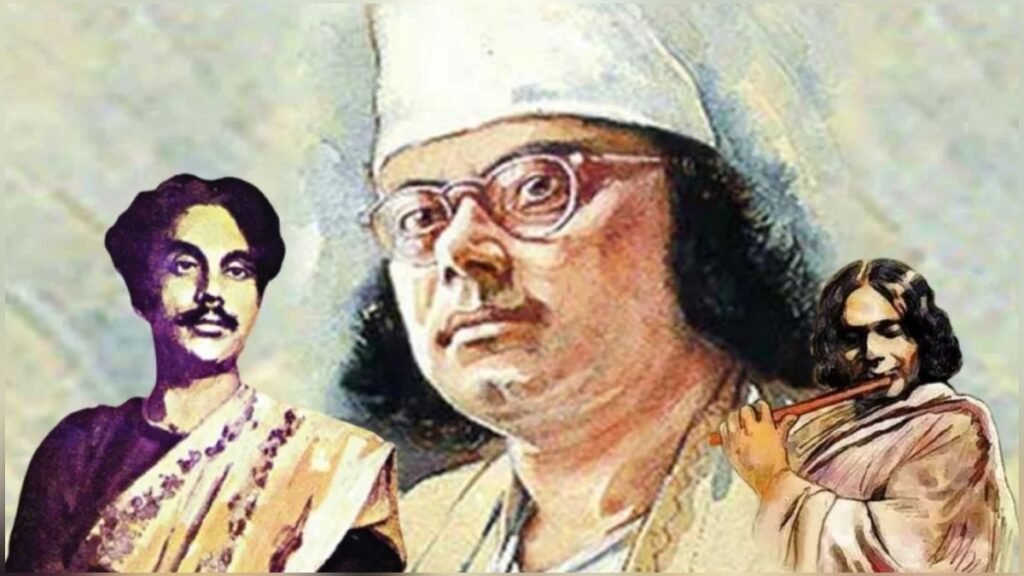
Bangladesh today marks the 50th death anniversary of National Poet Kazi Nazrul Islam, whose poetry, songs and literary works continue to shape the country’s cultural consciousness. Five decades after his death, his powerful expressions against injustice, exploitation and social inequality remain relevant to generations familiar with his work.
Nazrul died on 12 Bhadra 1383 in Dhaka, bringing to an end the life of one of the most influential figures in Bengali literature and music. He breathed his last at the then PG Hospital, now Bangladesh Medical University. He was later laid to rest beside the Central Mosque at the University of Dhaka, where his grave has become an important place of remembrance.
Born on 24 May 1899, corresponding to 11 Jaistha 1306 in the Bengali calendar, in Churulia village of Burdwan district in West Bengal, Nazrul grew up amid severe poverty. His early life was marked by hardship, but those difficulties did not prevent him from developing into a prolific writer, poet and musician.
His creative career lasted only around 23 years, yet within that relatively short period he made a lasting contribution to Bengali literature and culture. He wrote poetry, fiction, plays and essays, while also composing a vast body of songs. His works included hamd, naat, ghazal and Shyama Sangeet, reflecting the breadth of his artistic interests and his engagement with different strands of Bengali cultural life.
Nazrul’s literary identity was closely associated with rebellion and resistance. His writing challenged oppression and called for freedom, equality and human dignity. At the same time, his works explored love, spirituality and the shared humanity of people across religious and social divisions. His famous image of holding a বাঁশরী in one hand and a war trumpet in the other captured the contrasting yet complementary sides of his creative personality.
Following Bangladesh’s independence, Nazrul was brought to the country with his family on 24 May 1972 with permission from the Government of India. He was accorded the status of National Poet and was provided with a residence in Dhanmondi, Dhaka, where he lived under state arrangements.
The University of Dhaka honoured him with the honorary Doctor of Letters degree in 1974. In 1976, the Bangladesh Government granted him citizenship. He was also awarded the Ekushey Padak that year, further recognising his contribution to Bengali literature and culture.
The University of Dhaka has arranged a programme to mark the anniversary. On the morning of 12 Bhadra, its teachers, students, officers and employees will take part in a procession from the foot of Aparajeyo Bangla towards the poet’s grave. Floral tributes and Fateha will be offered there, followed by a discussion meeting at the grave complex.
Nazrul’s death five decades ago marked the end of his physical presence, but not the influence of his work. His poetry and songs continue to be read, performed and remembered, particularly for their emphasis on human dignity, equality and resistance to injustice. His enduring place in Bangladesh’s cultural landscape reflects the remarkable reach of a creative life that, although brief, left a profound literary legacy.