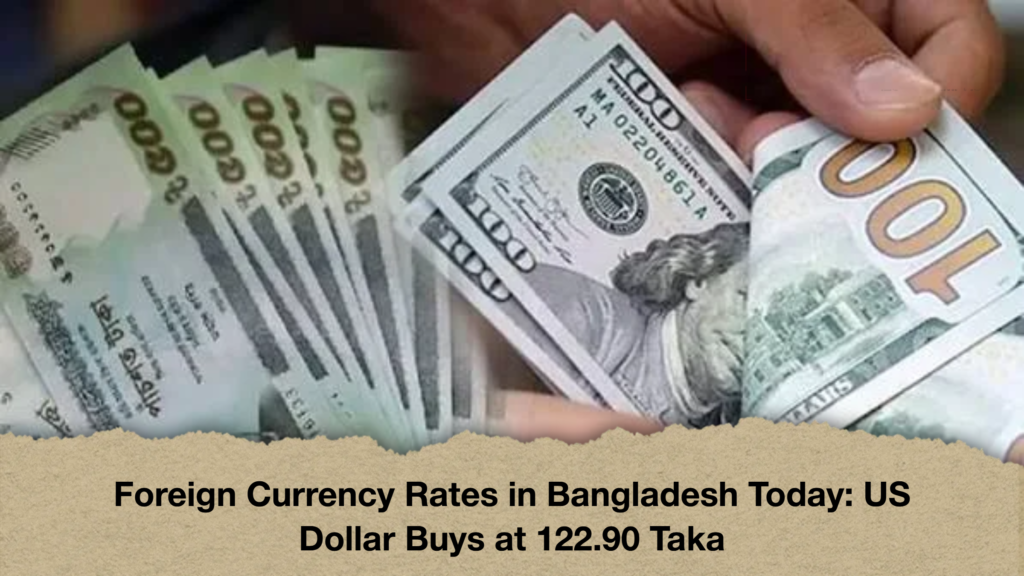
Bangladesh’s financial sector has published the official exchange rates for major foreign currencies on Sunday, 20 September 2026, setting the baseline values for international trade, overseas educational expenses, and incoming migrant remittances.
Under the latest market rates, the United States Dollar (USD) trades at BDT 122.90 for purchasing and BDT 123.00 for selling, leaving a tight ten-poisha spread between bank buying and selling points. The British Pound Sterling (GBP) remains the most valuable major currency traded in the domestic market, quoted at BDT 164.45 for buying and BDT 164.62 for selling. Meanwhile, the Euro (EUR) stands at BDT 140.89 for purchasing and BDT 141.04 for selling.
Cross-Rate Valuations and Regional Currencies
Across regional and major international currencies, valuations against the Bangladeshi Taka show steady figures across commercial counters:
-
Singapore Dollar (SGD): Buying BDT 96.13 | Selling BDT 96.24
-
Australian Dollar (AUD): Buying BDT 87.09 | Selling BDT 87.21
-
Chinese Yuan (CNY): Buying BDT 18.31 | Selling BDT 18.32
-
Indian Rupee (INR): Buying BDT 1.28 | Selling BDT 1.28
-
Japanese Yen (JPY): Buying BDT 0.79 | Selling BDT 0.79
Both the Indian Rupee and the Japanese Yen reflect identical rates for buying and selling transactions, settling at BDT 1.28 and BDT 0.79 respectively.
Impact on Trade, Remittances, and Personal Finance
Foreign exchange movements directly shape the broader economy, influencing the final cost of imported industrial raw materials, fuel, and consumer goods. Shifted conversion rates also alter net returns for exporters realising overseas payments and non-resident Bangladeshis sending funds home to families.
For individuals, these rates dictate the exact expenditure required for foreign travel, medical treatment abroad, and tuition fees for students enrolled in foreign universities. Because global currency markets fluctuate constantly based on international demand, trade liquidity, and macroeconomic trends, daily benchmarks serve as essential reference points for both institutional and private transactions.
While published figures establish the baseline, exact rates offered to retail customers may vary slightly depending on individual commercial bank policies, authorised money changers, or specific transaction types. Financial institutions may also apply routine service charges or administrative fees. Overseas remitters, travellers, and business entities are advised to confirm real-time counter rates with their respective authorised dealers prior to executing large-scale foreign currency conversions.