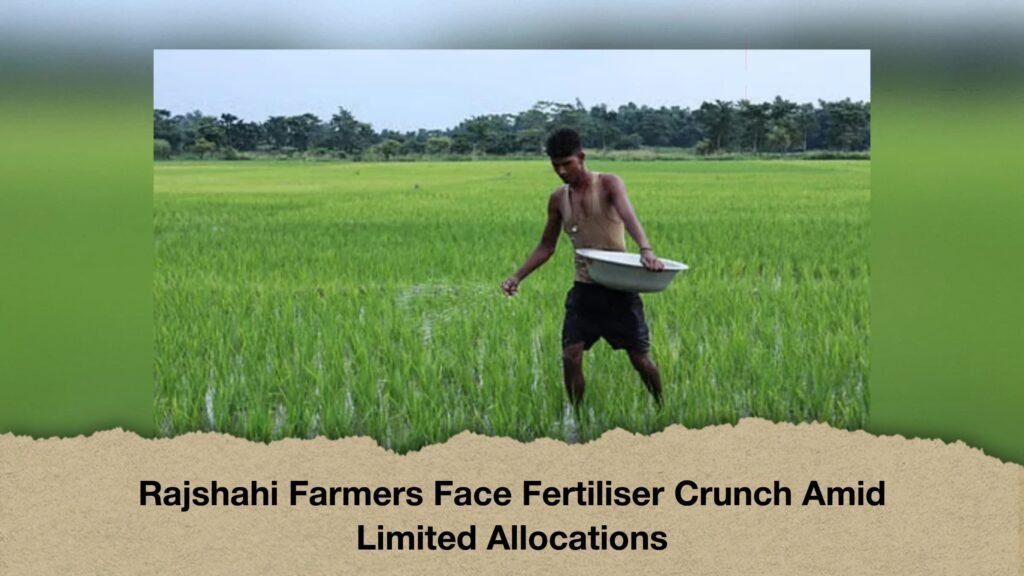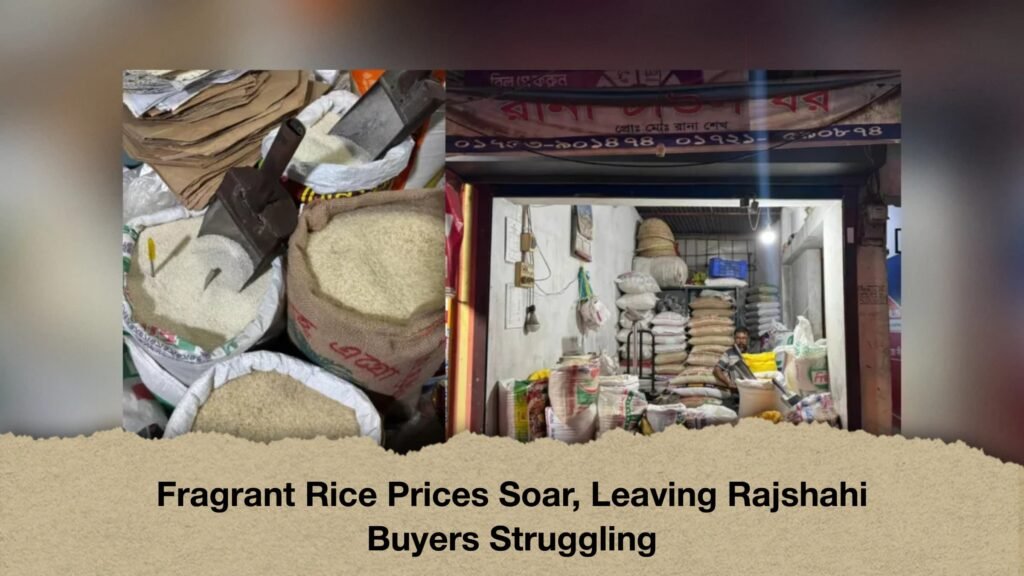
Fragrant rice, once reserved for special occasions, family gatherings and festive meals, has become increasingly expensive in Rajshahi, putting it beyond the reach of many ordinary households. Prices of some varieties have nearly doubled within six months, with packaged Chinigura, commonly used for pulao, now selling for as much as Tk230 a kilogram.
Traders attribute the sharp rise to a combination of exports, supply shortages and higher production costs. Consumers, however, are questioning why prices have climbed so rapidly when the same varieties were considerably cheaper only a few months ago.
At Rajshahi’s wholesale markets, fragrant rice is currently selling for around Tk180 to Tk200 a kilogram, while retail prices have reached about Tk210. Open Chinigura rice, which sold for Tk115 to Tk120 a kilogram three months ago, now costs Tk170 to Tk180. Packaged Chinigura has risen from Tk135–140 to around Tk230 a kilogram.
Other varieties have also become more expensive. Domestic Kalijira rice, previously priced at Tk120–125 a kilogram, is now selling for about Tk160. Dinajpur’s fragrant Kataribhog rice has increased from roughly Tk95 to Tk105 a kilogram.
The increase has surprised both consumers and people involved in the rice trade. Farmers and traders say they have rarely witnessed such a steep rise in fragrant rice prices within such a short period.
Exports blamed for part of the increase
Several traders believe exports have contributed significantly to the rise by reducing the amount available in the domestic market. During the 2025–26 financial year, three leading companies exported a combined 1,530 metric tonnes of rice. Much of the fragrant rice in question is produced from BRRI-34, commonly known as Chinigura rice.
Ashok Prasad, owner of AP Chal Bhandar-1 at Shaheb Bazar in Rajshahi, said prices began rising after Eid-ul-Adha. According to him, the price has increased by nearly Tk100 a kilogram in some cases, which he attributed largely to exports.
Wholesale trader Jasim Uddin of Kadirkhanj said the granting of export permission had contributed to the market pressure. He said rice that had cost around Tk100 a kilogram six months ago was now being sold for close to Tk200.
Jasim also said traders were purchasing rice directly from company warehouses at high prices. After adding transport expenses and a commission of around 10 to 20 per cent, he claimed, selling below the purchase price was not commercially viable.
He said he had also faced action from the Directorate of National Consumer Rights Protection after officials inspected his shop over pricing. He was fined Tk10,000 over allegations of selling pulao rice at Tk200 a kilogram.
However, the extent to which exports alone are responsible for the increase remains unclear.
Production and supply pressures add to costs
People involved in the sector say the price rise cannot be attributed solely to exports. Production and supply conditions have also played a role.
During the previous growing season, severe heat and inadequate rainfall affected fragrant paddy production in parts of northern Bangladesh. Lower-than-expected yields in some areas have contributed to tighter supplies.
Another factor is early procurement by large rice-processing companies. By purchasing paddy at comparatively higher prices at the beginning of the season and storing it, larger processors can reduce the amount of paddy immediately available to smaller mills and open markets.
The processing of fragrant rice also involves additional costs. Milling, polishing, electricity, packaging and transportation all contribute to the final retail price. As operating expenses have increased, those costs have been reflected in the market.
In Dinajpur, rice wholesaler Atiar Rahman said a 75-kilogram sack of fragrant paddy was traded for around Tk4,000 during the harvest period. The price later rose to Tk6,000 and has now reached about Tk8,500.
He attributed much of the increase to shortages of paddy in the area, while saying he could not determine how much of the rise was directly linked to exports.
Families cutting back on fragrant rice
The price increase is changing purchasing habits among consumers. Fragrant rice is not generally used as an everyday staple, but it remains popular for weddings, birthdays, religious festivals and family occasions.
For many households, however, even occasional purchases have become difficult.
Mohammad Azad, a private-sector employee who was shopping at Shaheb Bazar, said he had never seen packaged Chinigura rice reach Tk230 a kilogram. He said the high price had made him reluctant to buy large quantities even for family events.
Jahangir Alam Khan, another consumer in the area, said he was shocked when he returned to buy pulao rice after five months. He had previously purchased it for Tk140 a kilogram but had to pay Tk230 this time.
A housewife, Selina Parvin, said she needed fragrant rice for her daughter’s birthday because relatives would be visiting. Yet even open Chinigura rice was costing around Tk150 a kilogram, with better-quality varieties costing more.
She said the amount of rice a family could buy with the same budget had fallen sharply.
Restaurants also feeling the pressure
The price surge has affected restaurants as well. Restaurant owner Mohammad Golap Sardar of Kumarpada said he had bought pulao rice for around Tk130 a kilogram six months ago. He now has to pay about Tk200.
Yet raising the price of prepared pulao by the same proportion is difficult because customers may reduce their orders.
Trader Rajib Hossain said the situation was also hurting sellers. According to him, customers who previously purchased five to 10 kilograms at a time are increasingly buying only one or two kilograms.
As a result, rising wholesale prices do not necessarily translate into higher profits for retailers. Instead, lower demand can leave traders facing greater pressure.
Farmers yet to benefit from higher prices
Despite the sharp increase in retail prices, farmers are not necessarily receiving the benefit.
Asfakuzzaman Babu, a farmer from Keshabpur in Godagari, cultivated fragrant paddy on two bighas of land but sold his crop six months ago. Had he still had paddy in storage, he said, he would have received a much better price now.
The current market situation may nevertheless influence future cultivation decisions. Babu said he would consider increasing fragrant paddy cultivation if prices remained favourable for producers in coming seasons.
The gap between farm-gate prices and retail prices has therefore become another issue in the supply chain. While consumers are paying substantially more, farmers who sold their harvest months earlier are unable to benefit from the latest price increases.
Dinajpur remains a major production centre
According to the Department of Agricultural Extension, most BRRI-34, or Chinigura, paddy is produced in Dinajpur, with additional cultivation in Thakurgaon and Panchagarh.
Dinajpur has set a target of cultivating paddy on 260,860 hectares this year. Of that area, around 95,000 hectares have been allocated to Chinigura. Last year, the variety was cultivated on approximately 94,000 hectares.
Deputy Director of the Dinajpur Department of Agricultural Extension Mohammad Afzal Hossain said several large companies, including Square Food and Beverage, Ispahani Agro and PRAN Agro, package and market fragrant rice produced from Chinigura paddy.
The district also has numerous rice-processing facilities. Jahura Auto Rice Mill in Bochaganj processes and markets fragrant rice locally, while around 200 small and large auto rice mills have developed across the district around paddy production.
Afzal Hossain said farmers, however, had not received prices corresponding to the current retail value of the rice. The contrast highlights the complexity of the market, where higher consumer prices do not automatically translate into higher returns for producers.
Calls grow for stronger market monitoring
There are differing views over the main reason behind the sudden rise in fragrant rice prices. Traders have pointed to exports, while supply shortages, lower production in some areas, advance procurement by large mills, processing expenses and transportation costs have also emerged as contributing factors.
With some varieties increasing by tens of taka per kilogram within just a few months, consumers are calling for closer monitoring of the market.
A clearer assessment of the entire supply chain—from farmers selling paddy to mills processing it, companies packaging it and retailers selling the finished product—could help determine where the largest price increases are occurring.
For consumers, the immediate concern is straightforward: a food traditionally associated with occasional celebrations is becoming too expensive even for those occasions. Without effective oversight of supply, procurement and retail pricing, the gap between what farmers receive and what consumers pay could remain a growing concern.