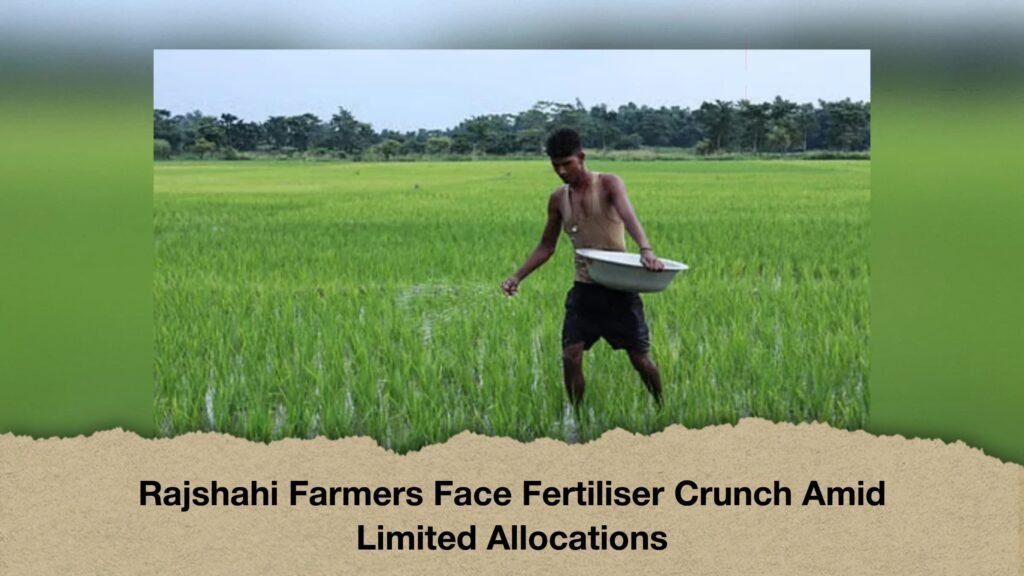
Farmers across Rajshahi are struggling to secure fertiliser during the peak Aman rice cultivation season, with many reporting long queues, inadequate supplies and sharply higher prices in retail markets.
At Darusa Bazar in Paba upazila on Sunday morning, farmer Sajjad went to a dealer’s shop seeking 20kg of fertiliser. After waiting in a queue for around two hours, he received only 5kg.
He said the time spent standing in line was preventing him from working in his fields, while the amount of fertiliser available was far below what he needed.
More than 100 farmers were reportedly waiting outside the shop of Bangladesh Agricultural Development Corporation fertiliser dealer Jiban Kumar at Darusa Bazar. Farmer Hazrat Ali said DAP and TSP fertilisers were difficult to obtain. He also alleged that retailers were charging almost twice the government-fixed prices, leaving farmers with little choice but to queue at authorised dealer outlets.
Another farmer, Shamsur Rahman, blamed traders for creating the shortage and said farmers were bearing the consequences.
Farmers allege steep price increases
According to farmers, the price gap between the official rates and retail market prices has become particularly pronounced.
A 50kg bag of urea, officially priced at Tk1,350, is reportedly being sold by some retailers for as much as Tk2,600. MOP fertiliser, whose official price is Tk1,000 per bag, is reportedly costing Tk1,300. TSP, officially priced at Tk1,350, is being sold for up to Tk3,000, while DAP, fixed at Tk1,050, is reportedly being sold for Tk1,800 to Tk2,000.
Farmers say they are sometimes compelled to pay these higher prices because delaying fertiliser application during the cultivation cycle could affect their crops.
Dealer Jiban Kumar said the main problem was inadequate allocation rather than a lack of demand. He said his outlet had received an allocation of 20 tonnes, but only 66 bags of DAP had arrived, all of which had already been distributed.
He called for larger allocations so that dealers could meet farmers’ demand.
TSP allocation raises questions
The allocation figures have fuelled further concern. Rajshahi has around 412,000 farmers, but only 1,045 tonnes of TSP has been allocated for September.
If the entire allocation were distributed equally among all farmers, each would receive only around 2.5kg. Even if one bag were distributed to each farmer, the available TSP would cover only about 20,900 farmers.
The September allocation also includes 1,629 tonnes of MOP and 3,015 tonnes of DAP. Rajshahi has around 185,000 hectares of cultivable land.
Leaders of the Bangladesh Fertiliser Association’s Rajshahi district unit have described the allocations as inadequate in relation to actual demand.
At a press conference at the organisation’s office in the Railgate area of Rajshahi city on Sunday, district president Md Osman Ali said there was no reason to panic about fertiliser stocks in government warehouses. According to him, sufficient quantities were available in buffer and BADC warehouses, but the allocation reaching dealers was not adequately aligned with farmers’ requirements.
The association has called for allocations to be increased according to actual demand and for additional supplies to be sent quickly to areas experiencing shortages.
It has also sought separate fertiliser allocations for fish-farming ponds, a review of dealers’ commissions and greater agricultural advice for farmers on the scientific use of fertiliser.
Dealers reject blanket allegations
Rajshahi has 216 fertiliser dealers, including 86 under the Bangladesh Chemical Industries Corporation and 130 under the Bangladesh Agricultural Development Corporation. There are also 475 card-holding retail sellers.
Dealers say they collect fertiliser according to government allocations and sell it to farmers at officially fixed prices. They argue that if an individual dealer is found violating the rules, responsibility should not be placed on the entire dealer network.
Dealers also claim that some farmers are buying fertiliser earlier than necessary and storing it in anticipation of the November potato and onion cultivation season. They say such advance purchasing can increase pressure on supplies during the Aman season.
Another concern raised by dealers is excessive use of fertiliser. They claim some farmers apply more fertiliser than recommended by agricultural officials, which can unnecessarily increase demand and potentially harm soil fertility over time.
The association says around 14,000 hectares of ponds in Rajshahi are used for fish farming. It has therefore called for separate allocations for aquaculture so that fertiliser intended for crop cultivation is not placed under additional pressure.
The official government prices cited by the dealers are Tk1,350 per 50kg bag for urea and TSP, Tk1,050 for DAP and Tk1,000 for MOP.
Farmers demand action against alleged hoarding
Farmers, however, maintain that simply visiting dealer outlets does not guarantee access to fertiliser. Some allege that several warehouses remain closed and that certain retailers are keeping fertiliser away from their shops, including at private locations, to create an artificial shortage and sell it later at inflated prices.
These allegations have intensified calls for closer monitoring of fertiliser distribution, particularly at the retail level. Farmers argue that official stocks in government warehouses are of little benefit if supplies do not reach fields at the right time and at the prescribed prices.
Agriculture department says there is no actual shortage
The Department of Agricultural Extension has offered a different assessment of the situation.
Rajshahi district deputy director Mostafa Kamal Hossain told Samakal that the total number of farmers should not be used alone to determine Aman-season fertiliser requirements because not all farmers cultivate Aman rice.
He said Rajshahi had received a larger allocation than it did last year and that additional demand had already been submitted. If further supplies are required, the department will send another request, he said.
According to Hossain, urea is the more immediately relevant fertiliser for the current stage of rice cultivation, while TSP and DAP are not required in the same quantities at this point.
He also suggested that some farmers may be purchasing fertiliser in advance for potato and onion cultivation, creating the impression of a wider shortage.
The contrasting accounts have left Rajshahi’s fertiliser market facing a question of distribution as much as availability. While farmers report difficulty obtaining supplies at official prices, dealers point to limited allocations and advance purchasing, and the agriculture department says government stocks remain adequate.
With Aman cultivation at a critical stage, ensuring that available fertiliser reaches farmers in the right quantities and at regulated prices will be central to preventing further disruption in the fields.