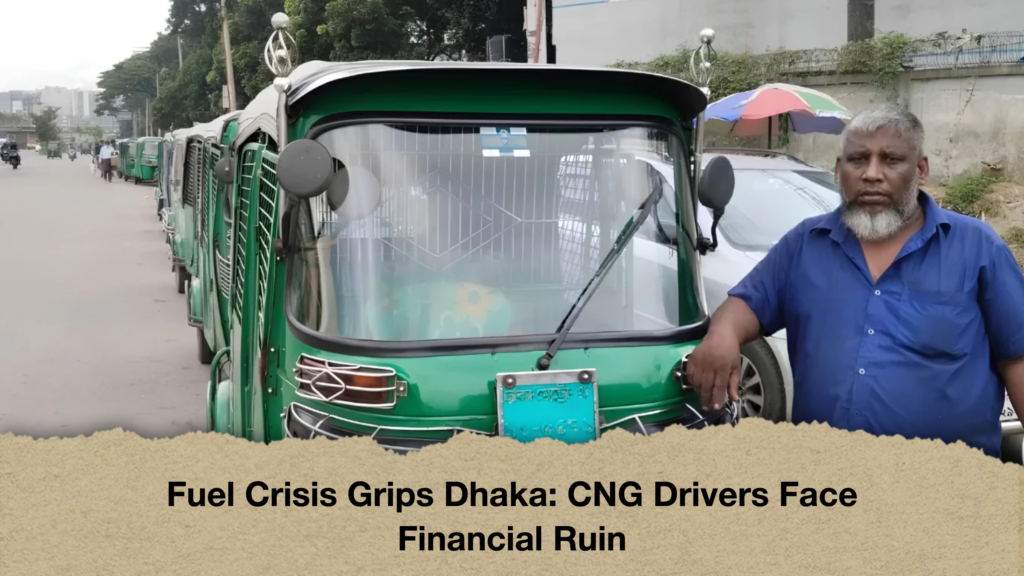
A severe fuel crisis has crippled public transport in Dhaka, leaving drivers of CNG-run auto-rickshaws and private cars stranded in endless queues at filling stations across the capital. Day after day, transport workers spend hours waiting for gas that often never arrives, destroying their working hours and threatening their livelihoods. The acute shortage has not only slashed daily earnings but also made it nearly impossible for drivers to pay vehicle rentals, clear loan instalments, and sustain their families. Commuters are equally stranded, facing immense difficulties in reaching their destinations as the number of available vehicles on the roads plummets.
A field inspection across key areas of the capital, including Uttara, Abdullahpur, Airport Road, Khilkhet, Badda, Rampura, Mirpur, and Gabtoli, reveals a grim picture. From the break of dawn, serpentine queues of CNG auto-rickshaws and private cars form outside filling stations. Unfortunately, most drivers return empty-handed or after wasting valuable hours, pushing them toward severe financial distress.
Borrowing to Pay Daily Dues
With vehicles stuck at pumps for hours, daily incomes have dropped to a trickle. Yet, the fixed daily vehicle rental, known as ‘jama’, and household expenses remain relentless.
Voicing deep frustration, auto-rickshaw driver Md Mona explained that he had been standing in line since four in the morning without securing any fuel. He revealed that he is now forced to withdraw money from his savings or micro-credit loans just to pay the vehicle owner. Wondering how he will manage his upcoming house rent or feed his family, he admitted he has run out of options.
Another driver, Jahangir, broke down his daily financial struggle. He must pay twelve hundred taka to the vehicle owner and spend around five hundred taka on gas. Adding two to two hundred and fifty taka for his own meals, he needs a minimum daily income of two thousand taka to survive. Due to the chronic gas shortage, he stated that his earnings have effectively halted over the past two months.
Private car driver Sanaullah echoed the same despair, noting that drivers are enduring their worst days. While work has ground to a halt, daily living costs remain unchanged. Transport workers warn that if the situation does not improve immediately, thousands of families face imminent destitution. They have urgently appealed to the government to restore normal fuel supplies without delay.
Plunging Pressure Paralyzes Filling Stations
Filling station authorities report that a drastic drop in pressure within the national gas grid has made it impossible to dispense adequate fuel. Kamal, manager of the M A Masud Filling Station, mentioned that while supplies were somewhat stable a few days ago, intermittent halts have worsened the situation. Due to extremely low pressure, station valves cannot be operated, though pressure slightly improves during late night hours.
Tarek, an employee at Akij CNG Station, expressed complete uncertainty regarding when the supply might normalise. While minimal gas is occasionally provided at night, the station has had to remain shuttered throughout entire days. Abdullah, a worker at Zaman Station, described the situation as critical, noting that no gas has been available during daytime hours following brief overnight supplies.
Root Cause of the Crisis
According to official sources and government clarifications, maintenance work at the Liquefied Natural Gas (LNG) terminal in Moheshkhali has caused delays in offloading LNG shipments. This temporary drop in supply to the national grid has impacted households, industrial units, and CNG filling stations alike. However, with maintenance work nearing completion, authorities have assured the public that the crisis will ease significantly in the coming days.