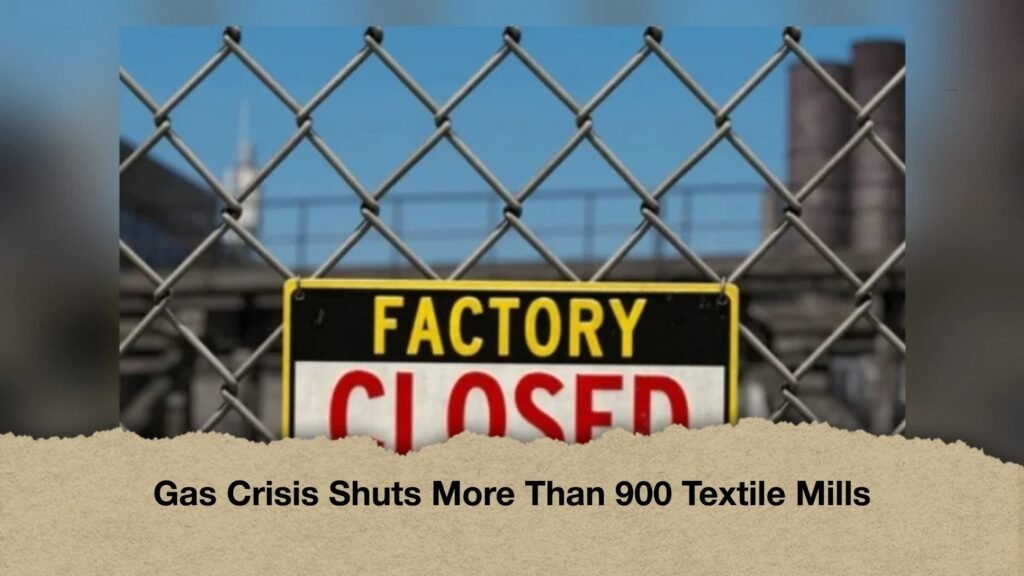
More than 900 textile mills have reportedly been forced to shut down as gas supplies to industrial areas remain severely constrained, despite recent assurances from the government that the situation would improve.
Industry leaders say the prolonged shortage has disrupted production across several gas-dependent sectors, with textile and spinning mills among the worst affected. Factories producing garments, steel, paper, particle board and ceramics are also operating at less than half of their normal capacity in some areas, according to sector representatives.
The latest disruption has deepened frustration among industrialists, who had been expecting an improvement after a government assurance on 6 August. Power, Energy and Mineral Resources Minister Iqbal Hasan Mahmud had told businesspeople and industrial owners that gas supplies would improve rapidly. However, industrial areas have yet to see any significant and sustained recovery.
Factory owners in Narayanganj, Savar, Gazipur, Mymensingh and Manikganj said there had been a slight improvement in gas pressure in some locations last Friday. The relief was short-lived. Supplies subsequently deteriorated again, with some industrial units reporting conditions that were even worse than before.
The Bangladesh Textile Mills Association (BTMA) says the scale of the disruption is particularly severe. Its president, Shawkat Aziz Russell, told The Business Standard that more than 900 of the association’s over 1,800 members are currently completely shut because of the gas shortage.
He said the impact was not limited to textile mills. Industries that rely heavily on gas, including steel, paper, particle board and ceramics, are also facing serious production disruptions.
The Bangladesh Knitwear Manufacturers and Exporters Association president, Mohammad Hatem, said the situation in Narayanganj had deteriorated after a brief improvement. According to him, gas supplies showed some recovery on Monday, but conditions had worsened again by the following day.
For individual factories, the financial consequences are becoming increasingly severe.
The managing director of a leading spinning mill in Araihazar, Narayanganj, speaking on condition of anonymity, said gas pressure at his factory had fallen to almost zero. That is far below the 15 pounds per square inch pressure that the government had promised to ensure, he said.
The factory owner claimed that his company was losing around Tk20 million every day because of the disruption. With production severely restricted, he said the company could struggle to meet workers’ wages and other financial obligations, raising the possibility of having to sell property to keep the business afloat.
He also expressed concern that many factory owners could face difficulties paying gas and electricity bills for July and August, as well as workers’ salaries, if the crisis continues.
The uncertainty is also affecting dyeing and finishing facilities. Minhaj Haque, managing director of Fatullah Dyeing and Calendaring Limited, said industrialists had received several assurances from the government in the past, but successive deadlines had passed without a lasting solution.
He said factory owners were now uncertain about when gas supplies would return to normal, making it difficult to plan production or manage their finances.
The crisis has also affected workers in Narsingdi’s Madhabdi, one of the country’s major textile and handloom centres. Abdullah Al Mamun, a former president of the Narsingdi Chamber of Commerce and Industry, said workers at handloom mills were losing their incomes because factories had stopped operating.
According to him, some workers took to the Dhaka-Sylhet highway on Tuesday to demand uninterrupted gas and electricity supplies. Since many of them are paid according to production, they receive little or no income when mills remain closed, he said.
However, the officer-in-charge of Madhabdi Police Station, Kamal Hossain, denied receiving any information about such a protest. Attempts to obtain a comment from Shibpur Police Station’s officer-in-charge, Mohammad Kohinur Mia, were unsuccessful.
The current gas crisis began after an incident at a floating liquefied natural gas terminal in Maheshkhali on 21 July. A fire and technical problems at the Excelerate Energy-operated floating storage and regasification unit led to a sudden reduction in gas supplies to the national grid.
Since then, industrial consumers across the country have reported inadequate gas pressure and interruptions to supply. The problem has become particularly damaging for industries whose production processes depend directly on a stable gas supply.
For textile and spinning mills, an unreliable supply can bring production to a halt rather than simply reduce output. Yet fixed costs such as wages, utility bills, loan repayments and other operating expenses continue even when factories are not producing.
With more than 900 textile mills reported to be completely closed among BTMA members, the continuing shortage is now posing a serious challenge to industrial production and the financial stability of businesses across several manufacturing sectors.