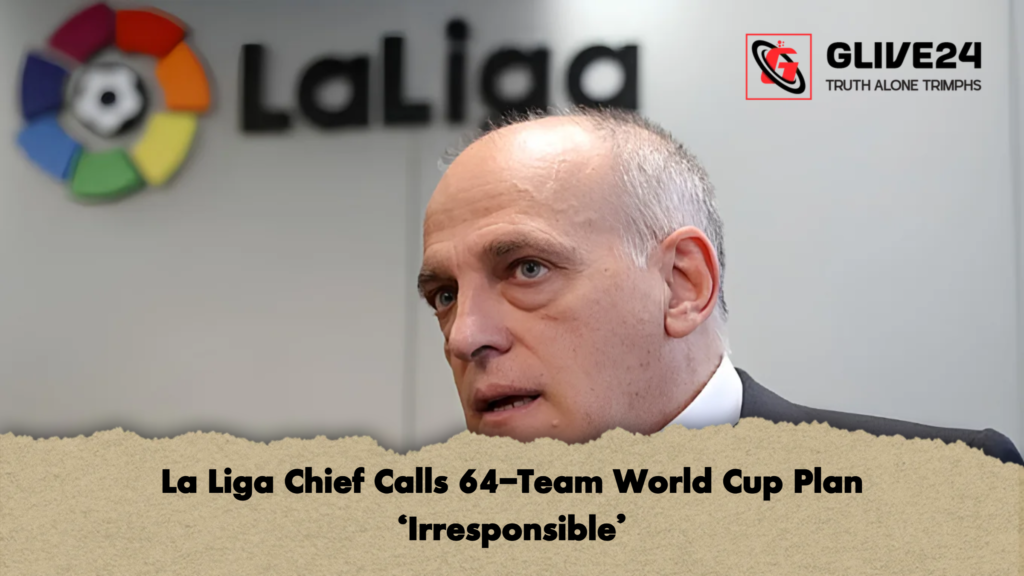
La Liga president Javier Tebas has launched a fierce attack on the idea of expanding the 2030 FIFA World Cup to 64 teams, describing the proposal as ‘irresponsible’ and warning that the continued expansion of international football could damage domestic competitions.
The 2030 tournament is set to be a landmark edition of the World Cup, marking the centenary of the competition. Spain, Portugal and Morocco will jointly host the main tournament, while Argentina, Paraguay and Uruguay are also due to stage centenary celebration matches as part of the wider event. Against that backdrop, discussions about staging a 64-team World Cup have attracted considerable attention across the football world.
Tebas, however, has strongly rejected the idea. His criticism centres on what he sees as the growing imbalance between international football and the domestic club game, which provides the bulk of competitive matches throughout the year and supports a vast economic ecosystem.
Speaking in an interview published by Italian sports newspaper La Gazzetta dello Sport, Tebas also criticised FIFA president Gianni Infantino and questioned the way world football is currently governed. Referring to Infantino’s long tenure at the head of FIFA, the La Liga chief argued that there were serious flaws in the system that had enabled the current leadership structure to remain in place.
Tebas suggested that Infantino’s era in football administration was approaching its final stage, making clear that he was dissatisfied with the direction in which the global game has been moving.
His strongest concerns, however, relate to the growing number of international fixtures and the increasing demands being placed on professional players. The modern football calendar has become increasingly congested, with domestic league matches taking place alongside continental club competitions and international tournaments. The expansion of major competitions has raised concerns among clubs and leagues about player workload, recovery time and the risk of injuries.
Tebas argued that the global appeal of football should not be measured solely by the success or size of the World Cup. While recognising the tournament’s enormous importance, he maintained that football is a much broader industry, encompassing domestic leagues, clubs, players, staff and millions of people whose livelihoods depend on the sport.
He said the football industry should not be placed under excessive strain merely to accommodate a tournament lasting around 40 days. In his view, only a relatively small proportion of professional footballers can participate in a World Cup, whereas the wider football economy supports employment and commercial activity throughout the year.
The debate over a potential 64-team tournament therefore goes beyond the question of how many nations should compete for the world’s biggest football prize. It reflects a wider dispute over the future structure of the sport and the balance between FIFA, national teams, domestic leagues and clubs.
The World Cup has already expanded from 32 teams to 48 for the 2026 edition, increasing the number of participating nations and matches. Any further expansion would intensify questions about the international calendar and whether players can cope with an even heavier schedule.
For Tebas, the issue is ultimately about protecting the wider football ecosystem. He believes the growth of international competitions must not come at the expense of domestic football, which remains central to the sport’s financial and competitive structure.
His remarks are likely to add fuel to an ongoing debate over how much football is too much. As governing bodies seek to make international competitions bigger and more globally appealing, leagues and clubs continue to argue that the health of players and the sustainability of domestic competitions must also be taken into account.