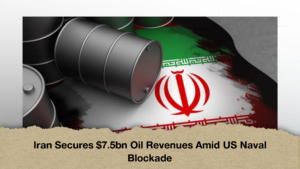
TEHRAN — Iran’s Central Bank has deposited $7.5 billion in crude oil earnings accrued during the first four months of the Persian fiscal year, spanning March to July, according to reports released on Saturday by the semi-official Fars news agency. Energy officials in Tehran affirmed that national budget revenue targets from hydrocarbon exports have been successfully met, even as the United States Navy maintains a stringent maritime blockade against Iranian shipping routes.
Figures released by the Iranian Ministry of Petroleum confirm that these foreign exchange receipts are earmarked to cover essential state expenditures denominated in hard currencies for the remainder of the fiscal half-year, running through December. The timing of the financial disclosure highlights the resilience of Tehran’s energy marketing apparatus amidst severe naval patrols and heightened international sanctions designed to curb its global oil sales.
Geopolitical friction remains firmly centered on the Strait of Hormuz, the narrow sea passage connecting the Persian Gulf to the Gulf of Oman. As a vital artery for global energy security, the channel facilitates the movement of nearly one-fifth of the world’s petroleum consumption daily. Following the onset of military hostilities, Iranian forces severely restricted commercial traffic through the waterway. Washington has repeatedly called for the immediate, unconditional reopening of the strait to ensure unhindered international navigation and stabilize global crude markets.
Efforts to de-escalate the crisis produced a diplomatic memorandum of understanding between Washington and Tehran in June, intended to lay the groundwork for a comprehensive ceasefire. Progress has stalled, however, as Iranian negotiators insist that unrestricted commercial passage through the Strait of Hormuz will remain blocked until the United States fully implements its promised obligations. Tehran’s primary demands encompass the complete removal of maritime blockades, the release of billions in frozen Iranian state funds overseas, and the dismantling of targeted financial sanctions.
In a candid address on state television, Iranian President Masoud Pezeshkian addressed the severe economic strain inflicted by the blockade. Rejecting assertions from political commentators who downplay the severity of Western embargoes, President Pezeshkian stressed that the nation is operating under full-scale wartime conditions that necessitate rigorous, pragmatic fiscal management.
Reinforcing the President’s assessment, the Governor of Tehran, Mohammad Sadek Motamedian, noted on Saturday that maintaining public administration and economic stability under an active naval siege presents unprecedented challenges. Nevertheless, the successful transfer of $7.5 billion to the central bank demonstrates that Tehran continues to exploit alternative trade channels, ensuring a steady stream of capital to fund vital public infrastructure and government operations.