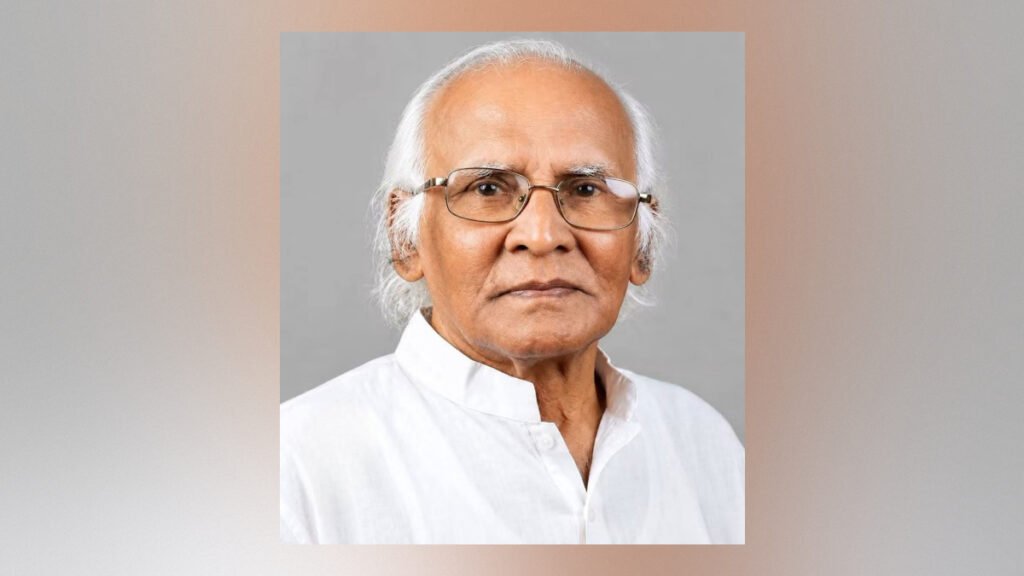
There was a time when his voice carried the intensity of a nation in turmoil. During the Liberation War of 1971, his songs stirred courage, patriotism and hope among those fighting for Bangladesh’s independence. His words reflected the aspirations of a people caught in one of the defining struggles of their history.
Today, Nayeem Gohar is remembered less frequently than many of his contemporaries, yet his contribution to Bangladesh’s cultural and national history remains significant. A lyricist, poet, novelist, singer, actor, playwright, broadcaster and newsreader, he was a remarkably versatile figure whose creative life extended across several fields.
Born on 15 August 1936 into a distinguished family in the Bikrampur region, Gohar showed considerable academic promise from an early age. He studied at the University of Dhaka and secured first position in his graduation examination.
His literary talent emerged during his youth. He initially wrote poetry in English, and his work was published in the Observer, one of the leading English-language newspapers of the time. He later established himself as a Bengali writer through poetry and fiction. Among his published works were the poetry collections Shob O Swagatokti and Nishiddho Bichhana, while his story collection Rahugras also reflected his literary ability. A considerable number of his poems and short stories appeared in newspapers and periodicals.
Yet Gohar was not particularly meticulous about preserving his own work. Much of his writing remained scattered in different publications and private collections. For that reason, some parts of his literary legacy have become difficult to trace, leaving an incomplete archive of a remarkably productive creative life.
His most enduring public identity, however, was as a lyricist.
The songs he wrote during the Liberation War captured the spirit of a country struggling for freedom. Among the best-known were ‘Nongor Tolo Tolo, Shomoy Je Holo Holo’, ‘Sagor Parite Jhor Jage Jodi Jagte Dao’, ‘Puber Oi Akashe Surjo Uthchhe Aloke Alokomoy’, ‘Joy Joy Joy Joy Bangla’ and ‘Jonmo Amar Dhonno Holo Mago’.
These compositions carried themes of patriotism, sacrifice, freedom and hope. For a generation living through the violence and uncertainty of 1971, such songs were more than entertainment. They became expressions of national feeling and emotional sources of strength.
Gohar’s contribution to the Liberation War was not limited to his creative work. On the night of 25 March 1971, when the Pakistani military launched its brutal crackdown in what became known as the night of mass killings, he reportedly took a serious personal risk to deliver an urgent message from Bangabandhu Sheikh Mujibur Rahman to M. R. Siddiqui in Chattogram.
His role during that critical period was formally recognised years after independence. In 2012, he received the Independence Award, the highest civilian honour of Bangladesh, for his contribution to the Liberation War.
Gohar’s creative interests extended well beyond patriotic songs. He wrote for modern and classical music, producing songs that dealt with love, nature, the country and the varied emotions of human life. His overall output is estimated at nearly 200 songs.
He also made a significant contribution to television drama. His first play in independent Bangladesh, Pakhi Amar Jayanta, was broadcast by Bangladesh Television. The name Jayanta was taken from the name of his own son.
His work in television also included the programme Jodi Kichhu Mone Na Koren, which he created with Fazle Lohani. The programme developed a distinctive style of social commentary and entertainment. One of the memorable passages associated with his writing for the programme was:
‘Ichchhe Korei Jara Bhul Koren,
Jeneo Na Janar Bhan Koren,
Tader Kichhu Bhul Bujhiye Deb.’
Acting was another area in which Gohar showed promise. Acclaimed film director Ehtesham repeatedly encouraged him to take on a leading role in films. At the time, the film magazine Rupchhaya published his photograph and described him as a promising new face.
He did not, however, pursue a conventional career as a film hero. His eventual legacy proved considerably broader. Through his songs, writing, broadcasting and involvement in the Liberation War, he became a witness to a defining period in the history of Bangladesh.
His later years were markedly quieter. The man who had once been active across literature, music, television and broadcasting gradually withdrew from public life. He moved away from the attention of crowds and, eventually, from much of the creative world that had once defined him.
The reasons for this retreat remain unclear. It would be easy to speculate about disappointment or unfulfilled expectations after independence, but there is insufficient evidence to establish what lay behind his withdrawal. What is certain is that his final years were spent largely away from the public spotlight.
Nayeem Gohar died on 7 October 2015. With his death, Bangladesh lost a multifaceted creative figure whose life was closely connected with the country’s cultural development and the history of its Liberation War.
His creative legacy has continued through his daughters. Singer Tajreen Gohar and prominent theatre and film actress Elora Gohar have carried aspects of their father’s artistic heritage into their own careers.
Nayeem Gohar may no longer occupy the same place in public memory that he once did, but his work remains part of Bangladesh’s cultural inheritance. His songs continue to evoke the spirit of 1971, while his wider body of work reflects the extraordinary range of a man who refused to be confined to a single artistic identity.
‘Nongor Tolo Tolo,
Shomoy Je Holo Holo’—
The words remain a reminder of a remarkable period and of the man who gave them life. Some artists leave behind monuments; others leave behind voices that continue to speak through generations.
Nayeem Gohar was one of them. His life may have ended in relative obscurity, but his contribution to the cultural memory of Bangladesh remains worthy of remembrance and respect.