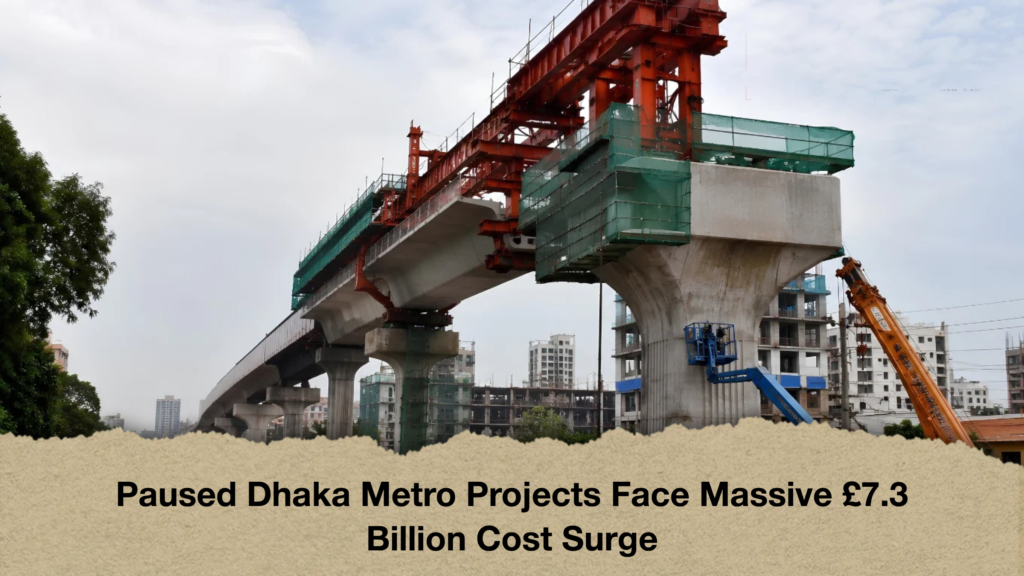
Two cornerstone infrastructure projects designed to reshape Dhaka’s future transit system—MRT Line-1 and MRT Line-5 North—are confronting a staggering financial inflation. Authorities have submitted proposals to increase the combined budget of the two projects, originally sanctioned under the Awami League administration, by 121,424 crore taka (approximately £7.3 billion).
The steep budget escalation follows a critical delay. In August 2024, after the change in national leadership, the interim administration headed by Muhammad Yunus paused several key procurement processes and initiated a formal review, citing concerns over inflated tender bids. That decision to halt progress in pursuit of cost reductions has instead extended construction timelines. Over the intervening period, the US dollar has appreciated by roughly 46.5 per cent against the Bangladeshi Taka compared to 2019 levels. Coupled with persistent domestic inflation, rising global material costs, and elevated commercial bids, the initiatives paused to prevent overspending have returned with a significantly heavier price tag.
Table of Contents
Evolution of the Capital Transit Lines
While initial conceptual work began earlier, both projects received formal approval under the Awami League government in 2019. MRT Line-1 was envisioned as Bangladesh’s first underground railway network, spanning 31.24 kilometres. The route connects Hazrat Shahjalal International Airport to Kamalapur via a 19.87-kilometre underground stretch, alongside an 11.36-kilometre elevated line linking New Market to Purbachal across 19 stations.
The original outlay for MRT Line-1 was fixed at 52,561.43 crore taka, supported by nearly 39,450 crore taka in concessional loans from the Japan International Cooperation Agency (JICA) and 13,111 crore taka from government funds. The initial completion window ran from September 2019 to December 2026.
Simultaneously, authorities approved MRT Line-5 North to link Hemayetpur to Vatara over a 20-kilometre corridor, incorporating 13.50 kilometres of underground tracks and 6.50 kilometres of elevated sections across 14 stations. Its initial allocation stood at 41,238.55 crore taka, with a project timeline spanning July 2019 to December 2028.
Together, the initial approved cost for both projects totalled approximately 93,800 crore taka—a budget calculated when foreign exchange rates, commodity pricing, and global logistics were markedly different from present conditions.
Key Data Metrics Across Project Timelines
| Project and Financial Parameter | MRT Line-1 Baseline | MRT Line-1 Revised | MRT Line-5 North Baseline | MRT Line-5 North Revised |
| Total Route Length | 31.24 km | 31.24 km | 20.00 km | 20.00 km |
| Underground Alignment | 19.87 km | 19.87 km | 13.50 km | 13.50 km |
| Elevated Alignment | 11.36 km | 11.36 km | 6.50 km | 6.50 km |
| Total Planned Stations | 19 stations | 19 stations | 14 stations | 14 stations |
| Underground Stations | 12 stations | 12 stations | 9 stations | 9 stations |
| Elevated Stations | 7 stations | 7 stations | 5 stations | 5 stations |
| Initial Approved Cost | BDT 52,561.43 crore | BDT 52,561.43 crore | BDT 41,238.55 crore | BDT 41,238.55 crore |
| JICA Loan Assistance | BDT 39,450 crore | BDT 39,450 crore | BDT 29,121 crore | BDT 29,121 crore |
| Government Funding | BDT 13,111 crore | BDT 13,111 crore | BDT 12,117 crore | BDT 12,117 crore |
| Execution Window | Sep 2019 – Dec 2026 | Extended to Dec 2035 | Jul 2019 – Dec 2028 | Extended to Dec 2034 |
| Base Exchange Rate | BDT 85.00 per USD | BDT 123.82 per USD | BDT 84.50 per USD | BDT 123.82 per USD |
| Exchange Depreciation | Baseline reference | 46.53% reduction | Baseline reference | 46.53% reduction |
Foreign Exchange Depreciations and Import Costs
Foreign currency movements represent the single largest contributor to the expanded financial estimates.
When MRT Line-1 received sanction in 2019, calculations relied on an exchange rate of approximately BDT 85.00 per US dollar. For MRT Line-5 North, the initial Development Project Proposal (DPP) benchmarked the dollar at BDT 84.50. In the working papers for the revised estimates, that conversion rate has been updated to BDT 123.82 per dollar.
This reflects a 46.53 per cent depreciation of the local currency against the dollar.
In practical terms, procuring $1 billion worth of specialized transit equipment in 2019 required BDT 8,450 crore. At the updated conversion rate of BDT 123.82, acquiring that exact same $1 billion allotment costs BDT 12,382 crore—an increase of nearly 46 per cent in local currency terms without any change in foreign currency pricing.
This trend follows wider currency adjustments in Bangladesh. The average exchange rate shifted from BDT 84.78 in FY2019–20 to BDT 86.39 in FY2021–22, reaching BDT 99.42 in FY2022–23 and BDT 111 in FY2023–24. Following the introduction of a crawling peg system by Bangladesh Bank in May 2024, market forces pushed the rate higher. High-technology public works such as urban railways absorb these shifts directly, as rolling stock, signalling apparatus, electrical systems, and specialized tunneling equipment must be imported.
Global Market Volatility and Local Construction Pressures
Beyond exchange rates, international market disruptions have compound the budget pressure. Pandemic-induced supply chain bottlenecks escalated freight and industrial material costs globally, whilst the outbreak of the Russia-Ukraine conflict in 2022 imposed further pressure on energy, structural metals, and raw inputs.
Domestically, these global trends coincided with local currency devaluation. Infrastructure contractors faced higher overseas prices alongside reduced purchasing power at home.
The domestic construction market felt similar strains. Increased prices for rebar, cement, fuel, and labour raised base expenses across major public works, creating a substantial disparity between 2019 baseline projections and present-day market rates.
In its revised budget submission for MRT Line-5 North, the Dhaka Mass Transit Company Limited (DMTCL) explicitly identified exchange rate shifts, global inflation, higher consultancy fees, and rising costs for rolling stock and electro-mechanical systems as the primary drivers of budget adjustments.
Evaluation of Procurement Delays and Commercial Bids
These financial dynamics underscore the debate surrounding the interim administration’s decision to pause contract awards.
When the administration led by Muhammad Yunus assumed office in August 2024, several critical civil packages for MRT Line-1 and Line-5 North were undergoing tendering. Because the commercial bids submitted by bidding consortiums exceeded original allocations—in some instances coming in at double or triple the initial engineering estimates—the government halted proceedings for re-evaluation.
Across various packages for MRT Line-1, total contractor proposals reached roughly BDT 96,000 crore against an original project budget of BDT 52,561 crore. On MRT Line-5 North, certain underground tunneling packages drawn up with initial estimates of BDT 3,000 crore to BDT 4,000 crore received commercial bids ranging between BDT 11,000 crore and BDT 15,000 crore.
Viewing these figures as excessive, the government paused contractor appointments and initiated discussions with JICA.
Public records show an absence of formal investigative findings or documented evidence of financial corruption as the primary ground for pausing the works. Instead, the freeze was triggered directly by the gap between approved allocations and high commercial bids.
Assessing the Economic Impact of Lost Time
The pause in procurement had an immediate structural consequence: prolonged delay. Tenders that were near completion were held back. During this delay, currency devaluation progressed, inflation accumulated, and market prices for construction inputs adjusted upward.
Waiting for lower commercial offers in 2024 ultimately made foreign currency procurement more costly, as payments must now be settled against exchange rates ranging between BDT 120 and BDT 124 per dollar rather than earlier rates.
Furthermore, execution delays often prompt contractors to build larger risk premiums into subsequent tenders. Facing uncertainty over exchange rates and raw material prices, international firms incorporate currency risk into their commercial offers, particularly for complex underground engineering works.
The core policy question remains whether the savings achieved by rejecting earlier commercial bids outweigh the added costs incurred through currency depreciation and inflation over the extended timeline.
Extended Execution Windows and Structural Overheads
MRT Line-1 was originally slated for completion between September 2019 and December 2026, though physical construction commenced only in February 2023. By early 2025, project officials acknowledged that the original deadline was no longer attainable. Revised proposals now seek to extend the completion target to December 2035.
Similarly, the completion target for MRT Line-5 North has been moved from December 2028 to December 2034, with commercial passenger operations targeted for January 2033.
Timeline extensions add significant financial overheads beyond delayed operations. Extending execution by five to seven years prolongs ongoing expenditure on engineering consultancy, site supervision, administrative management, and land holding costs.
Complexities in Contractor Pricing Models
Attributing total cost increases solely to procurement delays or exchange rate movements provides an incomplete picture. In several construction packages, the divergence between baseline allocations and commercial tenders was unusually wide, indicating additional structural factors.
On one package under MRT Line-5 North, the original government estimate stood at BDT 3,443 crore. Consultants later revised this benchmark to BDT 5,213 crore, yet the lowest commercial bid arrived at BDT 11,178 crore.
In another package, an initial estimate of BDT 4,365 crore was adjusted upward by consultants to BDT 6,126 crore, only to receive a lowest bid of BDT 15,527 crore.
These figures illustrate three distinct financial tiers: original baseline estimates, updated consultant evaluations, and actual commercial bids. A comprehensive analysis must account for limited competition among international bidding consortiums, specialized underground engineering risks, contractual risk-sharing clauses, and necessary design revisions.
Separating political rhetoric from verifiable economic data remains essential. While public works initiated under previous administrations faced broad review, pausing major urban transport links without documented findings of corruption has raised questions among transit analysts regarding long-term procurement strategy.
Determining whether the pause protected public funds or ultimately increased the total financial burden will require a transparent side-by-side comparison of negotiated savings against the cumulative costs of inflation, overheads, and currency depreciation.
— Senior Reporter