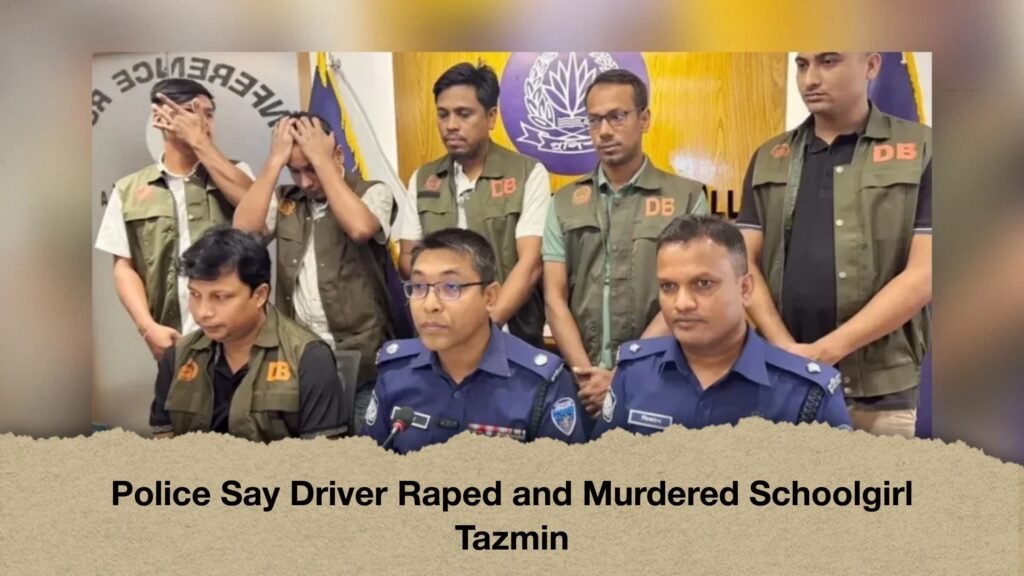
A CNG-powered auto-rickshaw driver has been arrested in Chattogram over the alleged rape and murder of Jannatul Tazmin, a seventh-grade schoolgirl from Cumilla. Police allege that the driver, identified as Sumon, took the teenager to an isolated location, raped her and strangled her to death. The victim’s iPhone has also been recovered, reportedly following information provided by the accused.
Additional Superintendent of Police (Crime) Pankaj Barua confirmed the details at a press conference held at the district police superintendent’s office on Saturday, 10 October. Investigators said they traced the suspect by examining the victim’s mobile phone records, establishing her identity and following other leads. Sumon was subsequently arrested in Chattogram by the district Detective Branch (DB) of police.
According to the police account, Tazmin boarded Sumon’s auto-rickshaw on Wednesday night after getting off a long-distance bus. She was travelling home to the Racecourse area of Cumilla city. Instead of taking her to the intended destination, however, the driver allegedly changed direction and drove towards an isolated area.
Realising that something was wrong, Tazmin sent her father a live location through WhatsApp and pleaded for help. Her family members were asleep at the time and did not see the message immediately.
Police said the auto-rickshaw travelled through Bijra, Rasulpur and Shikarpur before reaching a secluded paddy field in Jagatpur village, under Lalmai upazila. There, Tazmin reportedly tried to escape by running through several paddy fields but was unable to get away.
According to investigators, Sumon allegedly raped the schoolgirl and strangled her with a gamcha, a traditional cotton towel, following a struggle at the scene. He then abandoned the auto-rickshaw in the field and fled.
Lalmai police recovered Tazmin’s body from the location on Thursday morning. The auto-rickshaw was found abandoned nearby. Her identity was initially unknown, but relatives later arrived and identified her.
Investigators said the victim’s mobile phone records and other information helped them piece together the circumstances surrounding the killing. After identifying the suspect, police launched an operation that led to Sumon’s arrest in Chattogram. The recovery of Tazmin’s iPhone, based on information allegedly provided by the accused, was another development in the investigation.
Tazmin was the daughter of Abdul Alim, who came from Chhatiatala village in Jessore Sadar upazila. Her family lived in a rented house in the Racecourse area of Cumilla because her father worked for pharmaceutical company Renata in the Cumilla region.
She was a seventh-grade student at Farida Bidyayatan in Cumilla. School authorities, however, said she had not attended classes since February this year.
According to her family, Tazmin left home on the morning of 4 October, saying she was going to visit a friend. She was last seen outside Hotel Nurjahan in Cumilla city at 12.19am on Wednesday night, according to information provided by her relatives.
At 2.58am, she sent her father a live location through WhatsApp. The message was not seen immediately, leaving her family unaware of her whereabouts during the critical hours before her death.
After her body was recovered on Thursday morning, relatives went to the scene and confirmed her identity. Her father subsequently filed a murder case with Lalmai Police Station against unidentified individuals. The investigation later led police to Sumon, who was arrested by the district Detective Branch.
The case has raised concerns about the safety of young passengers travelling alone at night, particularly those relying on hired transport to return home. Tazmin’s attempt to alert her father through a live location also highlights the potential importance of emergency messages in situations where someone believes they are in danger.
Police have outlined their findings based on the investigation so far. The allegations of rape and murder against Sumon must be established through the legal process, and the evidence collected by investigators will be subject to judicial scrutiny. The arrest marks a significant development in the case, but the final determination of criminal responsibility rests with the courts.