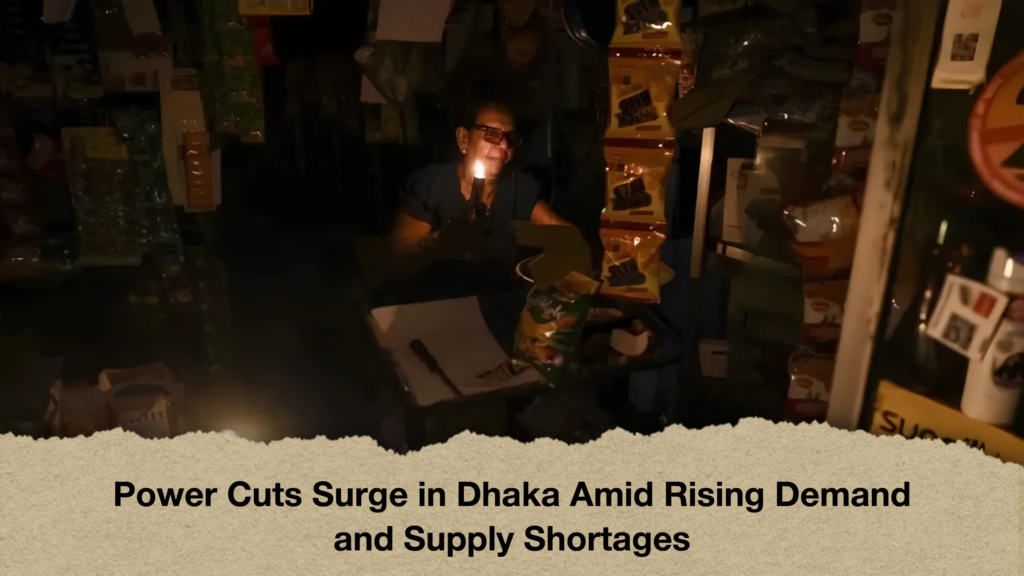
Residents across Dhaka are facing renewed hardship as power cuts and load shedding intensify across various neighbourhoods. Electricity supplies are frequently interrupted day and night, with the most severe pressure hitting during the evening peak hours when surging demand clashes with inadequate generation capacity.
Data released by Power Grid Bangladesh PLC illustrates the mounting strain on the capital’s electricity network. During the evening peak hours on 22 August, electricity demand in the Dhaka zone reached six thousand four hundred and eighty-nine megawatts, forcing authorities to implement five hundred and ninety-nine megawatts of load shedding. In contrast, during the same peak period on 21 August, demand stood at five thousand six hundred and thirty-five megawatts, requiring two hundred and fourteen megawatts of power cuts.
This translates to a sharp single-day surge of eight hundred and fifty-four megawatts in electricity demand within Dhaka, accompanied by an increase of three hundred and eighty-five megawatts in load shedding over twenty-four hours.
A broader review of recent daily figures highlights significant volatility in the capital’s power distribution. On the evening of 20 August, peak demand touched six thousand two hundred and fifty-one megawatts, resulting in five hundred and fifty-four megawatts of supply cuts. The situation proved even more severe on 19 August, which recorded six hundred and forty megawatts of load shedding—the highest figure across the five-day period spanning from 18 to 22 August. Earlier in the week, on 18 August, evening peak demand in the Dhaka zone was recorded at six thousand one hundred and eighty-four megawatts, with one hundred and fifty-four megawatts of shedding managed by operators.
Energy sector insiders attribute these disruptions to persistent gas shortages, underperformance across power generation facilities relative to their rated capacity, and an overall deficit in supply versus consumption. Gas-fired power plants, in particular, suffer reduced generation outputs whenever fuel supplies fall below necessary thresholds. To protect the national grid from destabilising, authorities are compelled to implement rolling power cuts across different areas to maintain equilibrium between supply and demand.
The ongoing nationwide crunch in natural gas supplies has prevented several gas-dependent power stations from operating at full capacity. This limitation directly impacts urban distribution networks, resulting in escalating electricity outages throughout Dhaka, especially as evening power consumption peaks.