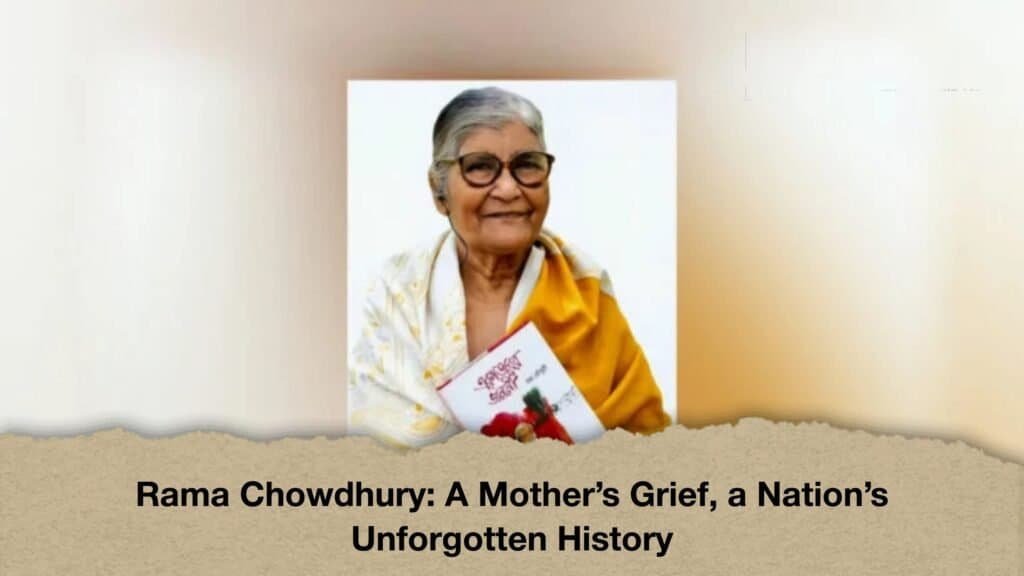
Rama Chowdhury remains one of the most poignant figures in the history of Bangladesh’s Liberation War. A survivor of wartime sexual violence, a bereaved mother and a determined writer, she bore the scars of 1971 throughout her life. Despite enduring profound personal loss, poverty and isolation, she refused to allow her experiences to fade into silence. Through her autobiographical book Ekattorer Janani (Mother of 1971), she preserved a deeply personal account of the war and its devastating consequences, particularly for women.
Born on 14 October 1941 in Popadia village in Boalkhali, Chattogram, Chowdhury was an accomplished student who pursued higher education at a time when opportunities for women were more limited. She earned a master’s degree in Bengali language and literature from the University of Dhaka in 1961. The following year, she began her professional career as headteacher of Cox’s Bazar Girls’ High School. She subsequently served as headteacher at several secondary schools, holding the position for 16 years.
Her career in education reflected her academic ability and determination. Yet the events of 1971 would transform her life, turning a promising educator into one of the most enduring witnesses to the human suffering caused by Bangladesh’s struggle for independence.
A life shattered by the Liberation War
On the morning of 13 May 1971, Pakistani soldiers subjected Chowdhury to sexual violence at her own home. In an attempt to escape her attackers, she sought refuge in a pond. Her ordeal continued when her house and possessions were destroyed in a fire set with gunpowder, leaving her without shelter or the means to rebuild her life.
At the time, she was raising three young sons and living with her elderly mother. With their home destroyed, she spent the remaining eight months of the war searching for shelter for herself and her family. The constant threat of violence, uncertainty over food and accommodation, and fear for her children’s safety made survival a daily struggle.
The experience left deep physical and emotional wounds. Yet Chowdhury eventually found the courage to recount what had happened to her. Rather than allowing her suffering to remain a private memory, she turned to writing, recording the violence and its lasting consequences.
Her autobiographical work, Ekattorer Janani, became an important personal testimony to the Liberation War. Through her recollections, she documented not only her own experiences but also the wider human cost of the conflict, particularly the violence endured by women.
The history of Bangladesh’s independence is often told through political developments, military operations and the final victory of December 1971. Chowdhury’s writing brings another dimension into focus: the destruction of homes, the anguish of families and the suffering that continued long after the fighting ended.
Independence did not end her personal tragedy
Bangladesh achieved victory on 16 December 1971, bringing an end to nine months of war. For Chowdhury, however, independence did not immediately bring relief or happiness. The trauma of the conflict remained with her, and further personal tragedies soon followed.
Her son Sagar began suffering from breathing difficulties on the night of 15 December, shortly before the country’s victory. On the night of 20 December, the child died.
In Ekattorer Janani, on page 211, Chowdhury recalled the moment she discovered that her son was no longer moving. She wrote:
“ঘরে আলো জ্বলছিল হারিকেনের। সেই আলোয় সাগরকে দেখে ছটফট করে উঠি। দেখি তার নড়াচড়া নেই, সোজা চিৎ হয়ে শুয়ে আছে সে, নড়চড় নেই।”
The passage conveys the shock and helplessness of a mother confronted with the death of her child. Her elderly mother’s anguished cry, “আঁর ভাই নাই, আঁর ভাই গেইয়্যে গোই”—meaning that her beloved child was gone—captured the family’s overwhelming grief.
The tragedy deepened when another of Chowdhury’s sons, Togar, also became ill. On 15 February 1972, during a period of severe emotional distress, Chowdhury accidentally obstructed the child’s breathing while administering medicine. Togar died as well.
The loss of two sons within a short period left her devastated. The woman who had struggled through war to protect her children now faced an unbearable bereavement in the aftermath of independence.
Her personal life remained difficult in the years that followed. After the end of her first marriage, she entered a second marriage but reportedly experienced deception in that relationship. Her third son, Tunu, died in a road accident at Kanungopara in Boalkhali on 16 December 1998.
Losing all three sons was a tragedy that would shape the remainder of her life. Her story reflects a painful reality of war: the suffering of those who survive does not necessarily end when a conflict is over. For many, grief, trauma and uncertainty continue for decades.
Writing became her means of survival
In the years after independence, Chowdhury turned to literature as a means of supporting herself. For nearly two decades, writing became her principal occupation, although it offered little financial security.
Initially, she contributed to a fortnightly publication. Instead of receiving money for her work, she was given 50 copies of the publication, which she sold to earn a living.
She later began publishing her own books and selling them herself. Carrying her works from place to place, she approached readers directly, determined to sustain herself through her writing rather than depend on charity.
Her circumstances were difficult, but her commitment to independence remained firm. Selling books on the streets was not merely a way to earn money; it also allowed her to bring her experiences and ideas directly to the public.
According to published accounts, she wrote 18 books, including essays, novels and poetry. Her literary work drew on the Liberation War, personal bereavement, social realities and the emotional experiences of ordinary people.
Among her works, Ekattorer Janani holds particular significance. It is more than an autobiographical account of personal suffering. The book preserves the testimony of a woman who endured wartime sexual violence and subsequently struggled with the lasting consequences of that experience.
Through her writing, Chowdhury helped bring attention to aspects of the Liberation War that can be overlooked in conventional historical narratives. Military victories and political decisions explain how independence was achieved, but personal accounts reveal what the conflict meant for individual lives.
Her testimony offers readers a glimpse into the experiences of women whose suffering did not necessarily end with liberation. It also demonstrates how literature can preserve memories that might otherwise remain unheard.
Personal convictions shaped her life
Several aspects of Chowdhury’s lifestyle reflected her deeply personal response to grief and her determination to live according to her own convictions.
Rather than following the Hindu custom of cremation, she chose to bury her sons. She also went without shoes for four consecutive years after the Liberation War. Although she later wore footwear occasionally at the urging of people close to her, she abandoned it again after the death of her third son, Tunu.
Published accounts state that she remained barefoot during the final 15 years of her life.
These decisions became closely associated with her public identity. They reflected her personal beliefs, grief and individuality, although their full significance can only be understood in the context of the suffering she endured.
Chowdhury did not wish to rely on other people’s sympathy to survive. Instead, she continued to write and sell her books, maintaining a measure of independence despite poverty and isolation.
Her life was marked by hardship, but she remained committed to preserving her dignity. That determination was evident not through grand public gestures, but through the persistence with which she continued her work and shared her experiences with readers.
Ekattorer Janani and the human cost of freedom
Chowdhury’s life serves as a reminder that the history of Bangladesh’s independence is also a history of women’s suffering, family loss and the struggle to rebuild shattered lives.
The Liberation War created a new nation, but the consequences of the conflict extended far beyond the battlefield. Survivors of sexual violence often faced lasting psychological distress and social challenges, while families across the country struggled with bereavement, displacement and the loss of their livelihoods.
Chowdhury’s willingness to document her experiences gave these realities a lasting place in the national memory. Her writing preserved the perspective of someone who had directly experienced the violence of 1971 and continued to live with its consequences long afterwards.
Personal testimony plays a vital role in historical understanding. Official records can establish dates, events and military developments, while the recollections of survivors reveal the emotional and human dimensions of those events. Through Ekattorer Janani, Chowdhury made her experiences part of a broader account of the Liberation War.
Her legacy also lies in the way she responded to adversity. She endured violence, lost her home, mourned three sons and struggled financially, yet continued to write. By transforming her memories into literature, she ensured that her suffering would not remain confined to her own life.
She was not simply a victim of history. She was also an educator, an author and a witness who chose to speak about what she had endured.
A legacy that continues to endure
Rama Chowdhury died on 3 September 2018 while receiving treatment at Chattogram Medical College Hospital. Her death brought an end to a long and difficult life, but her writings and the testimony they contain remain significant.
Her story is a reminder that the achievement of independence does not automatically heal the wounds of war. For some survivors, the struggle to live with trauma, loss and hardship continues long after a country has celebrated its freedom.
Born on 14 October, Chowdhury is remembered for her extraordinary courage, her commitment to writing and her refusal to surrender her dignity despite overwhelming adversity. Her life was shaped by suffering, but her legacy extends beyond tragedy.
She will be remembered as Ekattorer Janani—a survivor of wartime atrocities, a mother who endured the loss of all three of her sons, and a writer who preserved a deeply personal account of Bangladesh’s struggle for independence.
Her contribution lies in ensuring that the human cost of 1971 is not forgotten. Through her words, she gave expression to the grief of bereaved families, the experiences of women subjected to wartime violence and the determination of those who continued to live and work despite profound loss.
Rama Chowdhury’s life remains a solemn part of Bangladesh’s collective memory. Her writings stand as a testament to the power of personal testimony, the endurance of the human spirit and the importance of preserving the voices of those whose suffering forms an inseparable part of history.
She is remembered with profound respect.