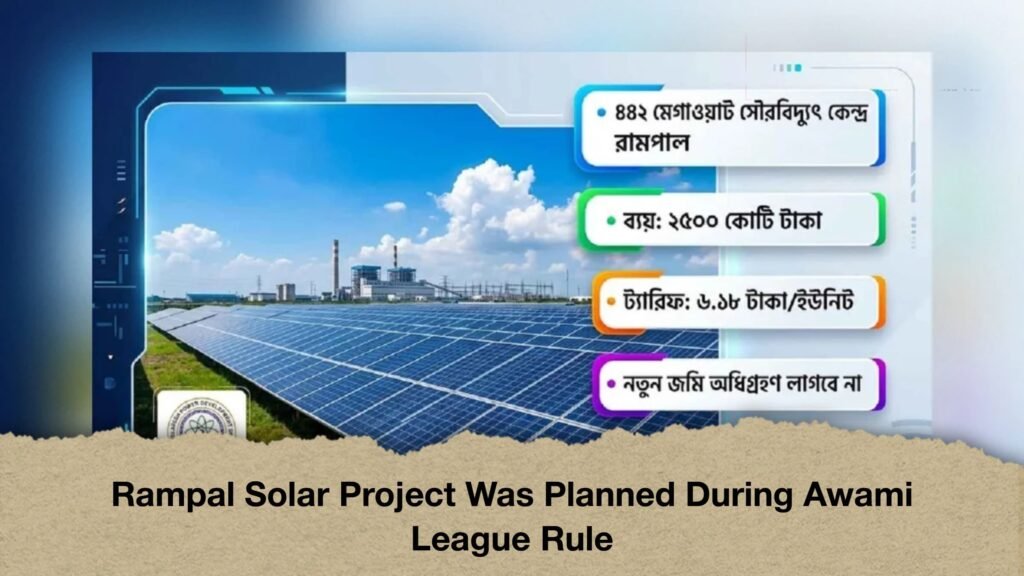
The approval of a 442-megawatt solar power plant in Rampal, Bagerhat, has sparked debate over the origins of the project, with former State Minister for Power, Energy and Mineral Resources Nasrul Hamid Bipu claiming that the initiative was first developed during the Awami League government’s tenure.
The project was approved at a recent meeting of the Executive Committee of the National Economic Council (ECNEC). While the approval has been presented by supporters of the current government as a new initiative, Hamid has disputed that characterisation, arguing that the project grew out of an earlier plan involving Saudi investment and preparations at the Rampal site.
In a post on social media, the former state minister said discussions on the solar power project had begun during the previous government in cooperation with ACWA Power, a major Saudi company involved in renewable energy.
Hamid also shared a photograph with Saudi Ambassador to Bangladesh Essa bin Yousuf Alduhailan and provided details of the discussions. According to his account, the ambassador visited his office on 10 November 2022, when preliminary discussions were held over a proposed memorandum of understanding with ACWA Power. He said, however, that talks between the parties had already been under way before the meeting.
The original plan envisaged a much larger renewable energy investment. ACWA Power was expected to invest around US$1.5 billion in Bangladesh to develop 1,000 megawatts of solar power, while the Bangladesh Power Development Board (BPDB) would arrange the necessary land.
Under the proposal, two separate solar power plants were planned. A 500MW facility was to be established in Rampal, while another 500MW plant was planned for Matarbari. The combined capacity would have reached 1,000MW.
The proposed arrangement moved forward with the signing of a memorandum of understanding between ACWA Power and the BPDB on 28 November 2022. Hamid said negotiations between Bangladesh and the Saudi side continued after the agreement and had reached an advanced stage by July 2024.
According to the former state minister, the expectation at that point was that construction could begin by the end of 2024 if the remaining negotiations were successfully completed.
The project, however, did not proceed according to that timeline following the political transition after 5 August 2024, Hamid claimed. He alleged that the negotiations with Saudi Arabia were subsequently discontinued, bringing the earlier investment initiative to a halt.
The former minister has also drawn attention to the financial difference between the earlier proposal and the project that has now received approval. He said the previous government had sought to attract around US$1.5 billion in foreign investment for the broader solar power plan. The current initiative, by contrast, is being pursued with domestic funding and is expected to cost around Tk 2,500 crore, according to his account.
The land at Rampal is another part of the project’s history cited by Hamid. He said the BPDB acquired 1,834 acres in the area in 2012 for the development of a coal-fired power plant. A portion of the land was subsequently used for the Maitree Super Thermal Power Plant.
The remaining Block B area, he said, was also prepared during the Awami League government’s tenure. Land development work and construction of a boundary wall had already been carried out there, according to his account.
The present 442MW project is not identical in scale to the earlier 500MW Rampal proposal. Nevertheless, Hamid argues that the latest initiative should be viewed against the backdrop of the earlier planning, land preparation and efforts to secure Saudi investment.
The development also highlights the changing structure of Bangladesh’s plans for renewable energy. Large-scale solar projects require significant land, financing and grid infrastructure, making early preparation and investment negotiations important parts of the development process.
For Rampal, the latest ECNEC approval represents a new stage in a project with a longer history than the recent announcement might suggest. Hamid’s account places the origins of the initiative in the previous government’s tenure, when discussions with ACWA Power were held, a memorandum of understanding was signed, land preparation was undertaken and negotiations over a major Saudi investment continued.
The extent to which the newly approved 442MW project follows that earlier proposal will become clearer as its detailed implementation, financing and technical arrangements are made public. For now, the central political dispute concerns whether the project should be regarded as a new initiative or as the continuation of an earlier plan that has since been reshaped.