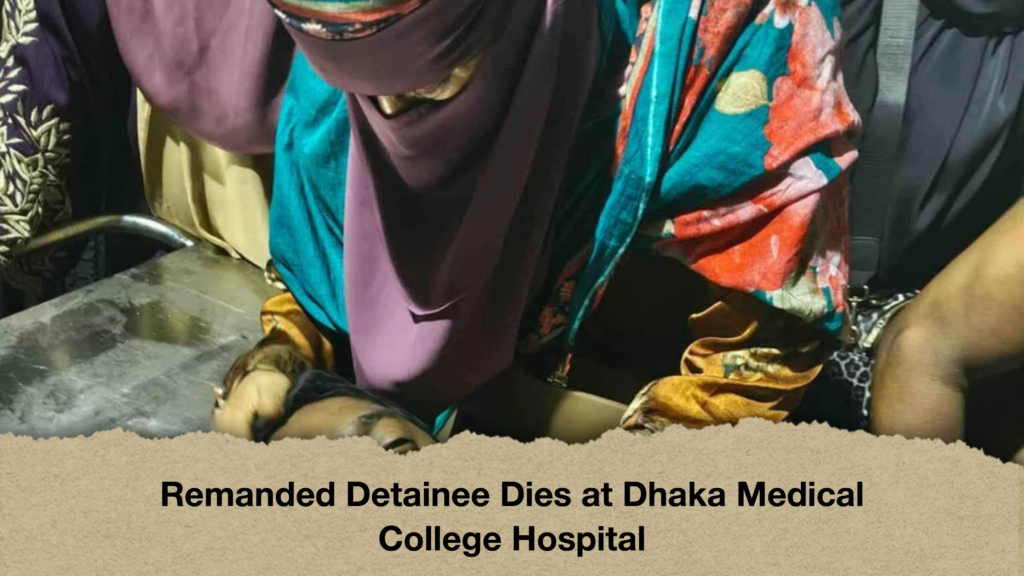
A twenty-five-year-old prisoner from Narayanganj District Jail has died whilst undergoing medical treatment at Dhaka Medical College Hospital (DMCH). The deceased, identified as Mohammad Sajib Ahmed, passed away on Wednesday evening, 7 October, following a marked deterioration in his physical condition over recent days.
The fatality was officially confirmed by Abdul Kuddus, the Superintendent of Narayanganj District Jail. Sajib was a resident of the Maijpara area in Ward No. 2 of the Narayanganj City Corporation, and the son of Mohammad Sanaullah.
According to correctional officials, Sajib had been unwell for several weeks and was initially managed within the medical ward of Narayanganj District Jail. On Saturday, 3 October, his health took a sharp turn for the worse, prompting prison authorities to transfer him immediately to the Khanpur 300-Bed Hospital in Narayanganj. Attending doctors at the regional facility evaluated his condition as critical and recommended an urgent referral to DMCH for specialized emergency care. He was admitted to the capital’s tertiary medical centre shortly thereafter, where he ultimately succumbed to his ailments during treatment.
Addressing the health complications that led to Sajib’s death, Jail Superintendent Abdul Kuddus explained that the prisoner suffered from severe obesity alongside acute hypertension. Medical officers concluded that these chronic physiological conditions contributed heavily to his sudden physical decline while in detention.
Sajib was originally taken into custody on 12 July by officers from the Siddhirganj Police Station on charges of preparing to commit a robbery. At the time of his arrest, police reported seizing a foreign-made revolver alongside live ammunition from his possession. Following a preliminary court appearance, he was remanded to judicial custody pending trial. Police records further indicate that Sajib was named as an accused in multiple criminal cases across the district prior to his detention.
Standard penal protocols in Bangladesh dictate that when a detainee’s condition worsens beyond the capabilities of an internal prison infirmary, authorities must arrange a referral to a public hospital. Prison officials emphasized that these standard procedures were followed in Sajib’s case, moving him sequentially from the prison clinic to the Khanpur hospital and finally to DMCH.
Details regarding whether Sajib’s family was notified prior to his passing, as well as the exact administrative and legal formalities undertaken after his death, remain undisclosed by the prison administration. Similarly, specific clinical diagnosis details beyond his underlying hypertension and weight issues have not been released. With his death occurring during ongoing legal proceedings, authorities will now initiate formal inquest protocols and report his passing to the relevant courts handling his pending charges.