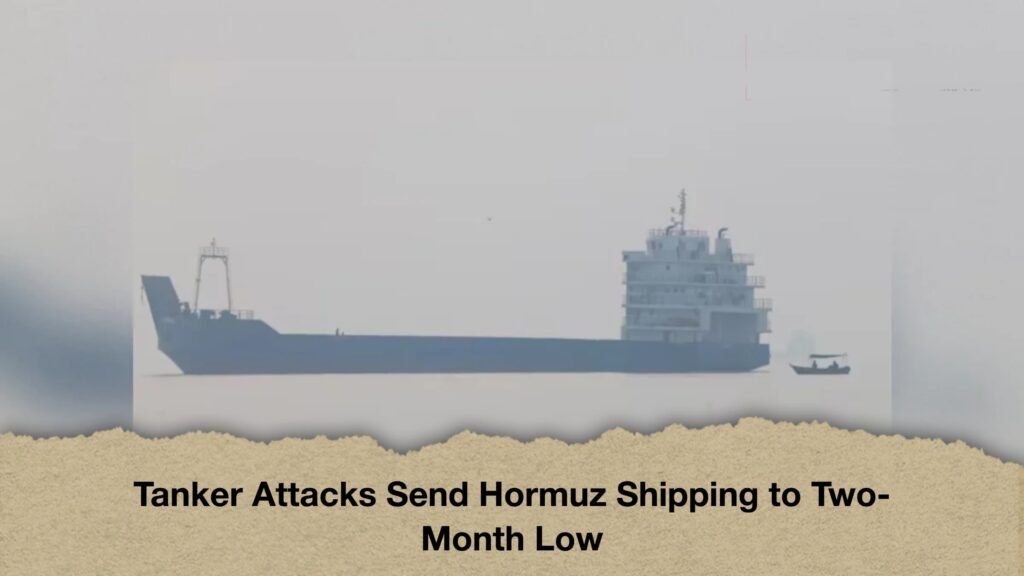
Commercial shipping through the Strait of Hormuz has fallen to its lowest level in more than two months, following a sharp increase in attacks on oil tankers along the strategically vital waterway.
The decline in vessel movements came after tanker attacks last week reached their highest weekly level since the start of the Iran-Israel war. The development has heightened concerns over the security of a maritime corridor that plays a crucial role in the global oil and liquefied natural gas trade.
According to shipping and commodity data analysed by Kpler, only seven cargo vessels passed through the Strait of Hormuz on Tuesday. Reuters reported that this was the lowest daily figure recorded since 23 July.
In a report published on 6 October, Kpler analysts Emmanuel Balestrino and Yui Torikata said crude oil shipments through the strait had fallen by 27 per cent from the wartime peak recorded during the previous week. Despite the decline, at least 11 million barrels of crude oil were still being transported through the waterway each day.
The analysts said the volume had returned to roughly September’s average. However, it remained at only 74 per cent of the level recorded before the war began.
Much of the decline was linked to a reduction in ship-to-ship transfers in the Gulf of Oman. In such operations, cargo is moved directly from one tanker to another, allowing oil shipments to continue without following the conventional pattern of loading and unloading at ports.
While traffic through Hormuz has weakened, exports along alternative routes have increased. Oil exports from areas along the Gulf of Oman and through the Red Sea rose to around 6.7 million barrels per day, more than twice the level seen before the war. According to Kpler’s analysts, this increase has helped offset the reduction in supplies moving through the Strait of Hormuz.
As a result, total crude oil exports from the Middle East have remained around their pre-war level, despite the disruption affecting the key waterway.
Shipping activity showed a modest increase on Wednesday, when 10 vessels were recorded passing through the strait. That was still substantially below the levels recorded on Sunday and Monday, when more than 20 vessels crossed the waterway on each day.
The data also showed that more vessels had entered the strait than had left it over the previous two days. That pattern may reflect vessels waiting in or around the waterway as operators assess security conditions before continuing their journeys.
There are limitations to the available shipping data. The figures do not include vessels that switched off their automatic identification systems, or AIS, to avoid being tracked while passing through the strait. AIS is widely used to monitor commercial vessel movements, but ships can disable their signals in certain circumstances, making their movements more difficult to track.
Separate figures from LSEG, which tracks vessel movements, showed that eight vessels crossed the Strait of Hormuz on Tuesday. Four entered the waterway and four left it. The corresponding figure a day earlier was 14.
Five of the vessels recorded by LSEG on Tuesday were oil tankers. An LNG carrier named Al Mafyar was also among the vessels operating in the area. The ship was scheduled to carry liquefied natural gas from Qatar’s Ras Laffan to Port Qasim in Pakistan.
The reduction in shipping comes against a backdrop of growing maritime security concerns. Maritime security sources said tanker attacks in the Strait of Hormuz last week were the highest recorded in any week since the Iran-Israel war began. Gulf states have also been intensifying efforts to maintain and increase oil exports through alternative routes.
In the latest reported incident, a tanker was struck by a missile or another airborne object about 51 nautical miles north of Qatar’s Madinat ash Shamal. Casualties were reported. The incident was reported on Wednesday by the United Kingdom’s maritime trade operations authority.
The Strait of Hormuz is one of the world’s most important energy corridors. Before the war began on 28 February, around 125 large commercial vessels passed through the waterway each day. These included oil tankers, LNG carriers, bulk cargo vessels and container ships.
The scale of trade through the strait explains why even a temporary reduction in traffic attracts close attention from energy markets and shipping companies. Cargoes carried by vessels using the route were equivalent to around one-fifth of global crude oil and liquefied natural gas supplies.
For Gulf producers, the increase in exports through the Gulf of Oman and Red Sea routes has provided an important alternative as traffic through Hormuz declines. But alternative routes cannot entirely remove the strategic importance of the strait.
The latest figures therefore point to a delicate situation. Oil exports from the region have so far remained broadly stable, but the sharp fall in vessel movements and the rise in attacks on tankers indicate that commercial shipping is operating under significantly greater security pressure than before the conflict.