“I speak of human liberation; I speak of human freedom. I want that freedom where every individual can live on their own terms.”
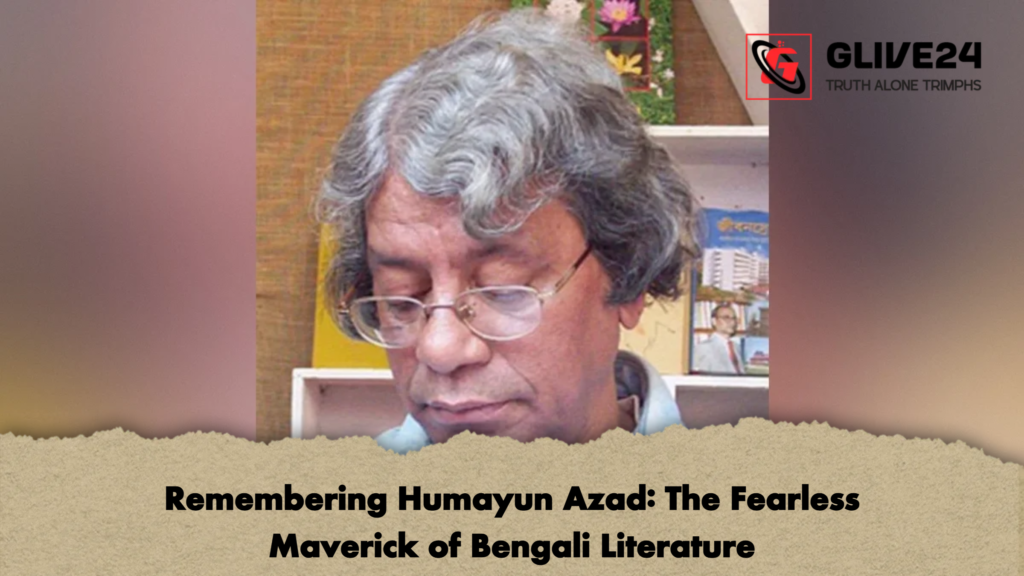
These resonant words encapsulate the essence of Humayun Azad, a monumental figure who refused to drift along the conventional currents of Bengali literature. Armed with unflinching logic, scientific rationalism, free-thinking, and fearless articulation, he carved out a distinct path for himself. He was a poet, novelist, essayist, researcher, linguist, critic, and academic—essentially a versatile intellectual powerhouse in the realm of Bengali letters.
Born on 28 April 1947 in Rarikhal, Bikrampur, his parents were schoolteacher Abdur Rashid and housewife Zobeda Khatun. Originally named Humayun Kabir, he officially adopted the name Humayun Azad on 28 September 1988. His academic journey was stellar. After completing his secondary education from Sir J.C. Bose Institution and higher secondary from Dhaka College, he earned his bachelor’s and master’s degrees in Bengali literature from the University of Dhaka. Later, in 1976, he secured his PhD in linguistics from the University of Edinburgh in Scotland.
Azad began his professional career as a teacher in 1970, initially joining the Department of Bengali at the University of Chittagong before moving to Jahangir University later that same year. Alongside his long academic and research career, he wrote relentlessly about the Bengali language, literature, and society. His pen served as a dual instrument of profound reasoning and sharp protest.
He never hesitated to raise his voice against religious fanaticism, fundamentalism, superstition, patriarchy, social discrimination, political hypocrisy, and institutional tyranny. This uncompromising stance earned him a massive, devoted readership while simultaneously making him a lightning rod for fierce controversy.
Among his landmark works are Nari (Woman), Dwitiya Linga (The Second Sex), Pak Sar Zamin Sad Bad, alongside numerous volumes of poetry, novels, essays, and linguistic studies. His groundbreaking books Nari and Dwitiya Linga triggered massive societal soul-searching regarding gender relations, women’s rights, and patriarchal structures in Bengal. In recognition of his monumental contributions to literature, he received the Bangla Academy Literary Award in 1986, followed posthumously by the prestigious Ekushey Padak.
However, the life of this champion of free speech took a tragic turn when he became the target of violent extremism. On 27 February 2004, as he was leaving the Ekushey Book Fair, Azad was brutally attacked and slashed by assailants in the area between Bangla Academy and TSC. Although he survived the assassination attempt after a fierce battle with death, the incident irrevocably altered his life.
Facing severe security threats, he later moved to Germany on a fellowship from the PEN centre, where he engaged in research on the life and poetry of the German poet Heinrich Heine. Yet, destiny had a cruel twist in store. On 12 August 2004, Azad passed away suddenly in Munich.
In a life spanning just 57 years, he challenged prevailing dogmas, rattled established beliefs, and ignited the torch of reason against pervasive darkness. His death was not merely the passing of a writer; it felt like the sudden silencing of a sharp, questioning, and fearless voice. Azad firmly believed that one must ask questions because knowledge originates from inquiry, and conventional beliefs must constantly be tested because blind allegiance inhibits human emancipation.
Even in death, he continues to return through the pages of his books, his relentless logic, and his unyielding courage. Writers may pass away, but ideas endure. Whenever superstition rears its head in society, or fundamentalism attempts to stifle free thought, Azad’s writings remind us that the struggle for intellectual freedom is perpetual.
Humayun Azad remains far more than just a name; he is an indispensable chapter in the history of Bengali free-thought. On his death anniversary, we pay profound tribute to this unconventional, fearless, and multifaceted intellectual.
“Teach a person to question, and only then will they truly become human.”