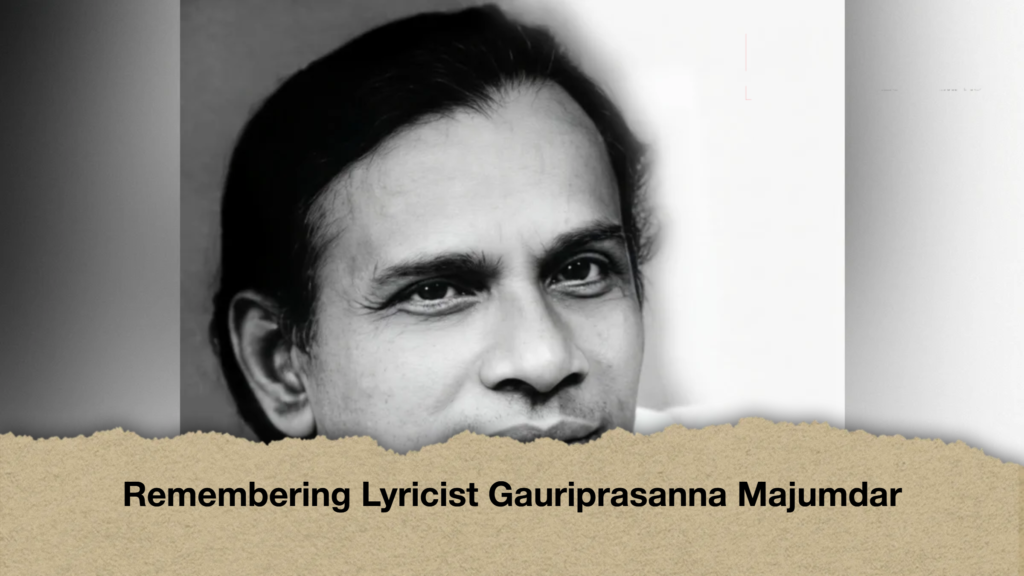
Some figures in Bengali music never needed to sing a note themselves to remain alive in the hearts of generations. Gauriprasanna Majumdar was one of them. A celebrated lyricist and poet, he gave Bengali songs a distinctive language of love, longing, separation, tenderness and emotional vulnerability. His words often appeared simple, yet carried a depth that allowed listeners to recognise their own experiences in his songs.
Gauriprasanna Majumdar was born on 5 December 1924 in Gopalnagar village of Faridpur in Pabna. His father, Girijaprasanna Majumdar, was a professor at Presidency College and a noted botanist. During his childhood, Gauriprasanna was deeply interested in sports. As he grew older, painting attracted his attention, but poetry and music eventually became the central forces in his creative life. He also received musical training from Anupam Ghatak.
His career as a lyricist began during his student years at Presidency College. One of his early songs, ‘Bondhu Go Ei Madhumas’, was composed and recorded by the legendary singer Sachin Dev Burman. That association opened the door to a remarkable career in Bengali music and established Majumdar as a promising lyricist.
His creative journey soon extended beyond recorded music into Bengali cinema. He went on to write songs for a number of memorable films, including Agnipariksha, Pathe Holo Deri, Harano Sur, Saptapadi, Deya Neya and Marutirtha Hinglaj. Many of the songs he wrote became enduring favourites, carried from one generation to another by listeners who found their own emotions reflected in his words.
The defining quality of Majumdar’s writing was his ability to express profound emotions in an accessible manner. Love, heartbreak, affection, regret and the pain of separation frequently appeared in his work. Rather than relying on complicated language, he often created emotional intensity through familiar words and natural expressions. That quality helped his lyrics move beyond the confines of films and recordings, becoming part of people’s personal memories and experiences.
Throughout the second half of the twentieth century, his presence in Bengali cinema and modern Bengali music remained significant. He also shared a close friendship with noted educationist and lyricist Dr Abu Hena Mustafa Kamal. Their association reflected the wider literary and cultural environment in which Majumdar developed his creative identity.
Majumdar spent nearly a decade battling cancer before his death on 20 August 1986. He left behind a substantial body of work that continued to resonate long after his passing.
His death marked the end of a distinguished creative life, but not the end of his influence. The songs he wrote continue to evoke the tenderness of love, the ache of separation and the quiet pain of memory. For many listeners, his lyrics have become intertwined with personal moments that cannot easily be separated from the songs themselves.
Majumdar’s enduring contribution lies in this emotional intimacy. His words gave ordinary feelings an artistic voice and transformed private experiences into songs shared by millions.
As long as people fall in love, experience separation, cherish memories and return to the songs that speak for them, Gauriprasanna Majumdar’s work will continue to find a place in Bengali musical culture.
On the anniversary of his death, the celebrated lyricist is remembered with respect and affection. His songs remain, carrying his words forward long after their creator has gone.