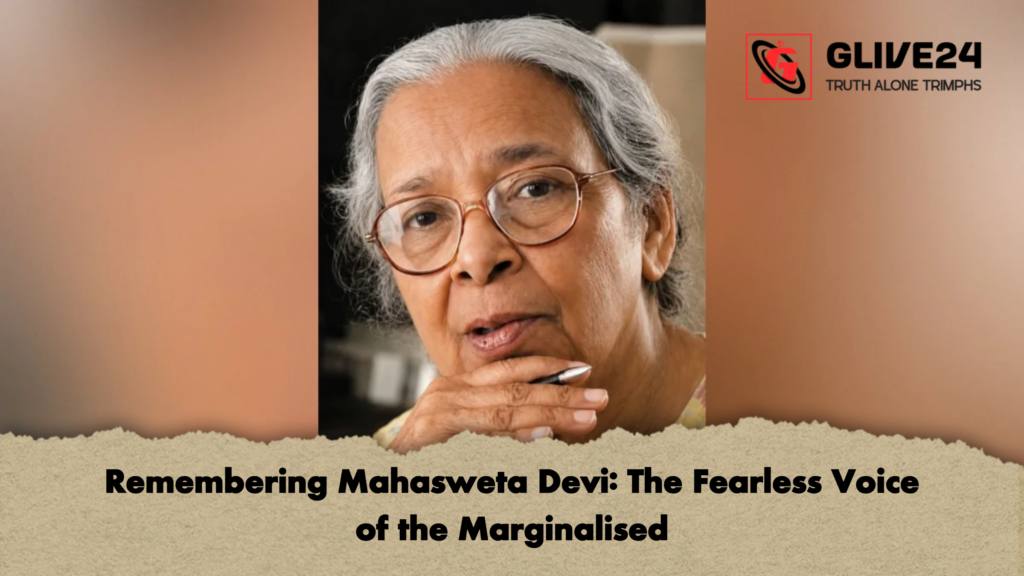
Mahasweta Devi stands as an uncompromising figure in Bengali literature, renowned for her fierce commitment to human rights, social justice, and the dignity of marginalised communities. Far more than an acclaimed novelist, short-story writer, and journalist, she was a fearless activist who transformed her pen into a powerful instrument of resistance for the oppressed and disenfranchised.
Through her literary works, she brought the struggles of indigenous tribal communities—including the Santhal, Lodha, Shabar, Munda, and Kheria—to global attention. Her narratives exposed systemic state neglect, exploitation, and social alienation, grounding her fiction in the stark, unvarnished realities of human experience rather than mere imaginative storytelling.
Born on 14 January 1926 in Dhaka into an intellectually distinguished family, Mahasweta Devi was raised in an environment rich in literature and culture. Her father, Manish Ghatak, was a prominent literary figure of the Kallol era, whilst her mother, Dharitri Devi, was a writer and social worker. Legendary filmmaker Ritwik Ghatak was her paternal uncle, and economist Sachin Chaudhuri was her maternal uncle.
Her early education began at Patha Bhavana in Santiniketan. She later earned a degree in English from the University of Calcutta and completed her Master’s degree in English Literature at Visva-Bharati University.
In 1964, she joined Bijoygarh College in Kolkata as a lecturer, simultaneously dedicating time to journalism and creative writing. However, her true calling extended far beyond academic halls. She travelled extensively across rural regions and tribal belts, living alongside indigenous communities to observe their hardships firsthand. This immersive approach lent an authentic depth and realism to her literary oeuvre.
Her celebrated novel, Hajar Churashir Maa (Mother of 1084), remains a landmark in political and humanitarian fiction. Set against the backdrop of the Naxalite movement, it poignantly details a mother’s grief, state suppression, and the harsh realities of the era. The novel was later adapted into a critically acclaimed feature film.
Among her other notable works are Aranyer Adhikar, Rudali, Chotti Munda Evam His Tir, Agnigarbha, Titu Mir, Stanadayini, Shikar Parva, Byadhkhanda, Prosthanparva, Ganesh Mahima, Neel Chobi, Mukh, Krishna Dwadashi, Bene Bou, Milur Jonno, and Ghorano Siri. Many of her compositions have been translated into English and numerous other international languages.
Her remarkable contributions earned her widespread national and international recognition, including the Sahitya Akademi Award, the Jnanpith Award in 1996, the Ramon Magsaysay Award in 1997, the Padma Vibhushan in 2006, and the SAARC Literary Award in 2007.
In her personal life, she was married to Bijon Bhattacharya, a pioneering playwright and leading figure of the Indian People’s Theatre Association (IPTA). Their son, Nabarun Bhattacharya, subsequently emerged as a distinctive and influential voice in modern Bengali literature.
Mahasweta Devi’s activism went beyond literature. She actively participated in various democratic and civil rights movements, including the anti-land acquisition protests in Singur and Nandigram, remaining a vocal champion for marginalized voices throughout her lifetime.
She passed away in Kolkata on 28 July 2016 at the age of 90. On her death anniversary, her literary legacy and humanitarian ideals continue to inspire generations, proving that literature can serve as a formidable tool for justice and liberation.